
The Alpha Window
The 1930s and 2030s Parallel - How to Think Like a Threshold Guide, Framework 9

Why this essay? In Framework 8, we walked through transvestment, which is the act of moving accumulated wealth out of the system that produced it and into commons that cannot be seized. The essay described the 2022 Patagonia transfer, and explained what it took for that family to cross the threshold. What it didn’t address is the timing question. Transvestment as a category has been theoretically available for decades. Why now? What about this precise moment makes transvestment and the work of a Threshold Guide urgent? That’s what this essay answers. We’ll explore the structural window that opens during the collapse of a system. That window opened when the Strait of Hormuz closed in March 2026. It won’t stay open.
The story so far
We’re building an argument over ten frameworks, and we’ve covered eight so far:
Framework 1 introduced the S-shaped growth curve to show how living systems grow first slowly, then quickly, then slowly, just as the human species is experiencing now.
Framework 2 showed that money is an instrument of coercion shaped by those who issue it.
Framework 3 examined how the money system is threatening those who built success and have accumulated wealth.
Framework 4 explained how the required human cognition and technology capable of birthing an alternative are emerging in our lifetime.
Framework 5 looked at mature forests as the living example of distributed coordination at scale.
The six inversions in Framework 6 showed what a monetary system designed for life would look like across each of its six features.
The constellation covered in Framework 7 showed the structure that avoids triggering the existing architecture, which will want to suppress it.
Framework 8 introduced the conversion of accumulated wealth out of the existing system into commons that cannot be seized, and walked through what it takes to cross that threshold.
What we need to address now is when this systemic transvestment happens, and why the timing has never been more ideal for the system to change in ways that are beyond even the wildest prosocial dreams.
An Important Side Note: I’m a certified Strategic Foresight Practitioner, which means I observe and report on patterns, rather than make specific predictions. While I hope the parallels below will be useful to you, it is most definitely not financial advice. Any decisions you make should be made with people you trust.
Setting the Scene: Hawarden, Iowa, October 1932
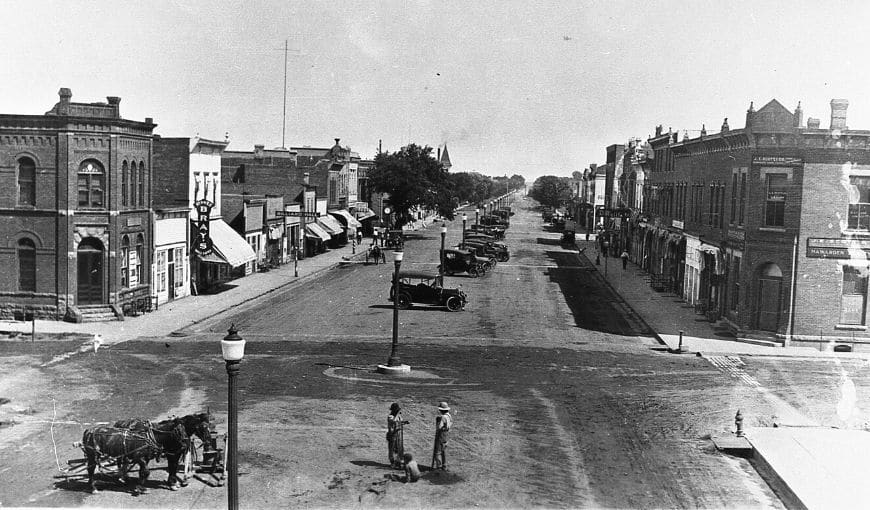
It’s October 1932 and upwards of 30 trains a day pass through the town, connecting Hawarden to Sioux City, IA, and Iroquois, SD. The town has just over two thousand inhabitants and the First National Bank of Hawarden is open, but times are tough. Half the merchants on Central Avenue carry customer debts they no longer expect to collect. Charles Zylstra, the high school principal, has been thinking about a German economist we’ve already discovered, whose book has just been translated into English. Silvio Gesell died in 1930 and left behind a simple idea: money that loses a fraction of its value at regular intervals will circulate faster, because nobody will want to hold onto it.1
Zylstra spent months convincing the Hawarden merchants to try it. Most eventually agreed, but only because of how dire the situation was. When the Great Depression of the 1930’s hit, everyone felt that they were at a point of no return. There was no money and no jobs. It was hard for most people to buy even the basic necessities; prices were low, but people couldn’t afford to go to the store. So the town issued three hundred pieces of paper, each printed with a serial number and a value of ONE DOLLAR:
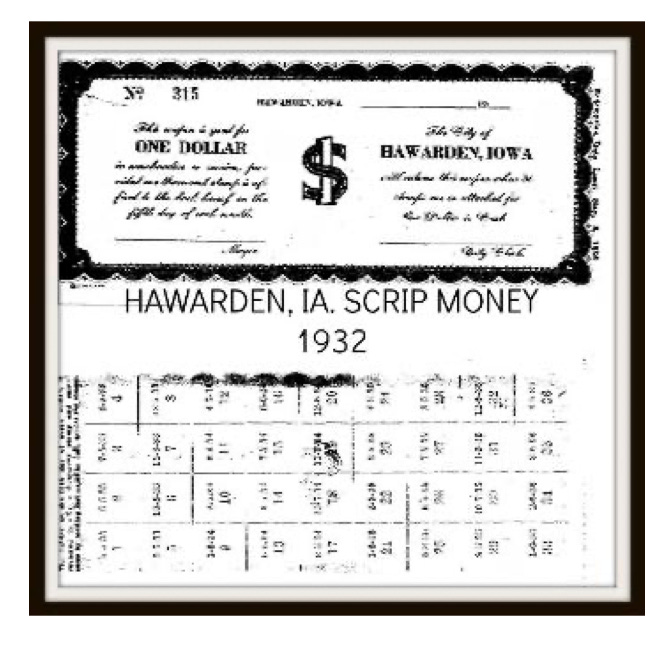
On the back of each was a grid of thirty-six small boxes. With each transaction, the person handing the scrip over had to affix a three-cent stamp into the next available box. When all thirty-six boxes were filled, the City redeemed the scrip for a regular dollar. The math worked out almost exactly: thirty-six stamps at three cents each is $1.08. The dollar redeemed the scrip and the eight cents covered printing costs.2
The first $300 of Hawarden scrip generated $10,800 of transactions before they were redeemed. Each scrip dollar changed hands thirty-six times. A piece of paper issued by the community moved through the town’s grocery counters, hardware stores, feed lots, and lumber yards thirty-six times because nobody wanted to be the one holding it when the next stamp came due.3
Word spread quickly. Yale’s Irving Fisher came to Hawarden in person to see what the fuss was about. He called the scrip “hot money” that burned the pocket of every person holding it. Pathé sent a film crew. Liberty and Collier’s wrote it up. Chase Manhattan asked for a specimen for its collection of unusual money. By February 1933, Zylstra had piloted a bill through the Iowa State Legislature giving all ninety-nine counties the right to issue stamp scrip. By the spring of 1933, more than a hundred American towns were running variants of the same idea.4
In those same months, across the Atlantic, the Reichstag burned and the Enabling Act passed. Hitler held dictatorial power within ten weeks of taking office. By the autumn of that same year, the Austrian central bank had shut The Miracle of Wörgl down. By the autumn of the following year, Roosevelt’s New Deal had absorbed the scrip movement in the United States and the experiments had quietly faded from the front pages.5
In those eighteen months, three structures took root in circumstances that didn’t exist before the arrival of The Great Depression. One was authoritarian consolidation; one was centralized democratic reform; and another was distributed, local, place-based, below the radar emergence. The third didn’t survive at scale, while the first two did. This simple outcome provides rich lessons for the Decade of Dramatic Disruption we’re currently in (2026-2035).6
Why it’s important to track these early money experiments
Again, I understand that discussions about monetary systems can fry the brain cells. This is important, though, and here’s why…
As you no doubt know, most activists today focus their energy on ecological crises: carbon in the atmosphere, plastics in the oceans, toxins in our food, topsoil washing off fields, plummeting fertility rates, species disappearing, and a whole host of other metacrisis-related symptoms. These concerns are entirely valid, and this summer’s heat wave across Europe makes this angle of debate much more visceral. However, what gets less attention (because it’s less visible) is the system itself within which all human activity takes place and which leads to the ecological concerns.
Donella Meadows, in her 2008 book, Thinking in Systems — A Primer, said, in essence, that a system determines behavior.7 Stated differently: all our social systems (designed for the steep part of the S-curve) produce steep-curve behavior. Contrary to what most people believe, this isn’t ‘human nature.’ It’s simply a system determining behavior. This system includes the form of money we use (discussed in detail in Framework 2), and until we understand how much this system determines our behavior, any discussion exclusively about the human impact on environment is a waste of time. Sorry.
Philip Zimbardo (1933-2024), who was best known for his controversial 1971 study, the Stanford Prison Experiment, had another way of saying the same thing. The study, intended to examine the psychological experiences of imprisonment, revealed the shocking extent to which circumstances (the system) can alter individual behavior. Here’s the brutal truth he discovered:
“Unless we become sensitive to the real power of the System — which is invariably hidden behind a veil of secrecy — and fully understand its own set of rules and regulations, behavioral change will be transient and situational change illusory.” - Philip Zimbardo, The Lucifer Effect : How Good People Turn Evil, written after the Stanford Prison Experiment.
In other words, the behavioral change activists long for is a pipe dream… until we acknowledge the system within which the behavior takes place.
That’s why we’ve spent so much understanding this (money) system and what happens when attempts are made to reset the money system itself.
My argument is that the monetary architecture is a more immediate threat than any ecological threat, and that changes to this architecture are coming at us faster than climate is changing. A Threshold Guide pays attention to this invisible shift and observes an opportunity.
Don’t believe me that money shifts quicker than climate does? Neither did those living through the heyday of the 1920s.8 When the Great Depression started that monetary system reset between 1929 and 1933, the daily life of an ordinary household collapsed within three or four years. Banks closed, making savings disappear overnight. Mortgages were called in. By 1932, American farms were being foreclosed at the rate of around two hundred a day, and the Dust Bowl that became iconic was the ecological consequence of an economic collapse that drove farmers to plow land that should never have been plowed. The causation ran from the monetary system outward, and the ecology suffered.
History rhymes.
We’re facing exactly the same pattern today, with the same sequence of causation. As I’ve laid out here and here, the global monetary system is currently being reset. Whatever ultimately replaces it will shape what is possible in every other domain, including the ecological one.
There is absolutely no way we can stop this planned reset. What we can do instead is understand what Nature does when a systemic shock arrives. We’ll use a forest fire as an example of such a shock.9

Panarchy Theory, or what ecologists learned about forest fires
In 2001, the Canadian ecologist C.S. Holling published a paper that turned out to be one of the more useful pieces of systems theory of the last fifty years, at least in my not so humble opinion.10 He was trying to describe what actually happens when a complex system like a forest, a fishery, or an economy experiences collapse. He’d noticed that the standard story (system grows, system peaks, system collapses, system rebuilds) skipped over the most interesting part of the cycle, which is what happens in the gap between collapse and rebuilding.
A Threshold Guide doesn’t need to fully understand the model that follows, except this: The Alpha Window is a tipping point from one equilibrium into another, a moment of collapse and regeneration when what happens next depends on what’s already seeded and what the conditions for growth are.
Holling broke the cycle into four phases:
The growth phase, where the system is exploiting available resources, which he called r.
The consolidation phase, where the system has matured and is locking in its structure, which he called K.
The release phase, where the structure breaks down, which he called Omega.
And the reorganization phase, where new structures can take root, which he called Alpha.
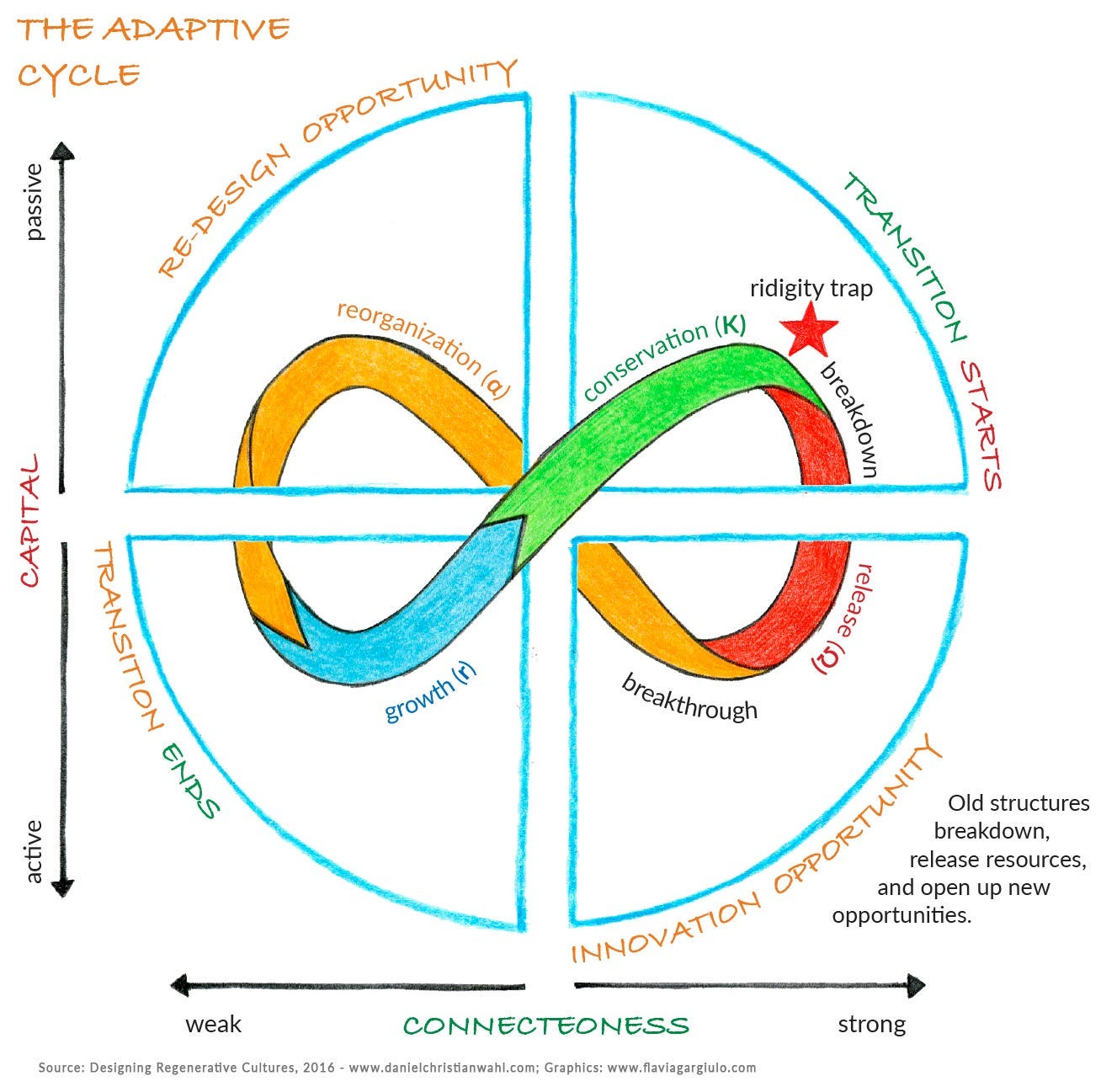
Most of the cycle is predictable: growth follows recognizable patterns and consolidation produces predictable, standard ideas that can be anticipated. Collapse, however — if and when you can see it coming — sends out weak signals of something truly novel emerging. However, the Alpha phase is the one that determines what comes next. It is brief, confusing, volatile, and the only window during which structures that were locked out by the previous K phase could establish themselves.
This is the moment when the forest canopy has entirely burned away and sunlight reaches the forest floor for the first time in decades. Seeds that have lain dormant in the soil can suddenly germinate. Many of those seeds will die, but some will take root. The ones that take root could become the next K phase. They will lock the next system in place by closing the canopy again. And for the next several decades, no other forest floor species will get to see the sunlight.11
A forest after a fire looks like death, chaos, and destruction, but there’s something deeper at work: selection. What grows back is whatever was already there as seed, root, or rhizome when the shock reset whatever was there. The Alpha Window is a short, unstable moment, that’s consequential out of all proportion to its duration. The Day of Dramatic Disruption (DDD) opens the seed bank of options and selects from whatever has been quietly waiting for the moment.12 Which means, the type of seeds lying around matters enormously.
The 1930s as an Alpha Window
The 1929 crash — followed in 1931 by the Credit-Anstalt collapse in Austria, the run on the Reichsbank in Germany, the British exit from the gold standard, and a cascade of bank failures across central Europe — produced an Omega phase across the industrialized world. This is the necessary release phase, where the structure breaks down. By 1932, the equivalent of the forest canopy had been burned away globally: US unemployment was around 24 percent, industrial production had halved, international trade had collapsed by two thirds, and twelve thousand American banks had failed.
The Alpha Window opened on Black Thursday, October 24, 1929, the catastrophic day the Wall Street Crash began, and the catalyst for the Great Depression that followed (the reorganization phase).
What competed for the light, during that reorganization phase, were architectures with very different design assumptions about money, work, ownership, and political authority. We tend to remember the period as two distinct stories: the New Deal in the United States (market-regulated capitalism), and fascism in Germany (state-directed capitalism). History records that those were the only available options competing. But the fuller picture is that there were three categories of architectures germinating simultaneously, and it’s worth quickly comparing them:
Three Historical Reset Architectures
The most important observation about the architectures that followed, is that they required a globally significant event to trigger them. World War 1 was the trigger, closely followed by World War 2 (just in case).13
Today’s equivalent globally significant trigger is Hormuz. It may not look like it today, but that’s only because the true consequences will only be felt 12-18 months from the date of closure. WW3 is non-military. It is supply chain closure (and there will be more to come if Hormuz proves to be inadequate).
Architecture one: Authoritarian consolidation through state command of the monetary and industrial system. Nazi Germany, Stalin’s USSR, and Imperial Japan all took shape inside this Alpha Window. The Reichstag Fire happened on February 27, 1933. The Enabling Act passed March 23, 1933. Hitler held dictatorial power within ten weeks of becoming Chancellor. The seeds for that consolidation were planted in the National Socialist organizing of the previous decade. When the fire came through, they were ready.14
Architecture two: Centralized democratic reform through national fiscal and regulatory intervention. This was the New Deal in the United States, the Popular Front in France, the Swedish Social Democratic model under Per Albin Hansson. These seeds were planted in the progressive reform tradition of the 1900s and 1910s. By March 1933, FDR had declared a bank holiday, passed the Emergency Banking Act, and begun the legislative cascade that would produce Social Security, Glass-Steagall, the FDIC, the SEC, the CCC, and the WPA. The architecture consolidated within five years.15
Architecture three: distributed, place-based, locally organized economic structures. This was the scrip movement in the United States; The Miracle of Wörgl; the Mondragón cooperative tradition, whose roots reach into this period through Father Arizmendiarrieta’s formation; the Scandinavian cooperative federations; the kibbutzim in Mandatory Palestine, founded earlier but consolidating institutionally in this window; the Catholic Worker movement, founded by Dorothy Day in 1933. These were seeds already in the ground. They germinated and produced real structures.
This third architecture didn’t consolidate as rapidly or at the scale of the first two. Wörgl was shut down by the Austrian central bank in September 1933. The scrip movement in the US was absorbed into the New Deal and had quietly faded by 1934. The cooperative movements that did survive, including Mondragón and the kibbutzim, survived as enclaves inside the architectures that took the window. The seeds were real, the sunlight was real, but what the third architecture lacked, in 1933, was the structural infrastructure to scale before the canopy closed.
By 1939, the window had slammed shut. The two architectures that closed it were authoritarian consolidation and centralized democratic reform. Each was a different answer to the same Omega phase. Each was a different answer to the question of who controls money, and through it, work, ownership, and the conditions of daily life. The seeds of the third architecture remained in the ground for another ninety years.
The 2030s Alpha Window
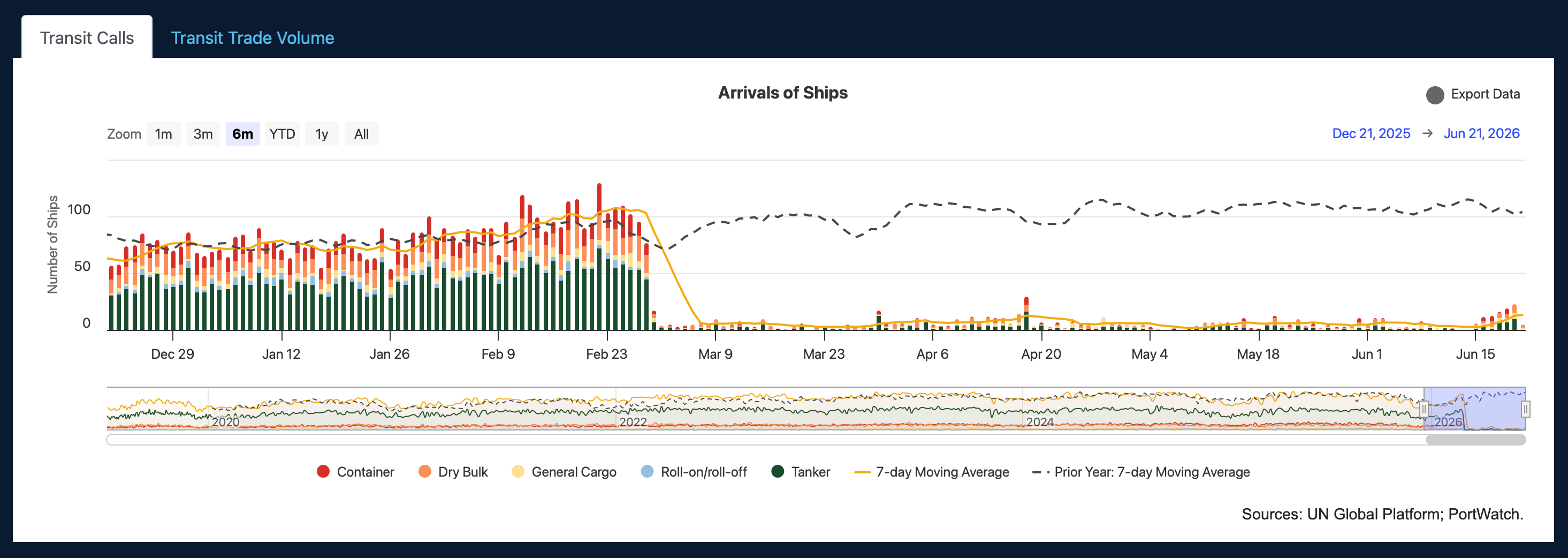
On March 2, 2026, the Strait of Hormuz closed… and our Alpha Window opened.
What is racing for the sunlight, this time, is four very different architectures. Three of them are pre-built and have been waiting in the wings for some time:
US private stablecoin architecture16
China’s e-CNY and the mBridge cross-border settlement network17
The BIS unified ledger, formalized through Project Agorá18
The fourth is the work we’ve been describing across this series.
All three pre-built architectures are now operational at some scale. All three are racing to capture the Alpha Window. What they share is the operating logic of the system that is fracturing. The currency in each is backed by sovereign debt, with all the growth pressure that implies. The issuance pathway in each is hierarchical, with the central bank or its private substitute at the top. The growth instruction we traced in Framework 2 sits inside all three, encoded at the substrate, with better technology and tighter surveillance than the system they are replacing. The seeds in the ground are not new species. They are the same species with sharper teeth.
The fourth architecture is bioregional currencies backed by ecological and labor capacity; commons trusts holding inalienable land; and cooperative enterprises operating under regenerative mandates. A constellation of small entities at three nested scales, with no single throat to choke. This is the architecture whose seeds were in the ground in 1932 in Hawarden and Wörgl and the early kibbutzim, and whose seeds didn’t consolidate in time. The structural infrastructure wasn’t quite ready. The collective consciousness required for acceptance at scale wasn’t yet fully developed.
This time, it might be. That is the work of a Threshold Guide.
What this asks of the Threshold Guide
None of us, except for a few exceptions, will be designing a commons trust, or implementing new monetary systems, so that’s not the ask.
The first ask is just to see the window. The cascading consequences from Hormuz will unfold as policy mistakes, blame will fall on the usual political enemies, and markets will be discussed as if their behavior were independent of the architecture underpinning them. What the Threshold Guide can see, and what most people cannot, is that the architecture itself is at stake, and what consolidates next is being decided right now.
The second ask is patience with the germination process. The alternative architecture we’ve been describing isn’t currently a well-defined option. Most of the structural pieces are still being built. The Valley of Grace prototype, which next week’s Framework 10 will walk through, is one site among what will need to be many. In the meantime, the work is to keep the conversation open, to keep the language available, to make sure that the people you guide will recognize the fourth architecture when they encounter it. Because they will encounter it. The window is now open.
The third ask is that you stop waiting and wondering. The architectures that emerged from The Great Depression took root because organizers had been working on them for years before the window opened. The Nazi Party had been organizing since 1920, and the New Deal team had been drafting reform legislation in the Brain Trust through the 1920s. The cooperatives that survived were the ones whose institutional infrastructure had been built in the 1910s and 20s. The window doesn’t reward those who start building when the wildfire comes raging through; it rewards those whose seeds are already in the ground.
That’s all for this week.
Next week, in Framework 10, we’ll close this series, which I know has been tough going intellectually (especially for me as I attempt to lay this out as best I can). We’ve spent nine essays building the conceptual architecture of how a Threshold Guide thinks about money, coercion, growth, and the structural transition of the system we’re currently inside and which is dictating our behavior. Framework 10 will take the architecture to a real place: The Valley of Grace, a rural bioregion in the Western Cape of South Africa, with twenty-five thousand people, low formal employment, deep indigenous knowledge traditions, and an economy that already operates partially outside the formal monetary system. It’s where my daughter and I call home, and it’s one of the places where the fourth architecture is being seeded. I’ll walk through what’s being built here, why we’re doing what we do, what’s been learned so far, and what it would take to make the prototype reproducible across other bioregions.
Until then, remember to love the ones you’re with, and frame on!
Michael 💚
Silvio Gesell’s The Natural Economic Order was originally published in German in 1916. The English translation by Philip Pye appeared in 1929, almost exactly at the moment the world that had ignored Gesell was about to need him. English version: https://www.naturalmoney.org/NaturalEconomicOrder.pdf
John Maynard Keynes (1883-1946), the English economist whose ideas fundamentally changed the theory and practice of macroeconomics and the economic policies of governments, called Gesell a “strange, unduly neglected prophet” in The General Theory of Employment, Interest, and Money (1936). Gesell’s core idea, covered in detail in Framework 6, is that money should depreciate at a small regular rate, which has the effect of making it cheaper to spend than to hoard. The 1930s US scrip experiments followed the example set by Wörgl, Austria.
The details of the Hawarden scheme are documented in Sarah Elvins, “Scrip Money and Slump Cures: Iowa’s Experiments with Alternative Currency during the Great Depression,” The Annals of Iowa, vol. 64 no. 3 (Summer 2005): https://doi.org/10.17077/0003-4827.10913.
The figure of $10,800 in transactions per initial $300 issue is from the Hawarden Historical Society’s account. Independent corroboration of velocity figures across multiple Iowa towns is in Bruce Champ, “Stamp Scrip: Money People Paid to Use,” Federal Reserve Bank of Cleveland Economic Commentary, April 2008. Champ notes that Mason City scrip moved about once a week, while Evanston scrip moved four times a week. Hawarden’s velocity was at the high end of recorded examples. https://www.clevelandfed.org/publications/economic-commentary/2008/ec-20080401-stamp-scrip-money-people-paid-to-use
Irving Fisher’s 1933 monograph Stamp Scrip is the standard contemporary account, and the source of the “hot money” quotation: https://userpage.fu-berlin.de/~roehrigw/fisher/
The Iowa State Legislature passed Zylstra’s bill in February 1933, authorizing all ninety-nine counties to issue stamp scrip. https://doi.org/10.15133/J.IJCCR.2010.004 By spring 1933, scrip programs were active in over a hundred American towns across multiple states. The Wörgl experiment, which we walked through in Framework 6, was operating concurrently and was the most successful of the European versions before its suppression.
The Austrian National Bank brought suit against Wörgl in summer 1933, and the Austrian Constitutional Court forbade further issuance in November 1933. The US scrip movement was effectively absorbed into the New Deal during 1933 and 1934. The Emergency Banking Act of March 9, 1933, the FDIC creation in June, and the broader New Deal architecture provided the federal monetary stability that had been the original justification for local scrip experiments. By 1935, almost all of the scrip programs had wound down. See Loren Gatch, “Local Money in the United States During the Great Depression,” Essays in Economic & Business History vol. XXIV (2008): https://www.ebhsoc.org/journal/index.php/ebhs/article/view/191
My claim is that the start of the Decade of Dramatic Disruption will be recorded in history books as commencing on March 2nd, 2026, with the closure of the Strait of Hormuz:
In my view, Meadows’ book is required reading for any Threshold Guide. You can access a PDF copy as well as a series of videos here: https://bit.ly/Sys-Think
The popular account called this period The Roaring Twenties. However, many people had lost faith in progress, democracy, and moral certainty. This sense of disappointment shaped the attitudes of a generation that came of age during and after WW1. We are at a similar tipping point. See https://www.khanacademy.org/humanities/us-history/rise-to-world-power/x71a94f19:culture-in-the-1920s/a/culture-of-the-1920s
For a profoundly visceral experience of being surrounded by a wildfire, watch this 2min 3D video, sourced from Scientific American:
C.S. Holling, “Understanding the Complexity of Economic, Ecological, and Social Systems,” Ecosystems vol. 4 (2001), pp. 390–405. The Adaptive Cycle was developed earlier in Holling’s work on ecosystem resilience in the 1970s and 80s. The 2001 paper is the canonical statement and the one most cited in subsequent panarchy literature. See https://bit.ly/Ad-Cyc
The forest analogy is an intentional simplification. Holling’s actual work covered ecosystems, river systems, fisheries, and economic and political systems, and the Adaptive Cycle is meant to describe the dynamics of any complex adaptive system. For the canonical extension into human social systems, see Lance Gunderson and C.S. Holling, eds., Panarchy: Understanding Transformations in Human and Natural Systems (Island Press, 2002). https://bit.ly/Panarchy
DDD means two things: The Day of Dramatic Disruption is the single-day fracture that breaks a system open: Black Thursday in October 1929, the Credit-Anstalt failure in May 1931, the Lehman collapse in September 2008, the Strait of Hormuz closure on March 2, 2026, and more importantly, the next major stock market correction which appears to be approaching rapidly as I write. The Decade of Dramatic Disruption is the longer window that follows: the Alpha Phase during which the structures that take the old system's place are decided. The Day is the fracture, and the Decade is the work.
I mentioned in last week’s essay a website I built. It focussed entirely on three world wars. What I learned during that part of my life journey is that the victors’ version of history is entirely different to what unfolded, in any given circumstance. Whatever your beliefs about world war, I’m willing to bet that I can demonstrate fallacies.
The historiography of the Nazi seizure of power between January 30 and March 23, 1933, is enormous. For one accessible account that pays attention to the institutional and legal mechanisms, see Richard J. Evans, The Coming of the Third Reich (Penguin, 2003). The seven weeks between Hitler’s appointment as Chancellor and the Enabling Act are one of the most-studied Alpha Windows in modern history, precisely because so much consolidation happened so fast. https://www.amazon.com/dp/0143034693 or PDF available at https://bit.ly/3Syjsb8
The Brain Trust, the informal group of advisors around Roosevelt during his 1932 campaign and first term, had been developing reform legislation for years before March 1933. The institutional and legal infrastructure of the New Deal didn’t appear in a flash of inspiration. It was waiting in legal drafts, in policy papers, and in academic research conducted across the 1920s. The seeds were already in the ground, and when the window opened, they germinated. See Roosevelt and the Brains Trust: An Historiographical Overview by Elliot A. Rosen (1972): https://doi.org/10.2307/2148195 (paywall)
This is what Milton Friedman referred to when he later said: “Only a crisis—actual or perceived—produces real change. When that crisis occurs, the actions that are taken depend on the ideas that are lying around. That, I believe, is our basic function: to develop alternatives to existing policies, to keep them alive and available until the politically impossible becomes the politically inevitable.” — Milton Friedman.
The GENIUS Act was signed into law in July 2025. The OCC's 376-page Notice of Proposed Rulemaking implementing it was published on March 2, 2026, the same day as the Strait of Hormuz closure. Tether already holds around 122 billion dollars in US Treasuries. Circle holds another sixty to sixty-eight billion. Apollo’s 2025 outlook publications project a $2 trillion stablecoin sector by 2028. The concurrent Anti-CBDC Surveillance State Act, which prohibits the Federal Reserve from issuing a central bank digital currency, ensures that the US digital dollar will be privately issued and privately controlled.
Project mBridge reached minimum viable product status in June 2024. As of early 2026 it has settled approximately $55.5 billion in cross-border transactions among the central banks of China, Hong Kong, Thailand, the UAE, and Saudi Arabia. The Atlantic Council's CBDC Tracker is the public reference for current state. The doubling of cross-border wholesale CBDC projects between 2022 and 2026 (from approximately five to thirteen) reflects sovereign anxiety about SWIFT exposure following the G7's Russia sanctions in 2022.
Project Agorá entered formal testing in January 2026 with seven central banks and 43 private institutions. The BIS’ 2025 Annual Economic Report laid out the trilogy architecture of tokenized central bank reserves, tokenized commercial bank deposits, and tokenized government bonds on a unified ledger. ECB Executive Board member Piero Cipollone’s statement of February 6, 2026, on the need for “bold measures to overcome the dependencies we have tacitly accepted until now,” frames the political logic behind the project.
I work at the hub of a constellation of bio regional communities. Most members of the communities don’t know that they are sitting in a bio region. Most do know that they are trying to do something apart from the current extractive system. The only sense making we have is what we don’t want to be part of. We don’t feel empowered to create or transition into what’s next, we think we should work within the current system to make a modified better system.
You’re well written essays are pulling me in different directions: my intellect keeps reading and striving to understand. My body knows what you’re stating is accurate but aches. My will pauses and waits, just as you stated happens in #3.
I have struggled to succeed in the extractive economy.
Thank you Michael, as you know I have really enjoyed this series. You say it has been tough intellectually but I have not found it to be so, I have thoroughly enjoyed it! And you have worked so hard, I really appreciate it.
I'm really looking forward to reading about the Valley of Grace and the work you are doing there.