
The Long Absence
How to Think Like a Threshold Guide, Part 6, Framework 4: Why bottom-up money was never possible at scale until now

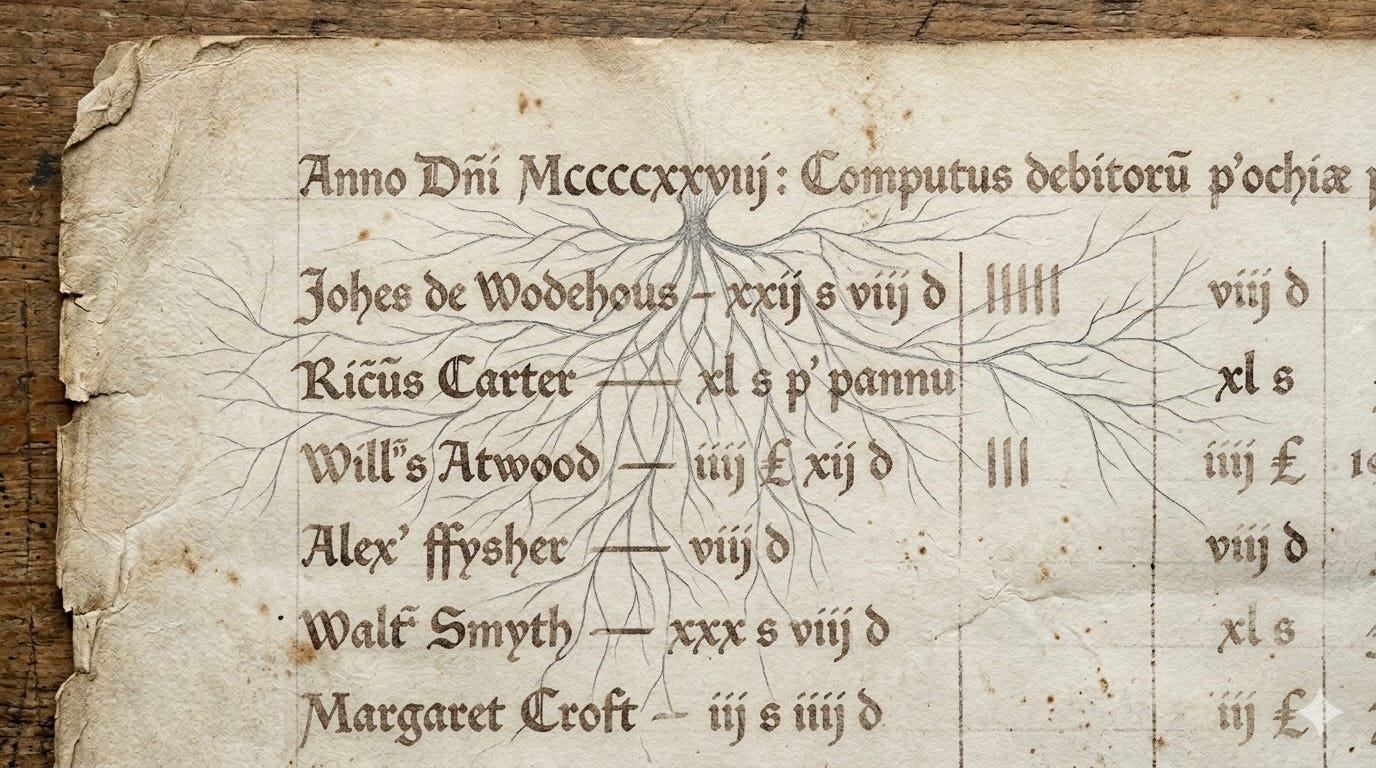
Why this essay? I make the bold claim that two major developments in human coordination are converging during the Decade of Dramatic Disruption: the collapse of a coercive monetary system and the emergence of a form of consciousness capable of conceiving an alternative.
Setting the Scene
There were about thirty people in the room. The meeting was about regenerative finance. The phrase ‘patient capital’ had come up four times in the first hour, always approvingly. A fund manager in a cream linen suit explained that her fund offered three percent over a fifteen-year term, with the option to renegotiate if outcomes didn’t work out as expected. Someone at the next table called the offering ‘courageous.’ Around the room, heads nodded gently. Unbeknownst to the attendees, the financial innovation they were discussing was identical, at the substrate level, to one a Florentine banker would have recognized in 1450.1
It dawned on me that nobody in the room could see what they were doing. They were arguing about the velocity and conditions of debt. They weren’t stepping away from the structural form of debt itself. This form of finance had been the only form for so long it had become invisible. Money was something a creditor (someone who has capital) extended to a debtor (someone who needs capital). The variations of each of the offerings discussed were (sometimes) innovative, but the underlying substrate remained constant.
A woman I had met once before caught my eye across the table and held it for a second longer than necessary. After the session she found me at the coffee table.
“You’re not buying any of this, are you,” she said. It wasn’t a question.
I told her I thought the room had inherited a substrate it couldn’t see, and that no amount of softening the terms or innovating the offer would change what the substrate was.
She nodded slowly.
“How long has this been the only form of money?”
“About five thousand years.”
A Question for Those who have Accumulated Capital
A previous essay in this series, The Fifth Phase of the Coercion Continuum, explained the legal architecture that has quietly redefined what it means to own a security.2 If you’ve followed the entire series, you now have a recognition that the system extends upward, from the lowest classes (slaves) to the highest classes (successful entrepreneurs and wealth holders). The architecture that coerced wage earners through credit has, over the last fifty years, extended its logic to the asset side of the balance sheet through the redefinition of securities ownership as a contractual claim subordinate to secured creditors. Even wealth holders, who believed their position protected them from the system’s coercive logic, find themselves trapped inside a similarly constraining system.3
There’s a question that this understanding brings to the surface:
When a wealth holder recognizes that everything they have spent their life building and accumulating is at risk, what is actually on offer as some form of alternative?
In other words, what does anyone with small or large savings do to extricate them from all five phases of coercion?
This essay answers that question by giving the wrong answer first. There is nothing adequate on offer.
❌ Central bank digital currencies (CBDCs) already adopted in 130-plus nations.4
❌ Privately-issued stablecoins the US is pursuing as an alternative to CBDCs.5
❌ Privately-issued programmable money the BIS is preparing through Project Agorá.6
❌ What passes today for any form of ‘regenerative’ or ‘conscious’ finance inside the existing constraints of a debt-based monetary system.7
The reason none of these innovations offer evolutionarily coherent alternatives is a lot older than most economists understand. For at least the past five thousand years, the form that could actually replace the substrate has been unthinkable.
Five Thousand Years of Monetary System Reform Status quo
David Graeber spent thirty years on a single empirical claim that overturns the standard economic origin story.8 He found that money didn’t evolve from barter. Credit and debt preceded coinage by thousands of years. The smoothly evolving sequence economics textbooks describe, in which barter gives way to commodity money which gives way to fiat, has no archaeological support, at least according to Graeber. The actual record shows something different. Long before coinage, communities ran on relational accounting. Neighbors extended credit to neighbors. Marriages, funerals, harvests, and disputes were settled through complex flows of obligation that carried memory rather than mathematics. The human economies Graeber documented, drawing on a wide anthropological literature, did not require an issuer. They required a network of people who knew each other.9
Coinage appeared, in the historical record, in a highly specific context. Mercenary armies needed paying. Soldiers in foreign territories needed something portable, anonymous, and accepted by strangers under threat of force. The same instrument that paid the army priced the captives the army brought home. Graeber called this the military-coinage-slave complex of the Axial Age, roughly 800 BCE to 600 CE. The convergence of standing armies, coinage, and slave markets in this period across Eurasia underscores the claim of a Coercion Continuum already discussed. The first money and the first large-scale slave markets emerged in the same temple precincts at roughly the same time.
From that point forward, every dominant monetary form has been a variant of the same coercive substrate:
Sovereign coin in the classical and medieval periods.
The early modern bills of exchange, which extended credit between merchants under the protection of states.
Bank credit, issued through the act of lending against collateral.
Fractional reserve money.
Fiat money issued by central banks.
Digital fiat issued through commercial banks under central bank supervision.
Programmable money, now being designed, in which the issuer can attach conditions to the unit’s use.
The progression may appear to be an evolution of exchange mechanisms that become more and more efficient with the arrival of each new innovation, however the substrate remains remarkably consistent: Someone upstream issues; Someone downstream owes. The flow runs in one direction only.
This is the empirical baseline. For five thousand years, our monetary systems have essentially consisted of one form only: debt.
Each Level of Consciousness Made the Money It Could Conceive
The deeper question is why the variations have stayed within a single substrate for so long. The wider economic anthropology can take you to the threshold of an answer. Crossing that threshold requires studying the monetary record through the lens of consciousness evolution, which Graeber himself didn’t do.10 What follows is a structural reading, rather than an established academic position.11 The five-thousand-year empirical pattern is solid, but the interpretation that follows is, I believe, an original synthesis. In other words, any errors you find here are entirely my fault.
Each stage of consciousness produced the money it could conceive.
Magical and Mythical Consciousness (1MYA & 70KYA)
The earliest human communities operated within what Jean Gebser called the magical and mythical structures of consciousness, and what the wider developmental literature recognizes as the cognitive modes that preceded individual abstract thought. These communities produced gift, reciprocity, sacred exchange, and obligation tracked in relationship. They didn’t need an issuer because their economic life didn’t require abstraction. Robin Wall Kimmerer described it well by saying that in a gift economy, the currency is relationship.12
In a gift economy, wealth is understood as having enough to share, and the practice for dealing with abundance is to give it away. In fact, status is determined not by how much one accumulates, but by how much one gives away. The currency in a gift economy is relationship, which is expressed as gratitude, as interdependence and the ongoing cycles of reciprocity. A gift economy nurtures the community bonds that enhance mutual well-being; the economic unit is “we” rather than “I,” as all flourishing is mutual. — Robin Wall Kimmerer
Wealth meant having enough to share.
Mythical consciousness, when it reached the scale of agrarian temple states, produced temple money and ritual coin. The unit of account was tied to cosmic order. The priest mediated between the invisible and the visible, and the temple recorded what was owed to the gods, the king, and each other. Sovereignty over the unit of account belonged to the sacred. The monetary form was still issued from somewhere identifiable. It just answered to a different authority.
Material Consciousness (emerged 12,000 years ago)
Material consciousness, which has been the dominant cognitive mode of the last twenty-five hundred years and especially the last five hundred, produced every monetary form that came next: State coin, bank credit, fiat, digital fiat, and now, programmable money. Every Material consciousness monetary form requires a central issuer because Material consciousness cannot hold distributed intelligence as a coordination mechanism. It sees distributed intelligence as chaos. Money has to come from somewhere identifiable. The alternative is unthinkable. Either a sovereign, or a bank, or a central bank, or a protocol with a foundation behind it. The variations are who holds the seat upstream, but the seat itself is structural to the form.
This is the finding the economic anthropology points toward without naming directly. Money is downstream of consciousness. The monetary form is the collective consciousness made visible at the substrate level.
It also explains why every reform that operates inside Material consciousness ends up reproducing the substrate it set out to challenge. Local currencies issued by local councils, stablecoins backed by reserves, and central bank digital currencies ‘with privacy protections.’ Every one of these proposals merely replaces the holder of the seat. None of them remove the seat entirely. The (limited) reform stays within the substrate.
What Mycelial Consciousness Can Hold
The fifth Major Evolutionary Transition is what I call Mycelial Consciousness and others have called Planetary, Gaia, or Universal Consciousness. Some refer to it as the Noosphere.13 Mycelial goes beyond Material consciousness because it can conceive of distributed intelligence as a legitimate form of human coordination. Material consciousness can only think in hierarchies of power.
The biological precedent is the mycelial network itself, which next week’s essay will cover in detail.14 The structural point that matters here is that the network has no issuer. Nutrients flow through a substrate that no individual fungus owns. Reciprocal accounting happens through the medium itself. The network functions because the participants weave it together, not because an authority above them dictates the unit of account. The mycelium is the proof at biological scale that distributed coordination is real, durable, and capable of organizing flows across millions of nodes for hundreds of millions of years.
Mycelial Consciousness can see this and recognize it as a coordination architecture. Material Consciousness sees it but cannot conceive of it ever working.
This cognitive shift makes a different monetary form conceivable for the first time in recorded history. What I mean is money woven upward from commitments and reciprocity, recorded by a substrate that no one owns, and balanced through the same logic that balances a forest. The participants issue, the substrate records, and the accounting emerges from the network rather than descending into it. This is mutual credit at civilizational scale, and it has been unthinkable for five thousand years because the consciousness capable of conceiving it had not yet emerged.
Here’s my claim: The alternatives on offer today (the big red crosses above) aren’t failures of design. Instead, they are failures of consciousness.
What Happens When Consciousness Evolves at the Same Time a Monetary System Implodes
Mutual credit at small scale has always existed. There are rotating credit clubs across West Africa and South Asia.15 The Wörgl experiment in 1932; Argentina’s Trueque networks at their peak; the local currency movements of the past forty years.16 The historical record shows mutual credit working at the scale of a village, a town, and a regional movement during a crisis. However, none of these instances scaled to civilizational substrate. Most were suppressed or collapsed within a few years.
What is new is the convergence of two conditions that have never both been present in the same window.
The first is consciousness. Mycelial cognition has emerged in enough nodes across enough domains that distributed intelligence is now recognized as legitimate coordination by a meaningful number of practitioners. Examples include Linux and Wikipedia. Commons governance scholarship traces back to Elinor Ostrom’s Nobel-recognized work.17 The recognition exists in pockets across the developed world and across the regenerative movement globally.
The second is the technical infrastructure. We now have global mobile and satellite communications, distributed ledger technology stripped of the speculative wrapper, and mutual credit accounting software that can run across thousands of participants without a central server. The infrastructure required to record reciprocal commitments across a bioregion of twenty-five thousand people, or a network of bioregions covering millions, exists now and didn’t exist twenty years ago. Sarafu in Kenya has recorded millions of transactions across communities the formal financial system abandoned.18 Sardex in Sardinia has cleared more than five hundred million euros of mutual credit across twelve Italian regions in fifteen years. The Slovenian multilateral clearing system reached liquidity savings of more than seven percent of GDP in its first full year of operation in 1992.19
These aren’t mere experiments. They are functioning prototypes, operating under contemporary regulatory conditions, demonstrating the substrate at meaningful scale.
This is what happens when a new form of consciousness emerges as the existing monetary system faces structural limits. For the first time in five thousand years, both conditions are present in the same window: 1) the consciousness capable of conceiving a bottom-up monetary substrate, and 2) the infrastructure capable of holding the accounting for it. The Alpha Window, which I introduced in The Threshold Guide, is the window in which these prototypes can be built into something structurally durable before the digital enclosure closes the option.
Which brings this essay to the question I posed earlier:
What monetary systems are on offer as an alternative to the coercion continuum?
The next time someone proposes a monetary alternative, whether it’s a new currency, a new lending vehicle, a new digital settlement layer, or a new instrument labeled as regenerative or conscious finance, ask one question: Who issues the unit of account? If the answer points upstream to a foundation, a treasury, a corporate consortium, or a protocol team, you’re looking at Material consciousness dressed in new clothes. If the answer is the participants themselves, through their reciprocal commitments, recorded by a substrate that no one owns, you are looking at something genuinely new.
That question, asked cautiously and consciously, will filter every monetary or funding proposal you encounter for the next decade.
What I Don’t Know
There are two honest uncertainties that I wrestle with every night as I fall asleep. This is where pattern recognition ends and prediction or prophecy raises its head.
Uncertainty 1: The Race Between Competing Monetary Systems
Whether the Mycelial prototypes will scale fast enough to be structurally sound before the digital, top-down alternatives are imposed isn’t something I can predict. The momentum is certainly heading in the right direction. Sarafu, Sardex, the bioregional currency movement, the commitment pooling protocols developed quietly by Will Ruddick and others are real and growing. The Bank for International Settlements’ Project Agorá, the GENIUS Act, the central bank digital currency rollouts across more than a hundred jurisdictions are also real and growing. Both trajectories are inside the same Alpha Window. The outcome is not guaranteed, either way.
Uncertainty 2: The Consciousness Shift
Whether the consciousness shift is happening in enough nodes, and quickly enough for the conception to translate into design at the scale required is also genuinely open. Pockets of Mycelial cognition exist. Whether the pockets coalesce into a coherent design movement in time is the question the next few years will answer. The work of this essay, and of the wider series, is to make the conception available to people who can already feel it and haven’t had language for it. Whether enough of those people exist, and whether they can find each other, is the open question beneath everything I’m writing about. It’s why I spend so much time laying out as carefully as I can what I see.
Both uncertainties are real, but neither cancels out the structural claim, which is this: the Long Absence of a non-coercive monetary system is at least five thousand years, and the conditions to end that absence have arrived. What happens next depends on what is built inside the window of opportunity that I’ve previously called the Decade of Dramatic Disruption, or DDD.
The Substrate Made Visible
The woman at the coffee table found me again before the afternoon session. She’d been thinking about the five-thousand-year answer.
“If that’s true,” she said, “then most of what gets called sustainable finance is just slower extraction.”
I told her that was the cleanest version of the recognition I had heard anyone speak out loud in that kind of room.
“What’s the alternative?”
I told her the alternative is older than the form in one sense and newer than the form in another. Older because mutual credit between people who know each other is what humans did for tens of thousands of years before money appeared. Newer because mutual credit as a civilizational substrate, coordinated across millions of people in multiple bioregions, has never existed. The technology to build it is recent. The consciousness capable of conceiving it is more recent still. The two have arrived in the same window. The window is open. The window is closing.
“How long is the window?”
I told her the honest answer was that nobody knows. Five years. Ten. Maybe a little longer if the digital enclosure stumbles. But the process is underway, and the outcome isn’t guaranteed. The choice has to be made inside it.
She looked at me for a long moment. Then she went back into the session and asked the room a question about who issued the unit of account. The answer she got, after some confusion, was the one Material consciousness has always given. The work she does next will depend on whether she keeps asking the question, or decides the room’s answer was good enough.
The Long Absence is closing now because, for the first time, the consciousness and the infrastructure capable of closing it exist in the same window. The substrate is becoming visible. What gets built before the window closes will determine what the next five thousand years are made of.
That’s all for this week. We’ll continue the Ten Frameworks for the End of Normal next week with The Biological Template, which explains the architecture nature already solved for distributed coordination at scale. I’ll show you how a mycelial network is the design specification.
Remember to love the ones you’re with, and frame on!
Michael 💚
I will use the word substrate extensively throughout this essay, by which I mean the starting ‘ingredient’ or basis that supports any modern debt-based monetary system. David Graeber uses the phrase military-coinage-slave complex of the Axial Age. This is what I mean by substrate. Excluded are mutual aid monetary systems, which are the inverse of debt-based monetary systems.
In the essay, I make the claim that post-Neolithic monetary systems have functioned as architectures of coercion evolving through five documented phases:
Chattel Slavery, during which it was permitted to engage in the slave trade;
Debt Bondage, where the chains of slavery were replaced by debt obligations;
Wage Compulsion, which came about with the enclosure of the commons that removed subsistence farming and forced populations into the monetary economy;
Monetary System Dependence, which means we all have to work for an income to put food on our table, whether we like the system or not.
The latest phase, the legal redefinition of securities ownership, extends coercion upward to target the wealth-holding class itself, creating a unique historical moment where the system’s own beneficiaries have structural reasons to seek alternatives.
As mentioned in previous essays, David Rogers Webb’s book, The Great Taking, is a worthwhile read if you have any form of investment portfolio (including a pension fund). The book presents evidence that the current financial system is set up to benefit a select group of secured creditors, leaving individuals vulnerable in the event of a market crash. The ripple effects of the closure of the Strait of Hormuz will trigger a crash. The only thing we don’t know for sure is exactly when this will happen. The book discusses the legal constructs created over decades to support a seizure of assets in a financial crisis, citing changes in legislation and the deliberate underfunding of a central clearing party. The book can be downloaded free of charge at https://thegreattaking.com.
146 countries & currency unions, representing over 98% of global GDP, are exploring a CBDC. In May 2022 that number was only 87. There is a new high of 77 countries in the advanced phase of exploration, which includes development, pilot, or launch. Every G20 country except the US is exploring a CBDC, with 18 of them in the advanced stages of exploration. Fourteen G20 members are now in the pilot phase. The US is an outlier among its peers, but the New York Fed continues wholesale cross-border research through Project Agorá. To find out the status of your country, visit https://www.atlanticcouncil.org/cbdctracker/
The best research paper I’ve come across comparing CBDCs to stablecoins is Canada’s Mark Carney vs. the Trump Administration: Competing Philosophies of Digital Asset Governance: https://papers.ssrn.com/sol3/papers.cfm?abstract_id=5235358. It’s well worth a read, especially if you hold any digital assets like Bitcoin.
The flagship BIS (Bank for International Settlements) project involving tokenized deposits and tokenized central bank money is Project Agorá. Launched in 2024, Project Agorá is a public/private collaboration between the BIS Innovation Hub, a consortium of 40 private financial institutions coordinated by the Institute of International Finance, and 7 central banks: the Bank of England, the Banque de France (representing the Eurosystem), the Bank of Japan, the Bank of Korea, the Bank of Mexico, the Swiss National Bank, and the Federal Reserve Bank of New York. The project is ongoing and will result in the creation of a prototype. A project report is expected in mid-2026. https://committees.parliament.uk/writtenevidence/163755/html/
I track upwards of 30 different approaches in my research portal: https://bit.ly/4nENGF2 (be patient - can take up to 20 seconds to load).
David Rolfe Graeber (1961-2020) was an American anthropologist, anarchist activist, and author known for his books __Debt: The First 5000 Years__, __The Utopia of Rules__ and __Bullshit Jobs: A Theory__. He also co-authored, with David Wengrow, __The Dawn of Everything__. He was a professor of anthropology at the London School of Economics. Graeber, D. (2011). Debt: The First 5,000 Years. Melville House. https://bit.ly/Debt5000
The economic anthropology drawn on in this essay rests primarily on Graeber’s synthesis, supplemented by Polanyi, Ingham, and Zelizer.
Mutual Aid is a method of exchange that creates networks of care and generosity to meet the immediate needs of neighbors in a community. When combined with Promise Theory, it is a powerful way to bring community together, since promises are the fundamental building blocks of cooperative behavior. A modern-day pioneer exploring these forms of human coordination is Will Ruddick with his work on Grassroots Economics: https://bit.ly/MutAid
Here, I’m grateful for the work of Roger Briggs in his 2021 book, Emerging World: The Evolution of Consciousness and the Future of Humanity. https://bit.ly/Em-World. I have built on Roger’s work to define the following five Major Evolutionary Transitions as follows: Mimetic ⇢ Magical ⇢ Mythic ⇢ Material ⇢ Mycelial Consciousness. See details at https://bit.ly/M-E-T
I’ve explained why I don’t take an academic position on this in my essay explaining the expanded consciousness experience I received in 2004:
See, for example, Braiding Sweetgrass: Indigenous Wisdom, Scientific Knowledge and the Teachings of Plants by Robin Wall Kimmerer (2013): https://www.amazon.com/dp/B00D0V44LC/ or access a PDF at https://bit.ly/RWKimmerer.
The Serviceberry - An Economy of Abundance by Robin Wall Kimmerer: https://emergencemagazine.org/essay/the-serviceberry/
Mycelial Consciousness is a networked form of cognition that mirrors the sophisticated coordination patterns found in fungal networks and is characterized by ten distinctions from Material Consciousness, which I document here: https://bit.ly/MetaCon
The foundational source includes the time I spent with Elisabet Sahtouris before her passing in 2024. See Sahtouris, E. (2000), EarthDance: Living Systems in Evolution, and the wider mycorrhizal-network literature. See https://bit.ly/Myc-Sci for an extensive list of what I call Mycelial Science.
See, for example, Rotating Labor Associations (ROLAs) and Rotating Savings and Credit Association (ROSCAs): https://bit.ly/3ReRNLI
For an extensive list of alternative economics, see https://bit.ly/Alt-Econ.
Elinor Claire “Lin” Ostrom (1933-2012) was an American political economist whose work was associated with the New Institutional Economics and the resurgence of political economy. Her work, Governing the Commons, was partly inspired by the errors in Garrett Hardin’s Tragedy of the Commons. https://bit.ly/3OWhCPi
See Sarafu Community Inclusion Currency 2020–2021: https://www.nature.com/articles/s41597-022-01539-4
For the case-study record of Sarafu, Sardex, the Slovenian multilateral clearing system, and the failure modes of earlier alternatives (Wörgl, Argentina Trueque, the UK regional pounds), see the research brief The Cheapest Available Behavior: Bioregional Demurrage Money as the Engineering Point for the Next Form of Human Coordination (April 2026), Section 9. Available to paid subscribers only, because their support helps me do the research:
Michael, I find your work fascinating and deeply meaningful. I recognize the vast amount of time you invest in your research, writing, and documentation.
I spent my career teaching English to community college students at all levels, from the very basic (write a correct sentence) to advanced classes for exceptional students. A skill I developed over the years was the ability to explain complex ideas in ways that were easy(ish) for all students to understand.
I invite you to consider whether I might have something to offer to the movement in this vein. I have been contemplating how I might be called to contribute to positive change in the world. Maybe making your work accessible to a less educated, less erudite audience would be helpful. Maybe not. I just feel called to mention this idea.
Brilliant Michael, as always. Thank you for your deep research, committed vision, and your ability to convey this huge story with a lightness that makes it feel like an adventure unfolding!