
Transvestment vs. Divestment
or How Money Moves at Scale from Coercion to Liberation - How to Think Like a Threshold Guide, Framework 8

Why this essay? In Framework 7, we discussed a constellation, which is a set of bioregional bodies, each one holding a piece of custodial land and a community currency, with no single point of failure across the whole. What we didn’t answer was the question of money. Where does the capital come from to fund a constellation that has stepped outside the system that enabled capital accumulation? That’s what we’ll tackle in this essay, which entirely rejects the notions of impact/systemic investing, ESG, corporate social responsibility, charity, and philanthropy.
The story so far
We’re building an argument over ten frameworks, and we’ve covered seven so far:
Framework 1 addressed how living systems never stop growing, otherwise they die; their form of growth simply changes, just as a teenager’s physical growth spurts eventually morph into growth of wisdom.
Framework 2 showed that money has never been neutral; it is an instrument of coercion shaped by those who issue it.
Framework 3 examined how coercion has reached the phase where it activates against even those who built success and have accumulated wealth.
Framework 4 explained the we’ve never had a non-coercive monetary system. We also saw that the required consciousness and infrastructure capable of birthing an alternative are coinciding in our lifetime.
Framework 5 looked at mature forests as the design specification for distributed coordination at scale, with mycelial mutualism as the working model.
The six inversions in Framework 6 showed what a monetary system designed for life would look like across each of its six features.
The constellation covered in Framework 7 showed the entity architecture that holds the inversions in place, without triggering the existing architecture to suppress it.
The question we now need to address is what it would take for the accumulated capital from 5,000 years to cross the bridge from an extractive, coercive system to a system that supports life at the top end of the S-shaped growth curve we discussed in Framework 1.
The Importance of Self-Interest
I want to be clear about what I’m not addressing or suggesting in this essay. I’ve spent more than a decade chasing impact investing and/or systemic investing through either philanthropy or corporate social responsibility. Those approaches do not work at the scale required, so I’m entirely rejecting them. They may work in some settings, but we’re discussing an entirely different setting in this series of essays. Both impact investing and philanthropy carry an implicit story about the wealth holder, in which the wealth holder gives something up in exchange for a moral position.1 In the framing we’ve laid out in the preceding seven essays, that story is evolutionarily incoherent, because it continues the same mode of thinking that drove the steep part of the S-shaped growth curve.
In stark contrast, I want to discuss a structural move that wealth holders can make to get their capital out of a steep-curve system and into a gentle-curve system. It is a pure self-interest move that comes about when someone recognizes that the steep-curve system has already been quietly rewired to devalue (at best) or entirely remove (at worst) their accumulated wealth.
In short, my claim is that all accumulated wealth is about to be taken by a rapacious system designed to concentrate resources in the hands of a few.
Most natural resources have already been siphoned up. The slurping sound we hear now is the last of what remains at the bottom of the parfait glass of globalization: financial resources.
This creates simultaneously a systemic risk and an opportunity.
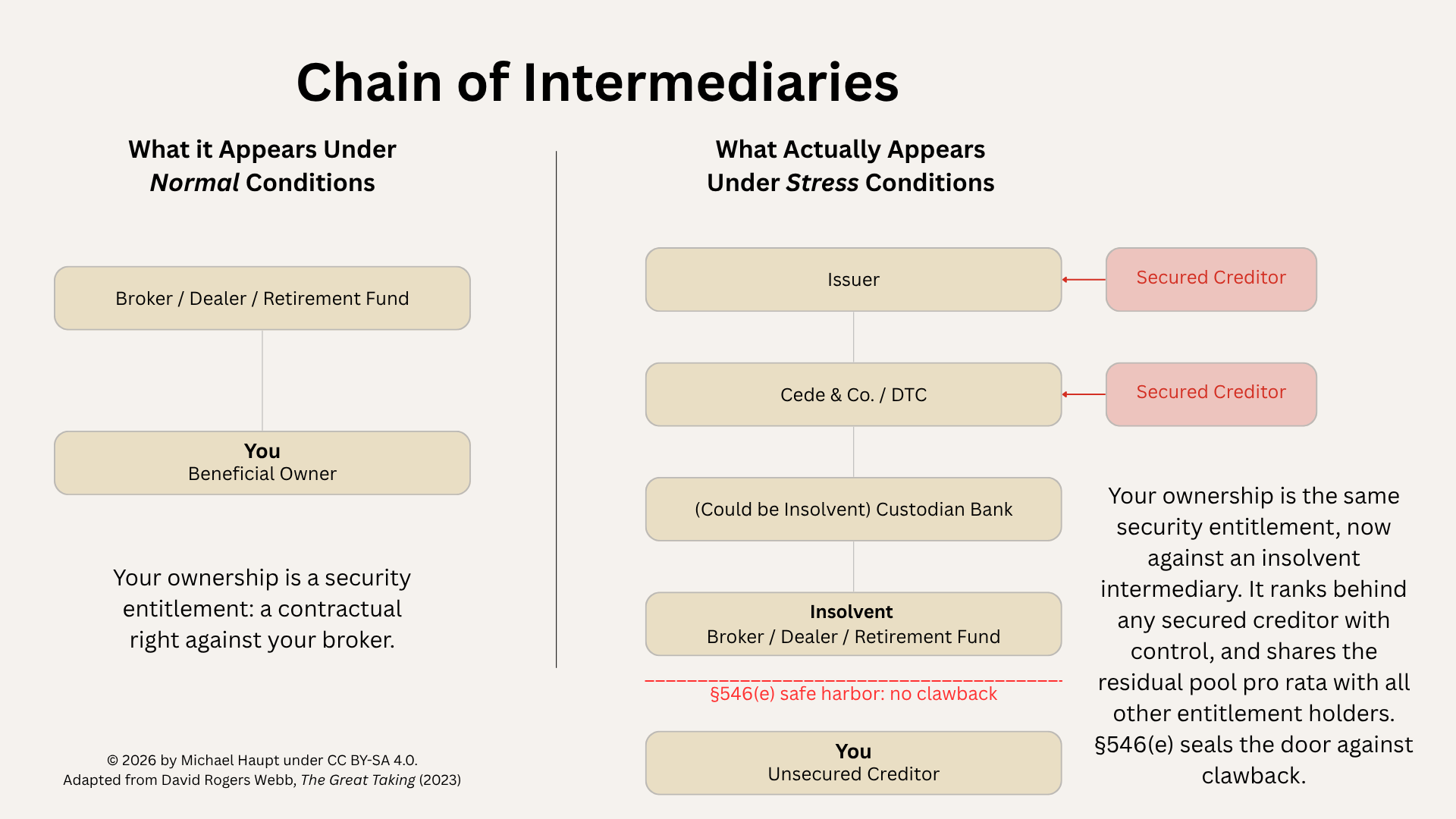
David Rogers Webb’s 2023 book, The Great Taking, documents the complex legal architecture already in place for the financial siphoning to happen.2 Over the last fifty years, in OECD jurisdictions, securities ownership has been redefined in ways most account holders are entirely unaware of. What was once title to an asset is now a contractual claim that sits below secured creditors, held inside a chain of intermediaries that, in a crisis, leave the original holder with nothing, or very little. Think Black Thursday, October 24, 1929.3
The important point is that the architecture is statutory and already in force. A sufficiently large market dislocation or correction activates it automatically (in other words no one can be ‘blamed’ when it occurs). The Hormuz Crisis is the trigger for that correction, even though we haven’t yet seen the systemic impacts. Those impacts are likely to arrive by late 2026 or early 2027, irrespective of when an agreement about Hormuz is reached.
Here’s a diagram showing what happens during margin calls triggered by a systemic shock like Hormuz. You may not understand it if you don’t hold a share portfolio or a pension fund. If you do, this should keep you awake at night.
What evidence do we have that an elite class already have this mechanism in place?4
In November 2016, the World Economic Forum published an essay by Danish politician Ida Auken titled Welcome to 2030. I own nothing, have no privacy, and life has never been better.5 A WEF video released in the same month memeified the essay into a single line: By 2030, you will own nothing, and you will be happy.
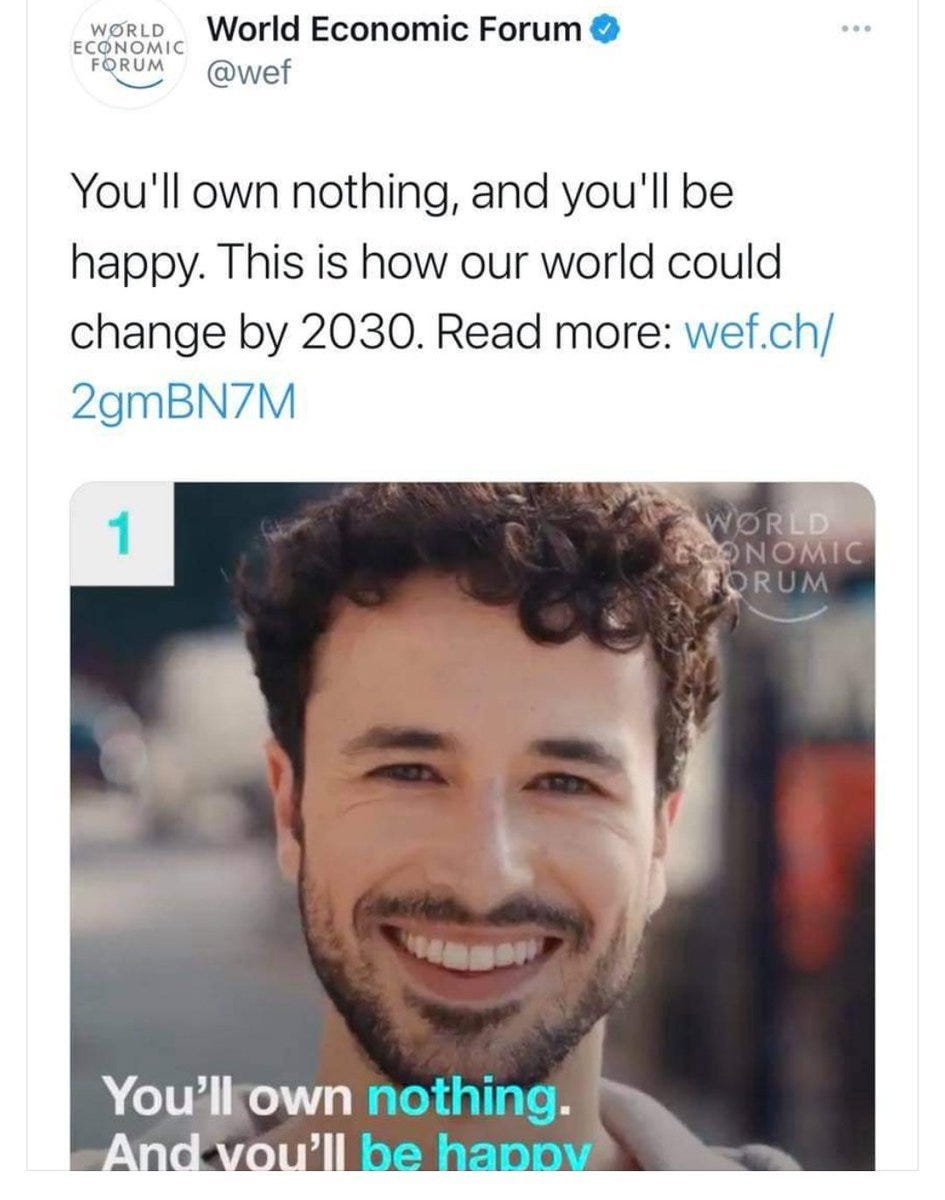
The meme has been interpreted as a marketing campaign that backfired and as a joke. Webb’s assessment interprets it as a forecast. So do I. The legal infrastructure to make “you’ll-own-nothing” factually true for most holders of paper wealth was already in place by the time the 2016 WEF essay was published. Whether “you’ll-be-happy” will turn out to be factually accurate is for each wealth holder to evaluate.
Transvestment is the move a wealth holder could make when they understand what is being forecast… and choose to play their cards differently… before the forecast is fulfilled. A move like this also funds a regenerative architecture for the broader community, but the primary reason to consider transvestment is the preservation of one’s own capital from a system that has been designed to take it away.6 Remember, the WEF (not my) forecast gives us roughly four years: By 2030, you will own nothing. I wouldn’t wait till Christmas 2029.
What Exactly is Transvestment and is There an Example?
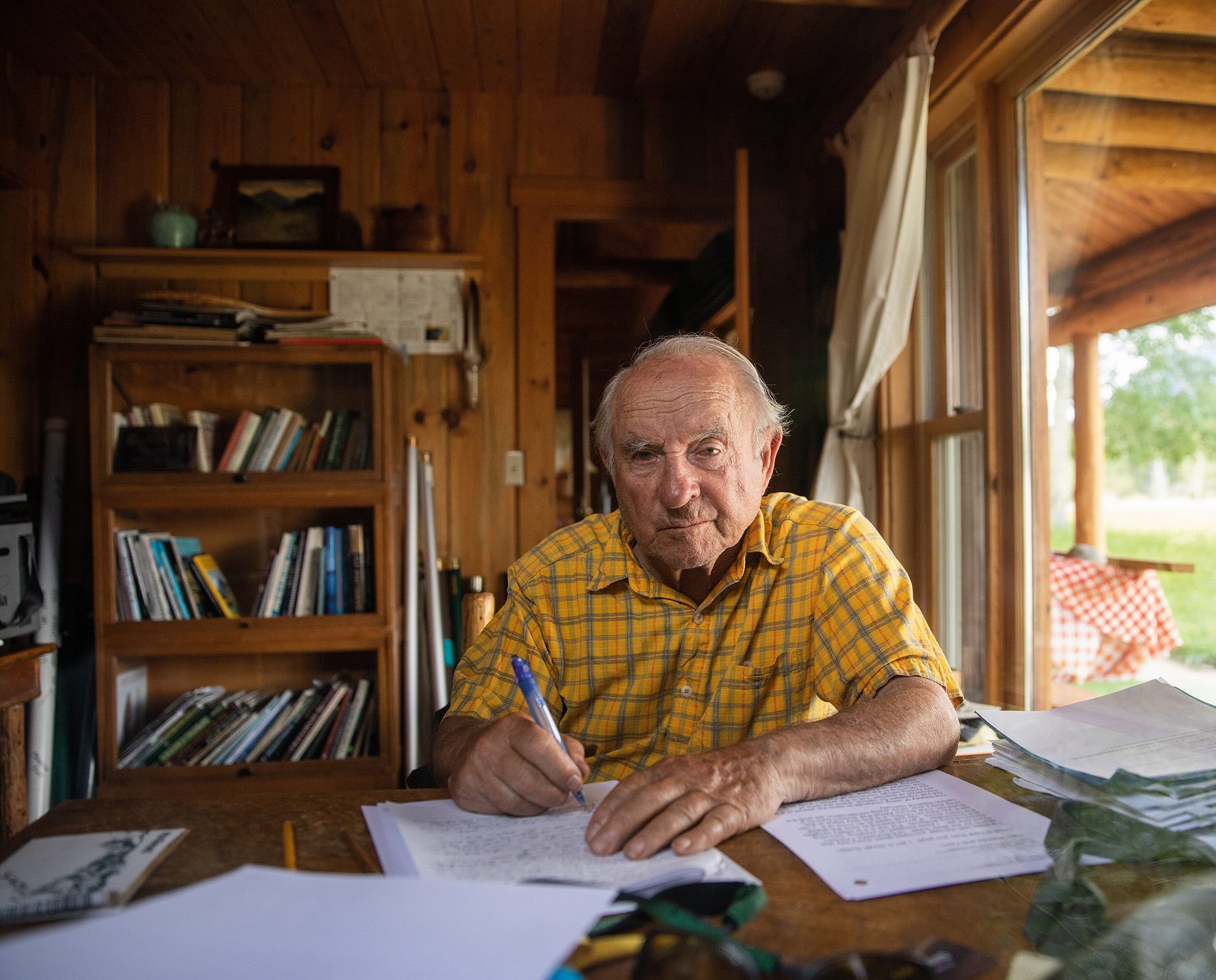
On the morning of September 14, 2022, Yvon Chouinard sat in a private office with his family and a small group of lawyers. The papers in front of him transferred 100% of the stock of Patagonia, the company he had built over fifty years, into two new structures. The Patagonia Purpose Trust received all of the voting stock, while the Hold Fast Collective received all of the non-voting stock, which carries 98% of the economic value of the company. The transfer was irrevocable, which means no future Chouinard can undo it, and no future Chouinard can extract the wealth.7
Excess profits from Patagonia, after reinvestment in the business, now flows to environmental causes through the Hold Fast Collective.8
In the public coverage of the transfer, the word that appeared most often was “donation” and a few outlets used “gift.” The Chouinards themselves used a different sentence. The letter Yvon published that day opened with the line: Earth is now our only shareholder.
That profound sentence describes a structural transfer from traditional shareholders. The company has moved into a regime that the surrounding system has no claim on, and the founder named what happened with deliberate precision. What most readers heard when the story broke in 2022, was a generous billionaire “giving away” his wealth before he passes. What actually happened was something the investment world still doesn’t have a word for. The papers moved a three-billion-dollar company across a threshold, into a structure the financial system cannot touch.
While I have no evidence to confirm this, I’m suggesting that Chouinard’s move was a structural exit from a coercive monetary system. Whether it was his intention or not, he’s provided a prototype to examine and implement.
Why a Threshold Guide Needs to Understand Transvestment
I get it. Money system discussions completely fry your brain. You and I are just ordinary citizens who don’t have the levels of wealth families like the Chouinard’s enjoy, so why should we concern ourselves with understanding complex financial concepts that make absolutely no sense, no matter how much anyone tries to explain?
The good news is that a Threshold Guide does not have to master the economics:
The legal mechanics that made Patagonia’s transvestment possible took specialist lawyers years to assemble.
The monetary system Webb describes runs on statutory amendments and trust law and the back-room machinery of central securities depositories, enough to fry anyone’s brains.
The constellation has governance protocols the average governance guru wouldn’t understand.
Each requires a lifetime of study, and you have your day-to-day life to deal with. The architects of this work are other people.
Your role is just to know that a shift is happening, including within the monetary system itself. Something that can’t quite be described is moving through all of the steep-curve systems that got us to this moment. The Patagonia transfer is one expression of it, and wealth holders who are starting to ask different questions are another. None of us generated this shift, and none of us will master it. The shift doesn’t need any of us to understand its architecture, or to force it in any particular direction. That role falls to forces beyond our comprehension.
What we are called to observe and amplify are the subtle signals we receive confirming the shift is underway:
Perhaps it’s that job you were turned down for.
Perhaps it’s not being able to find meaningful employment anywhere.
Perhaps you were rejected for a loan that would have helped you meet financial obligations.
Perhaps it’s an account you were trying to open and they rejected you, without any logical explanation.
These are all subtle signals of the steep-curve systems shutting down, and while the rejection may hurt, there is a greater wisdom unfolding.
What I’m suggesting is that a Threshold Guide is the person who can sit across the table from a wealth holder and say: You and I are both trapped inside this system. The architecture is hard on us in different ways. That’s the kind of conversation that can lead to the question of what to do next. And right now, wealth holders (at least those who are thinking deeply about these things) don’t know what to do next.
The only advice the financial advisory industry can offer the wealth holder is divestment. Sell the oil stocks and buy the ESG fund and adjust the portfolio toward companies with better disclosures. The wealth holder does these things and notices that nothing structurally changes. The asset moves from one position inside the system to another. The buyer is now where the seller was, and the system is unaffected by the swap.
What forward-thinking wealth holders are actually asking is whether there is anything they can do that removes their wealth from the system entirely. There is. It has a name and legal precedent and working examples, and it asks something of the wealth holder that existing financial advice doesn’t come close to addressing.
That is what the rest of this essay walks through. Again, it’s not necessary to understand all of the technical details, but knowing at least a little of what’s unfolding gives you a different perspective on any discussion about impact investing and the like.
Why Divestment Doesn’t Cut It
Divestment is a buy-sell decision.9 The owner of the asset sells and another buys. The asset simply changes hands. Inside the legal and financial regime that defines what the asset is, nothing has shifted. The asset is still a contractual claim on a stream of future income. It is still legally precarious in all the ways the modern monetary system makes contractual claims precarious. Phase 5 of the Coercion Continuum still applies to it. The new owner is now exposed to the same activations the previous owner was trying to step out of.
The oil company whose stock was sold is now owned by an investor who has no qualms about owning it. The fund that received the divestment dollars is still inside the system whose rules require continuous growth. The wealth that crossed from one account to another is still in the same regime of value. Value, in that regime, means price. Price is set by markets. Markets are governed by the same incentives that produced the conditions the wealth holder was trying to step away from.
Divestment is a moral gesture inside a system that responds only to economic incentives, not morals. Divestment isn’t a structural move.
To be fair, I’m not entirely dismissing divestment. Many people who have divested did so because it was the only move their advisors told them about. The intent was good, but the mechanism was inadequate. The work now is to find investment options that are adequate.
What Transvestment Actually Is
The word transvestment describes a transfer of capital out of one regime of value and into another.
How are the two regimes different?
In the first regime, the one that anyone with investments is familiar with, value means price. A thing is worth what someone will pay for it. The system that holds the things is the market. The legal architecture supporting the market is the architecture of private contractual claims. Most of what is called wealth lives inside this regime.
In the second regime, value means the generativity of living systems. A forest is worth the soil it builds, the water it holds, the carbon it sequesters, the community it sustains, and the generations it feeds. The system that holds the forest is the commons, and the legal architecture supporting the commons is the architecture of inalienable trust. A commons is held in such a way that it cannot be sold off, cannot be collateralized, and cannot be seized.
Transvestment is the act of moving wealth from the regime of price into a regime of generativity.
Bollier and Hulst put it this way: a transvestment is more than a money-making transaction. It is an affirmation of shared commitments to commoning, to bioregional markets, to a different theory of what value means. The money moves and the meaning moves with it.
This is why transvestment is structurally different from charity, philanthropy, and impact investing. Charity keeps the asset inside the first regime and uses some of its excess for socially approved purposes. Philanthropy does the same thing through institutional foundations. Impact investing tries to do well by doing good, which keeps the underlying value definition (return on investment) intact. All three of these are moves inside the first regime. None of them constitute crossing a threshold.
Transvestment is a crossing.
The Five Pathways to Cross a Financial Threshold
Five pathways have been worked out, in detail, for how the crossing can be made. Each accommodates a different kind of asset and a different level of commitment. The full architecture can be found in a longer thesis this essay summarizes.10 Here’s the brief version:
Land and productive assets can be transferred into a Bioregional Commons Trust that consists of farms, forests, buildings, and productive facilities. The trust holds the asset in perpetuity. The land is governed by stewards selected for competence, on ninety-nine-year renewable ground leases that mirror the long-running Community Land Trust model, legal in most countries.
Financial capital can capitalize the currency reserves of a Bioregional Financing Facility.11 The fiat money backs the issuance of a regenerative currency at full reserve during the establishment phase. As the bioregional economy strengthens, the reserve ratio can decrease, and the original capital can be gradually returned.
Patient capital can endow regenerative enterprises directly. Interest-free or below-market loans, repaid in the bioregional currency the enterprise operates with. The wealth holder receives a yield that has to be spent locally or gifted onward, which keeps the capital cycling through the commons.
Intergenerational vehicles can convert inheritance into commons endowment. Estate structures pass an income stream to heirs in bioregional currency, with the underlying capital held perpetually by the commons trust. The family retains material security and a meaningful position in the community. The wealth, as a private holding, ends.
The demurrage dividend is the slow-acting fifth pathway. Bioregional currencies carry demurrage, a small holding charge that recirculates back into the commons. A wealth holder who lives inside the bioregional economy contributes to the commons through the holding of currency itself, with no explicit transfer required.
The point of the list is that each option matches the actual situation of the person, the asset, and the bioregion. All of the legal architecture for transvestment already exists under current US and most Western nations law. This is how Patagonia was able to structure their investments the way they did.12
What the Crossing Means
In the old regime, the wealth holder’s relationship to the asset was one of ownership, which means the asset belongs to them. Their authority over its use was proportional to the size of their position. The board seat and the controlling stake were functions of how much they owned. So was the practical voice in how the company ran. Authority was purchased through accumulation.
In the new regime, the asset belongs to the commons. The wealth holder no longer owns it. Their authority over its use is no longer proportional to capital. It is proportional to membership in the community the commons serves. The Bioregional Commons Trust is run by stewards selected for competence. The bioregional political authority handles rights questions. The cultural sphere handles questions about what gets funded. The wealth holder participates as a community member, with a voice, with experience, with the standing earned over a lifetime of work. Authority has become a function of contribution.13
This is the threshold the person crosses. It is the part of transvestment that has nothing to do with money, and it’s usually the part the wealth holder finds most challenging. Why?
Most wealth holders have spent their adult lives operating inside a structure where capital and voice were the same thing. The amount of equity you held was the amount of voice you had. To relinquish the equity is to relinquish the voice. To trust that a different kind of voice will emerge on the other side, a voice earned through participation, requires a leap that the financial system never asked the person to make. The leap is real, the fear is real, and the grief is real, because something is being given up that was, in some way, a redefinition of self.
What the wealth holder becomes, on the other side, is what Stephen Jenkinson and Orland Bishop have called an elder.14 An elder is a person whose authority in the community is earned through wisdom, presence, contribution, and care. The elder has no equity stake. The elder has standing, and the standing is granted by the community and can be revoked by the community. The elder’s meaning comes from inside relationship, with all the constraints relationship carries.
This is the move transvestment requires. The investor becomes an elder, and the capital becomes community-held.
The wealth holder who completes this move discovers something the financial system couldn’t predict: the new position is more secure than the old one. The community embraces them, and the land that feeds them cannot be seized. The currency they spend cannot be inflated to nothing in a margin cascade. The healthcare they receive doesn’t depend on private health cover or a brokerage statement that might become illiquid overnight. Their grandchildren grow up inside a container that has a secure future.
The wealth holder’s privilege hasn’t ended, but it has changed shape in significant ways. It has become a privilege of membership in a living community. Instead of the numbers on the brokerage statement being the basis of safety, the relationships become the basis of their ongoing well-fare.
As a side note, I’m considering building a diagnostic and/or offering a service that explains the laws specific to your jurisdiction relevant to transvestment. Send me a DM if you’d like to find out more or would like to be placed on an early announcement list.
Not Charity, Philanthropy, or Impact Investing
Charity is excess from accumulation, deployed for good purposes. The accumulation continues and the structure remains unchanged. The excess does some good, but the wealth holder remains a wealth holder, and the system that produced the accumulation remains the system.
Philanthropy is institutionalized charity. A foundation is established, the foundation deploys excess, and the accumulation continues, often growing further under management. The structure again remains unchanged.
Impact investing seeks financial return alongside social or environmental return. The accumulation continues, and the structure remains unchanged. The metrics of success still include the financial return, which keeps the underlying value definition (price, growth, yield) intact.
All three continue our steep-curve systems. In other words, they are evolutionarily incoherent.
Transvestment ends the accumulation and builds a bridge to a gentle-curve system. The wealth moves into a structure that holds it on behalf of the commons in perpetuity. The wealth holder loses the position of being a wealth holder and gains an environment which honors them as an elder. The structure changes and the value regime changes entirely.
Most financial advisors don’t know how to talk about transvestment because the category itself makes no sense in their framework. They are trained inside the first value regime. The vocabulary they have for any move with the word “give” in it is the vocabulary of charity. They will tell the wealth holder to give carefully, to give tax-efficiently, or to give in a way that preserves the principal. Sure they’re offering advice that can’t be faulted, but it’s advice for a system that’s ending.
The Threshold Guide who can hold the conversation Framework 3 introduced is often more useful at this point than the financial advice. The guide can name what the wealth holder is actually asking. The question has moved past how to give well, toward how to step across the threshold.
The Unknowns
I have to be honest about the many uncertainties Framework 8 has to acknowledge. There are two main uncertainties:
First, the commons-side infrastructure is partial. Patagonia worked because the receiving structures were available: the Purpose Trust, the Hold Fast Collective, the Newman’s Own legal exemption, and the lawyers who knew how to draft the documents. For a wealth holder in most bioregions today, the equivalent receiving structures are partly built. The pioneers who cross now will help build what is still missing, and they will cross into something that is being assembled around them. This is real, and unavoidable. The earliest stewards of any commons architecture have always lived inside a half-finished building. It’s uncomfortable… and it’s also where meaningful construction actually happens.
Second, the psychological crossing is a real consideration. This essay assumes the wealth holder will arrive on the other side of the threshold intact and at peace. Some will, and some won’t. Those who have spent forty years inside a structure that defined them by their accumulation won’t always be able to release that definition. The architecture cannot do that work for them. The work has to be done by the person, with the help of those who love them, with the help of Guides (that’s you!) who can hold the conversation, and with the help of communities that can receive them. This architecture supports the work, but there is much inner work required before a candidate transvestor can fully cross the threshold.
Both uncertainties are an integral part of navigating the Decade of Dramatic Disruption. I can’t pretend that this work is easy, and it certainly isn’t for everyone. But there is a pathway through the threshold.
That’s all for this week.
Next week, we’ll cover Framework 9, The Alpha Window, which is a window of opportunity that opens after a systemic shock. Think of a forest fire. After the fire, sunlight reaches the forest floor and seeds that couldn’t germinate before suddenly can. But the window doesn’t stay open indefinitely. I’ll walk through what the Alpha Window is, how it directly affects transvestment, and what it asks of those willing to step through the window.
Remember to love the ones you’re with, and frame on!
Michael 💚
Mahatma Gandhi criticized charity to the poor by stating that misplaced charity adds nothing to the wealth of the country, whether material or spiritual, and gives a false sense of meritoriousness to the donor. The same applies to any form of impact investing.
From Gandhi: “Take what you require for your legitimate needs, and use the remainder for society. This truth has hitherto not been acted upon; but, if the moneyed classes do not even act on it in these times of stress, they will remain the slaves of their riches and passions and, consequently, of those who overpower them.” (Excerpt from Chapter 38 of The Mind of Mahatma Gandhi. Note that this is the basis of the Emancipation Architecture: a mechanism to free everyone, rich and poor, from a coercive monetary system.)
David Rogers Webb, The Great Taking (2023), is self-published and available at no cost at https://thegreattaking.com. The book traces the legal redefinition of securities ownership across OECD jurisdictions, including the 1994 Article 8 amendments to the US Uniform Commercial Code that reclassified securities holders as general unsecured creditors. The structural argument is technical and the documentation is dense. Recommended reading for any wealth holder before they make a decision about anything else in this series. Just be aware that the framing of the book is conspiratorial, which is a shame. The position I take with Framer OS is to avoid all conspiratorial claims. Rather, this is simply how systems operate in (all) late-stage, class-based civilizations, no conspiracy required.
I prepared a report in late March 2026 that explained how this unfolds with Hormuz as the trigger. You can access the PDF here.
As a reminder, when I use the term ‘elite class,’ I’m not referring to any form of conspiratorial framing. The emergence of an elite class is a standard feature of late stage class-based societies. For a deeper dive, see Elite Overproduction, a concept developed by Peter Turchin. It describes the condition of a society which is producing too many potential power elites relative to its ability to absorb them into the power structure. Intense competition between the elites creates rivalry and hubris, which often combine to cause the downfall of a society. See https://bit.ly/Elite-Over
Auken’s essay was originally published on the WEF website in November 2016. It was later retitled and eventually removed from the WEF site after the “you’ll own nothing and be happy” meme had spread globally. The original is preserved on the Wayback Machine at https://web.archive.org/web/20161125135500/https://www.weforum.org/agenda/2016/11/shopping-i-can-t-really-remember-what-that-is. Auken has since clarified that she intended the piece as speculative scenario rather than as policy advocacy. Regardless of authorial intent, her essay is a worthwhile cultural shorthand for what Webb documents in legal architecture in his book, The Great Taking (see footnote 2).
Transvestment is the structured, voluntary conversion of capital from extractive financial forms into regenerative commons wealth, crossing between value regimes rather than seeking return within the same regime. The term was developed by Michel Bauwens within the P2P Foundation literature and refined by David Bollier and Natasha Hulst in their 2025 essay on relationalized finance, with a PDF available here. David Bollier is the leading contemporary writer on commoning; his books Think Like a Commoner (2014) and Free, Fair and Alive (with Silke Helfrich, 2019) are good entry points. I go further in this essay to suggest the removal of capital from a fiat monetary system into a bioregional regenerative monetary system.
You can find the official announcement here: https://www.patagoniaworks.com/press/2022/9/14/patagonias-next-chapter-earth-is-now-our-only-shareholder
See the initial letter and subsequent updates here: https://www.patagonia.com/ownership/
Divestment is the practice of selling holdings in companies the seller considers harmful. Fossil fuel divestment by universities and pension funds is the best-known recent example. The asset moves to a different owner, and the company continues to operate. The seller might feel a moral superiority, but nothing structural has changed.
The full pathway architecture, with legal structures, governance mechanisms, and tax treatment for each pathway, can be found in Part III of the longer manuscript this series draws on. The essay version compresses the architecture to a paragraph per pathway. If you’d like the operator-level detail, you can find it here (Google doc).
Discussed in detail in Samantha Power and Leon Seefeld’s book, Bioregional Financing Facilities, available here: https://bit.ly/BFF-Power
The Bipartisan Budget Act of 2018 added §4943(g), the “Newman’s Own exemption,” which permits 100% ownership when defined conditions are met. The Chouinards used a 501(c)(4) social welfare organization, which is a slightly different legal pathway, but the cumulative effect of the Newman’s Own precedent was to establish that mission-locked ownership of operating companies was both viable and explicitly sanctioned in US law. For the statutory text, see https://www.law.cornell.edu/uscode/text/26/4943
The governance separation referenced here draws on Rudolf Steiner’s Threefold Social Organism: the economic sphere governed by competence, the rights sphere governed democratically, and the cultural sphere governed by individual initiative recognized by the community. The steep-curve system collapses all three into the economic sphere and the claim is that this separation needs to be restored. The practical consequence for the transvestor is that capital contribution doesn’t purchase a board seat. The capital crosses into a governance structure designed so that no single actor, including the donor, can capture it.
Stephen Jenkinson’s Come of Age: The Case for Elderhood in a Time of Trouble (2018 https://www.amazon.com/dp/1623172098) and Orland Bishop’s work on Sawubona and the recovery of elder practice both inform the use of the word “elder” in this essay. The elder framework is also developed across Indigenous knowledge traditions, including work by Robin Wall Kimmerer, Tyson Yunkaporta, and others. The word “elder” in this essay doesn’t mean “older person.” It means a person whose authority is granted by a community and held inside relationship.
Michael, I want to reinforce a comment you make in footnote 2, a comment that I think merits more visibility. It's about the book The Great Taking, by David Rogers Webb. You mentioned this book in an earlier essay, and I downloaded it and read most of it in one sitting. I don't recommend that approach; it was too much to swallow all at once.
I found the book hard to finish, not because it was so dense and technical -- I welcomed that -- but because Webb scared the daylights out of me! The facts are scary enough without Webb's conspiratorial framing. Which brings me to footnote 2, where you state: "Just be aware that the framing of the book is conspiratorial, which is a shame." I agree on both points. I'm finding that it's very important for me to stop myself from any tendency toward conspiracy thinking, blaming, or 'othering' as I try to face what's happening in the world.
A relational translation for why monetary value and natural value differ so much:
Monetary value is abstracted value. It asks us to treat value as price, rather than relationship. It often lets us move quickly by skipping the slower processes that living systems use to build trust: reciprocity, care, community, shared purpose - the dancing beforehand.
Natural value is lived/relational value. It is experienced through satisfaction, connection, nourishment, beauty, love, and continuity. That is what builds trust, community, and purpose.
Money can coordinate action, but it can also strip value out of its living context. It may be efficient, but it is less alive than doing meaningful tasks with friends.
Maybe that is part of the sadness: money has become so inflated as a measure of value that many people now lack the enrichment of community because they are trapped in scarcity.
If this interpretation is useful enough to carry forward, please credit me.