


So you’re one of the few who have accepted that we’re navigating a civilizational decline.
Getting to the point of acknowledging that the runaway train cannot be stopped has been a rough personal journey for you. You faced sleepless nights of denial, anger, resistance, and depression. You spent hours and hours consuming more and more information, looking for that needle in the haystack that tells you EGBOK — Everything’s Gonna Be OK. Finally, reluctantly, you reached the point of acceptance.1
And now you’re in some variation of two camps:
You sense you have something to contribute, but because you can’t name it, you feel helpless and hopeless, or;
You’ve found something that numbs the pain and you’ve thrown all your efforts into it. It gives you a sense of purpose and meaning because it answers — at least for now — the question, “What do we do?”
I’m willing to bet that throughout this challenging journey, you’ve been bumbling along without the one thing that matters most: a clearly articulated worldview.
You mistake having opinions about capitalism, climate, COVID, and collapse for having a framework. You confuse the feeling of conviction with the achievement of coherence. And when crisis arrives you discover that the people you assumed shared your values actually inhabited entirely different interpretive universes.
And it’s not just you. Everyone is struggling to form a coherent picture of what is unfolding.
This pattern of an incoherent citizenry has repeated across every major civilizational transition in recorded history, from the fall of Rome to the collapse of the Soviet Union. The lesson is consistent and unforgiving: societies collapse when people’s unarticulated beliefs turn out to be mutually incompatible, and no one discovers this until the crisis makes coordinated action impossible.2
Understanding why this incoherence is a hallmark of late-stage civilization, and why the antidote is conscious worldview articulation, is perhaps the most urgent intellectual task of our current moment.3 That’s what this essay addresses. It’s long. I’ve kept it as clear as I can. And I’ve written it knowing that most people will stop reading before the end. That’s fine. This isn’t for most people.
If you’ve spent even a short time looking at the meta-studies in Collapsology, you’ll spot an undeniable pattern.4 This pattern is so consistent it functions almost as a law: in every late-stage society, the citizenry who believe they are united against a common cause discover under pressure that their shared vocabulary hides irreconcilable differences. When that happens, meaning and coherence crumble and the social contract — the unwritten worldview that maintains cohesion — rips apart.
Let’s look at a few examples.
Rome in 410 AD
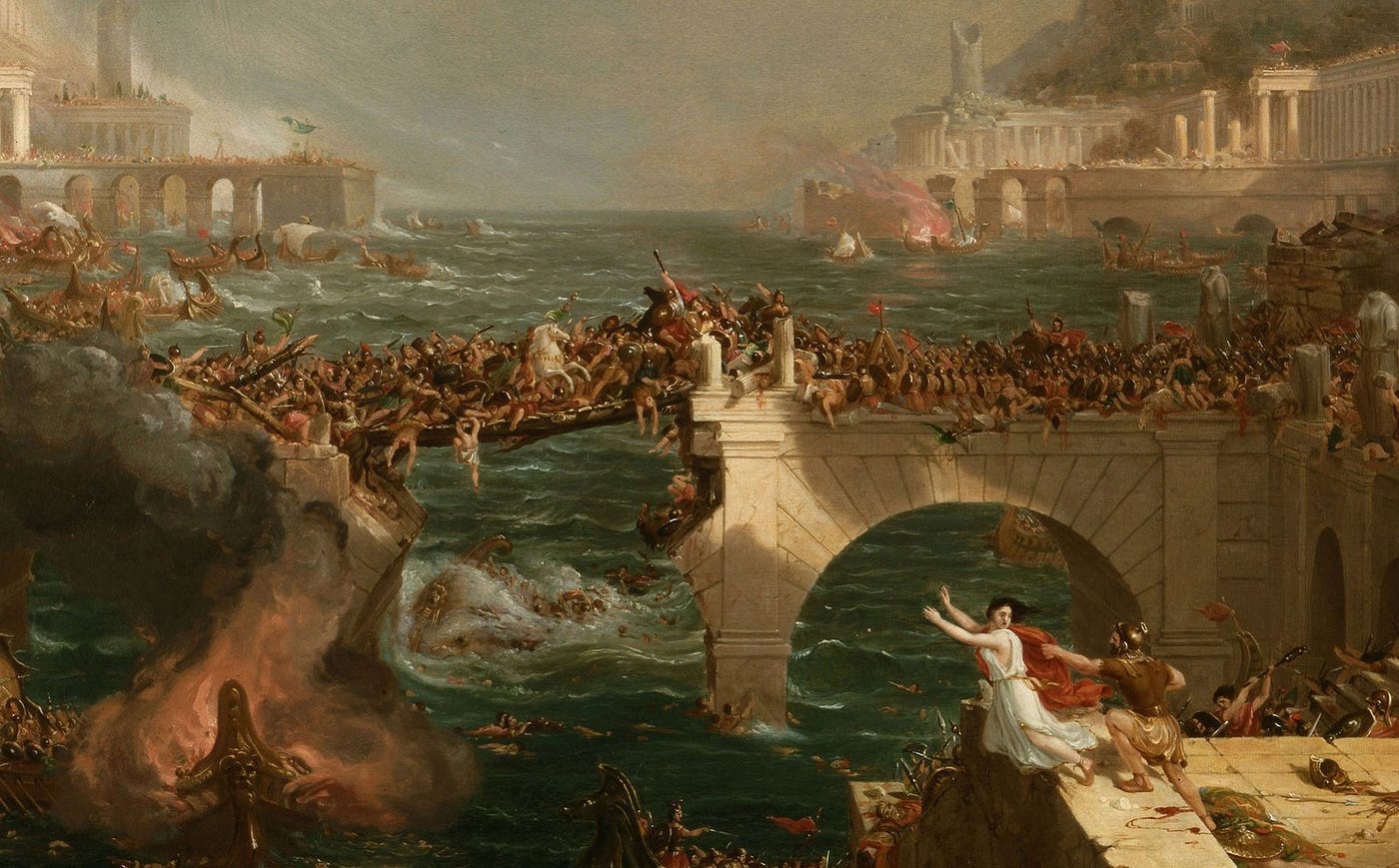
When Alaric’s Visigoths sacked Rome on August 24, 410 AD, the event triggered a military crisis in the already strained administration.5 But far more than the bureaucratic crisis, the invasion triggered a worldview crisis among Roman citizens. Pagans blamed Christians for abandoning the gods who had made Rome great. Christians had believed that Rome’s conversion from paganism represented God’s triumph in history. Their worldview crumbled with the invasion. Their triumphalist framework became suddenly worthless and untenable.
Augustine spent fourteen years writing The City of God to address the resulting confusion, telling pagans their gods never protected Rome while telling Christians that a ‘Christian’ empire was never the same thing as the Kingdom of God. Meanwhile, the Stoic tradition insisted Rome could be sustained through philosophical virtue. Everyone was defending ‘Rome.’ Everyone meant something different.
The 1529 Marburg Colloquy
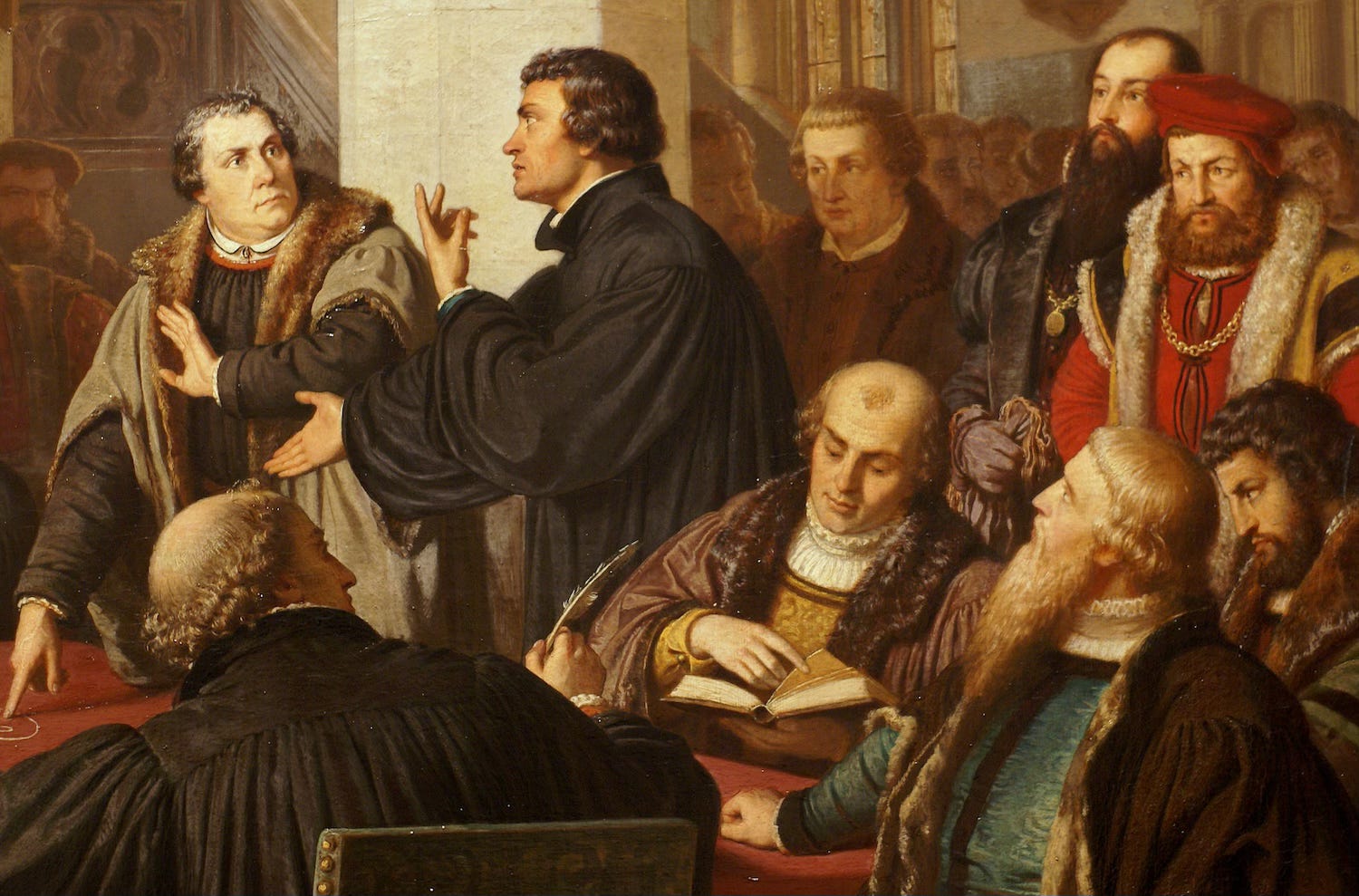
The Reformation exposed a similar clash of worldviews. Martin Luther (German) and Huldrych Zwingli (Swiss) were allies against Catholicism. They’d spent two years refining their thesis and had reached a point of agreement on fourteen of fifteen doctrinal points, disagreeing only on the Lord’s Supper. They were invited by Philip of Hesse, a prominent German noble and supporter of the Protestant Reformation, to reach agreement at the 1529 Marburg Colloquy. Even though both men vehemently rejected papal authority, they failed to unite. It was there that they discovered their disagreement over the Eucharist was an ontological chasm.6
Luther reportedly carved “THIS IS MY BODY” into the table, words still used in many communion services today. Zwingli wept at the impasse. Luther’s devastating verdict was that “We are not of the same spirit.”
The root cause of the breakdown was incompatible intellectual worldviews. Zwingli’s Renaissance humanism elevated the spiritual over the material, while Luther retained a medieval incarnational worldview. Both men studied the same Bible, they both had the same faith, and yet they were operating from entirely different universes.
Two years later, Catholic forces attacked Zurich with seven thousand soldiers, calculating — correctly — that the Lutheran princes would never defend a man Luther had refused to recognize as a fellow Christian. Zwingli was killed on the battlefield. His body was quartered and burned. Luther called it God’s judgment.
A single worldview divergence, over a single phrase, had fractured the only alliance that could have brought Protestants together. The schism eventually hardened into two permanent Protestant confessions — Lutheran and Reformed — a division that has lasted nearly 500 years.
Weimar Germany 1930s
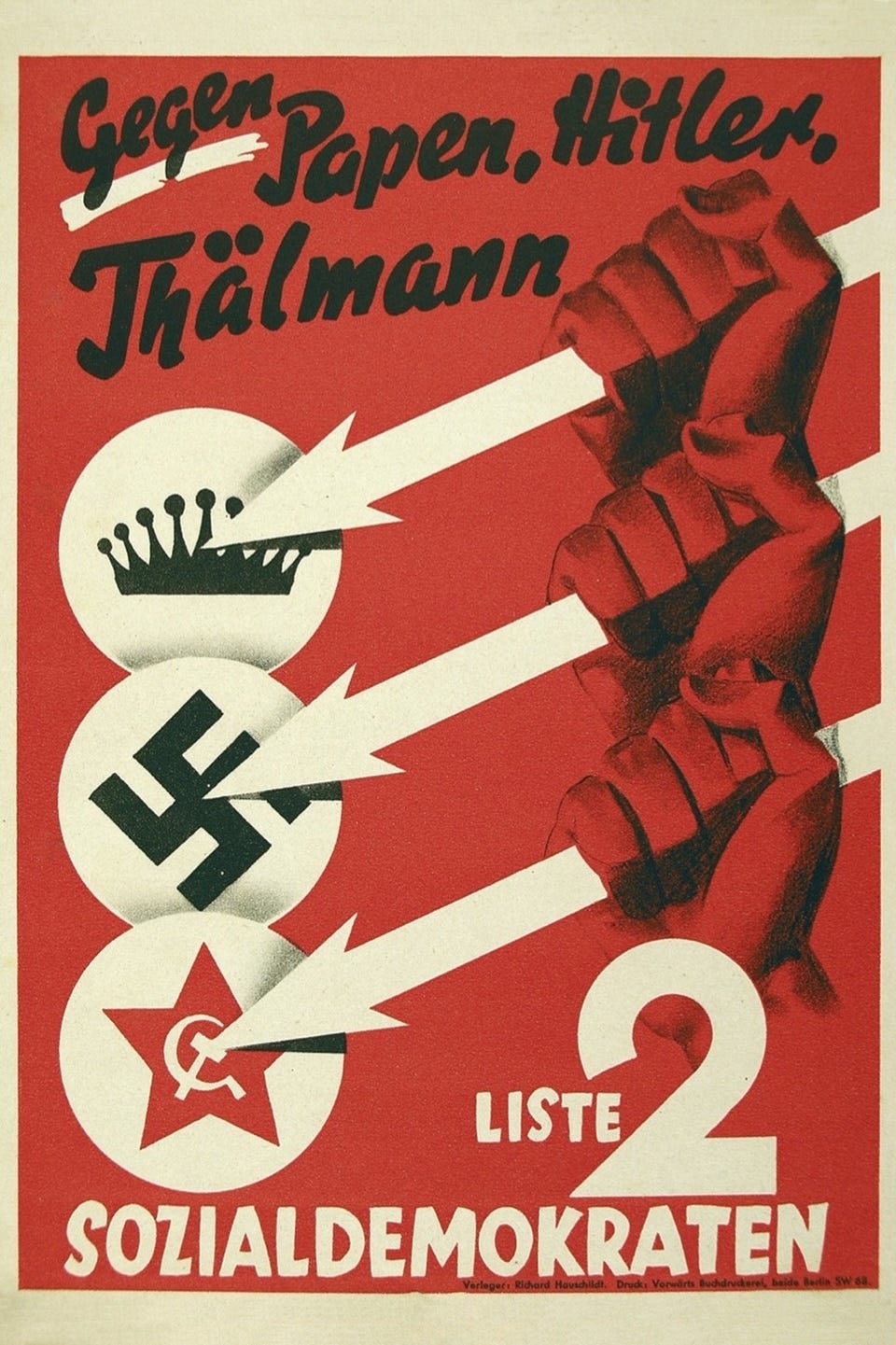
In Weimar Germany, the working class itself fractured along worldview lines. The Social Democrats (SPD) and Communists (KPD) shared Marxist vocabulary and class identity, but the KPD adopted Stalin’s “social fascism” doctrine, declaring that “fighting fascism means fighting the SPD just as much as it means fighting Hitler.”7
In the last free elections of November 1932, the two parties together received 1.5 million more votes than the Nazis. Their worldview incompatibility made coordination impossible and both parties lost the election. The consequences need no elaboration.
Dissolution of the USSR, 1991
Perhaps the most intimate documentation of worldview collapse comes from Svetlana Alexievich’s Secondhand Time, which chronicles the USSR’s dissolution through hundreds of oral histories.

One passage captures the essence:
“No one had taught us how to be free. We had only ever been taught how to die for freedom.”
For seventy years, ‘freedom’ had been an abstraction. It was something to die for, never a way to live. When the Soviet Union collapsed and freedom arrived as a practical reality, nobody agreed on what it actually meant.
Former party officials expressed paradoxical nostalgia:
“Socialism isn’t just labour camps, informants, and the Iron Curtain, it’s also a bright, just world.”
Post-Soviet Russia fragmented into democratic liberals, nostalgic communists, nationalist imperialists, religious revivalists, and cynical materialists. All of them claimed to represent ‘Russia,’ but over time they all discovered they meant completely different things.
What I hope these historical examples have shown is that shared vocabulary and even a common enemy often mask divergent worldviews and these differences can lead to significant schisms. Crisis forces people to act on what they believe — and that’s when they discover that former allies were never aligned in the first place. Ultimately, the moderate center is crushed between polarizing extremes whose existence nobody anticipated.
Let’s now turn to present-day examples.
COVID
The outbreak in 2020–2022 turned out to be the most comprehensive worldview stress test in modern history. A Pew Research Center survey found that 81% of Americans said their country became more divided during the pandemic.8 What I found fascinating about those two years is that COVID made visible existing worldview incompatibilities that had previously been largely invisible.
Alternative health practitioners were deeply divided about bodily sovereignty — the long-standing wellness community assumption that ‘your body knows better than any doctor’ and ‘only you know what’s best for your health.’ For decades, this framework coexisted comfortably with mainstream medicine. COVID forced a choice between individual bodily autonomy and collective public health. It revealed that people who had participated in — for example — yoga side-by-side for years held fundamentally incompatible views about the relationship between individual and society.
Religious communities fractured along the same invisible fault lines. Barna Group data showed pastors considering leaving ministry surging from 29% in January 2021 to 42% by March 2022, with 38% citing divisions within the church.9 Despite consistent pro-vaccine guidance from top leadership, 19% of members flatly refused the vaccine. The pandemic exposed that deeply held values of ‘obedience to authority’ and ‘individual liberty’ had never been reconciled into a coherent framework.
Political divides morphed into ‘diagonalism’ — movements that cut across the left-right spectrum entirely.10 Germany’s Querdenken (lateral thinking) movement united hippies, antiwar activists, libertarians, constitutional loyalists, anti-state monarchists, neo-Nazis, alternative medicine practitioners, anti-vaccination campaigners, and apolitical left-liberals. The real dividing line became a cluster of deeper orientations: trust in institutions versus anti-institutionalism, individual sovereignty versus collective obligation, and competing answers to the question of who has the authority to define truth.
A study in the Journal of Prevention confirmed these divides empirically. Two worldview orientations — hierarchy and individualism — predicted COVID risk perceptions more powerfully than party affiliation.11 A PLOS ONE study found that after accounting for preexisting ‘ontologies of distrust,’ political affiliation per se was not a reliable predictor of COVID skepticism.12 The real drivers were deeper worldview structures that political labels had obscured.
Politics
The illusion that political agreement implies worldview alignment is perhaps the most dangerous form of this worldview articulation gap. Research consistently demonstrates that people within the same political coalition hold views about human nature, authority, and meaning that are widely different, often irreconcilable.
The Brookings Institution and PRRI documented what they called an ‘unbridgeable divide’ within the Republican coalition.13 On physician-assisted suicide, 72% of libertarians favor it while 70% of white evangelicals oppose it. On abortion, 57% of libertarians oppose making it more difficult while 68% of white evangelicals favor restrictions. Only 53% of libertarians describe religion as important in their lives versus 94% of white evangelicals.
As you can see, these aren’t minor disagreements amenable to compromise. They reflect fundamentally different views about whether individuals are sovereign agents whose freedom of choice is paramount, or creatures under divine authority whose choices are bounded by moral law.
The progressive coalition contains equally fundamental fractures. The split between ‘green growth’ and ‘degrowth’ advocates reflects irreconcilable cosmologies about capitalism, human nature, and what progress means. Techno-optimists believe economic growth and environmental sustainability can be achieved through innovation; degrowth advocates believe infinite growth on a finite planet is a logical impossibility. Identity-politics advocates and class-first leftists diverge on whether race or class is the primary axis of oppression. These questions have no empirical resolution because the answer depends on what you already believe injustice is — and that belief was never chosen consciously.14
Academia
The most devastating academic challenge to the assumption of worldview coherence within political coalitions comes from Pinsof, Sears, and Haselton’s Alliance Theory (2023), published in Psychological Inquiry.15 Their core argument is:
“Political belief systems are not so much ‘philosophies’ as collections of ad hoc justifications, rationalizations, moralizations, embellishments, and rhetorical tactics designed to advance the interests of complex political alliances.”
Moral principles are ‘not so principled.’ Core values are ‘not so core.’ Ideological worldviews are not designed to literally view the world but to serve strategic functions like signaling allegiance or mobilizing support.
If all this is correct — and the evidence is strong — then what people call their ‘political worldview’ is actually a post hoc rationalization of tribal allegiance, rather than a coherent interpretive framework at all.
Jonathan Haidt’s Moral Foundations Theory is useful in understanding how this all works.16 Different moral foundations — care, equality, proportionality, loyalty, authority, purity — can produce identical policy preferences through entirely different reasoning chains. A conservative might oppose welfare because of proportionality (people should earn their rewards), while another opposes it through authority (the church, not the state, should care for the poor). Both individuals cast exactly the same vote, but they have widely incompatible worldviews.
How’s this all linked to the metacrisis?
As we’ve seen, one of the hallmarks of late-stage societies is worldview fragmentation. This occurs in societies where citizens have high degrees of free choice. However, there is an added complication in authoritarian regimes, and that is this: manufactured ideological conformity is the antithesis of genuine worldview coherence, rather than a substitute for it.
What do I mean?
One of my favorite essays to shed light on this is Václav Havel’s 1978 writing The Power of the Powerless.17 In it he provides a perfect example of manufactured worldview compliance. He tells a parable of the greengrocer who displays the sign “Workers of the world, unite!” in his shop window.
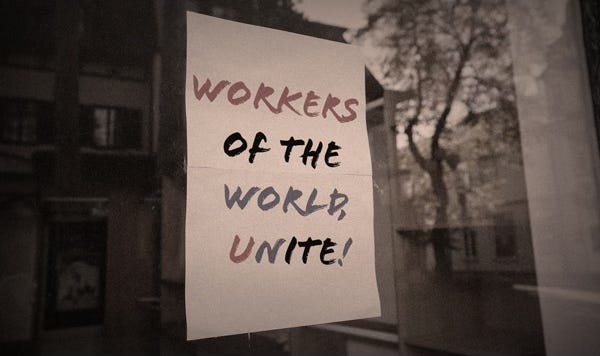
He then explains that the sign’s real meaning is
“I, the greengrocer, live here and I know what I must do. I am obedient and therefore I have the right to be left in peace.”
The ideology serves as “a bridge of excuses between the system and the individual,” offering “human beings the illusion of an identity, of dignity, and of morality while making it easier for them to part with them.” Everyone participates in maintaining appearances, and no individual feels responsible.
Alexei Yurchak’s concept of ‘hypernormalization,’ developed from his study of late Soviet society, describes the terminal stage of this process.18 This is when the state’s ideological system “had become hollow and disbelieved by nearly everyone, including the leaders themselves, but still functioned as if it were real.” Soviet citizens practiced what Yurchak called being vnye — literally ‘outside’ — maintaining internal psychological distance from the system while participating in its rituals. The language itself became ‘hypernormalized, which means “fixed and cumbersome forms” that were “often neither interpreted nor easily interpretable.”19
The quote commonly attributed to Solzhenitsyn captures it beautifully:
“We know they are lying, they know they are lying, they know we know they are lying, we know they know we know they are lying, but they are still lying.”
Hannah Arendt identified the ultimate goal of this process in her most devastating single sentence:
“The aim of totalitarian education has never been to instill convictions but to destroy the capacity to form any.”
The ideal totalitarian subject “is not the convinced Nazi or the convinced Communist, but people for whom the distinction between fact and fiction and the distinction between true and false no longer exist.”20
The aim of totalitarianism is not primarily to install a particular worldview. Totalitarianism aims to destroy the conditions under which any genuine worldview formation is possible. Arendt referred to this as ‘thinking,’ which requires both solitude for reflection and community for reality-testing.
Martin Seligman’s learned helplessness research shows clearly the psychological mechanism underpinning worldviews that form during totalitarianism. Sustained powerlessness erodes the very capacity to imagine taking action.21 When people interpret negative events as permanent, personal, and pervasive — the three attributional dimensions of helplessness — they cease forming independent judgments.
Researcher Eszter Nova argues that fear alone is insufficient to produce authoritarian compliance:
“…in order to trigger or catalyze a relapse into unfree thinking it must be paired with the sense of helplessness.” 22
The most insidious application is the internalization of censorship, or self-censorship. A Stanford/American Economic Review study found that when Chinese students were given free VPN access to bypass the Great Firewall, many chose not to use it.23 It’s not that they were fearful of what might happen. They refrained from bypassing the Great Firewall because they “underestimated the value of such censored information.” External constraints had become internal ones.
Which brings me to the main point of this lengthy essay (thank you for sticking with me).
Manufactured worldviews are characterized by external conformity without internal conviction, ritualistic repetition detached from meaning, and fragmentation of identity between public persona and private self.
Genuine worldview coherence requires integration of beliefs, values, and actions; capacity for critical self-examination; ability to articulate reasons for one’s positions; and alignment between public expression and private conviction.
Havel called this “living within the truth” in his essay, The Power of the Powerless. What he was referring to is something more radical than dissent or protest. It is the discovery that you have an inner world that no regime, no algorithm, no cultural consensus has the right to tarnish. Freedom, in this sense, has nothing to do with what you are permitted to do. It has everything to do with whether the thoughts you think are actually yours — or whether they were installed so seamlessly that you mistake compliance for conviction.
Compliance is the water we swim in
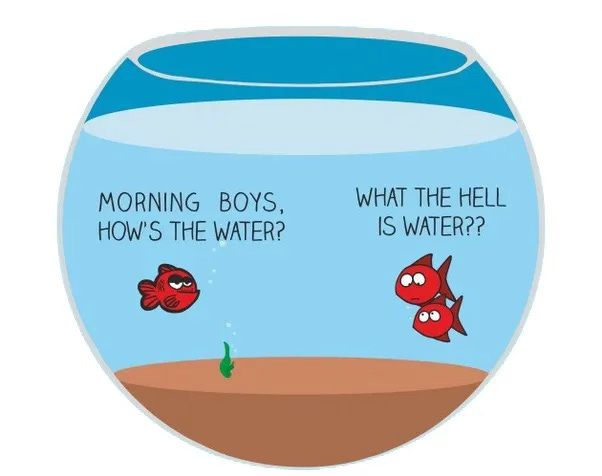
Havel’s greengrocer lived under an obvious regime. The sign in the window was required. The performance was visible to everyone, including the performer.
What makes our moment more dangerous is that the compliance is invisible. I don’t mean hidden in some conspiratorial way. It’s ‘hidden’ because it arrives dressed as common sense, public health, or planetary survival.
Consider a sequence of events that, taken individually, most reasonable people accepted without much examination. In 2020, governments worldwide imposed vaccine mandates and health passes that determined where citizens could eat, work, travel, and gather. The justification was public health. The mechanism was digital verification of personal medical status. Sounds reasonable, but just five years earlier the mandates would have been unthinkable in any liberal democracy. Most people complied. Those who resisted were dismissed as conspiracy theorists. Almost nobody on either side examined the worldview beneath their response.
The compliant assumed that the state has legitimate authority over collective health decisions; experts should determine policy; individual sacrifice for collective safety is a reasonable trade.
The resistant assumed that bodily autonomy is inviolable; institutional authority is inherently suspect; compliance with one mandate creates precedent for the next.
Both positions contain coherent logic, but neither side could articulate why they held theirs — which means neither side could distinguish their reasoned position from their emotional reflex.
Now extend the pattern.
Across the UK and Europe, urban planners are restructuring cities into ‘15-minute neighborhoods.’ These are zones where residents can access daily needs within a short walk. The stated purpose is sustainability and quality of life. Critics see something else: the infrastructure for restricting movement, enforced through traffic filters, surveillance cameras, and fines. The trial scheme in Oxford, UK provoked protests and the physical destruction of cameras. Proponents called the resistance paranoid. Opponents called the scheme a Trojan horse. What almost no one did was examine the worldview gap beneath the disagreement: one side holds that collective planning for sustainability justifies restructuring how people move through space; the other holds that any infrastructure capable of restricting movement will eventually be used to restrict movement, regardless of its stated purpose. This is a further example of incompatible assumptions about the nature of institutional power.
China’s Social Credit System makes the implicit explicit. Citizens are scored on financial reliability, social behaviour, and political compliance. High scores unlock privileges; low scores restrict travel, education, and employment. Most Westerners recoil at this. But the distance between social credit and the systems already operating in liberal democracies is shorter than most want to admit. Insurance premiums adjusted by wearable health data. Employment screened by social media history. Financial services denied based on algorithmic risk profiles. ESG scores that determine which companies can access capital. The behavioral compliance we have in the West is identical to China. However, behavior is manipulated through access to services, enforced by corporate actors rather than centralized in the state, which makes it simultaneously less visible and less accountable.
Changes in climate have become perhaps the most potent compliance framework of all. The invocation of existential threat creates a moral environment in which questioning any proposed response becomes indistinguishable from denying the problem itself.
Suggest that net-zero timelines might destabilize energy grids in developing nations and you’re a climate denier.
Question whether carbon credit markets are a financialization of the atmosphere that primarily benefits the institutions that created the crisis and you’re obstructing progress.
Ask who profits from the particular version of a ‘Just Energy Transition’ being implemented and you’re siding with the fossil fuel industry.
The pattern is certainly not unique to climate. You’ll see the same thing occurring wherever an existential frame is used to collapse the space between agreeing that a problem exists and accepting a specific solution without examination.
The uncomfortable thread connecting all of these examples is this: the framework that determines your compliance or resistance is one you inherited, not one you constructed. The person who trusts public health mandates ‘because science’ and the person who rejects them ‘because freedom’ are both operating from worldviews they absorbed rather than built. The person who welcomes 15-minute cities ‘because sustainability’ and the person who opposes them ‘because surveillance’ have both skipped the step of examining the deeper assumptions that generate their certainty.
I’m not for a minute making an argument that any particular position is wrong. I’m making visible an observation that almost nobody holds their position consciously. The worldview doing the work has never been surfaced, examined, or stress-tested against alternatives. Which means that when the next compliance framework arrives — and it will — you will react from the same unexamined place, mistaking reflex for reasoning and calling it conviction.
Your worldview is your lifeboat
I’ve argued that the absence of a consciously constructed worldview is detrimental.
The case for having a worldview that one can articulate is just as strong.
Viktor Frankl’s observations in Nazi concentration camps provide the most direct evidence. His central finding was that those who could articulate a sense of purpose survived at higher rates than those who could not, regardless of external circumstances.
Frankl documented a devastating natural experiment. During the week between Christmas 1944 and New Year’s 1945, camp death rates spiked beyond all previous experience. The cause wasn’t harsher conditions, worse food, or new epidemics. The majority of prisoners who died during this period lived with the naive hope of being home by Christmas. When that framework collapsed, death followed. An articulated worldview — even a false one like ‘I’ll be home by Christmas’ — functioned as the individual’s lifeboat. When it shattered, bodies followed minds.24
Communities that survived major societal upheavals confirm the pattern at collective scale. Irish monasteries during the Dark Ages went to great lengths to preserve manuscripts, but they went even further. They organized entire communities around an explicitly articulated Christian worldview that provided a reason for preservation work, a communal structure for daily life, a sense of mission transcending individual survival, and a framework for incorporating both pagan classical knowledge and Christian teaching.25 The disciples of St. Columbanus alone established more than 100 monasteries across continental Europe. The Carolingian Renaissance was made possible by their labor.26 The Benedictine Rule — summarized as Ora et Labora (Pray and Work) — sustained communities for over 1,500 continuous years through its subtle balance between prayer and work, solitude and community, obedience and inner freedom.27 The power of the shared worldview lay in its explicitness. Everyone shared a comprehensive directory for governance and well-being that could be transmitted, examined, and adapted.
The Jewish diaspora represents approximately 2,000 years of maintained cultural and religious identity despite exile, persecution, and geographic dispersion. Academic research identifies the key resilience factors as strong organizational structures, comprehensive education systems, maintained liturgical language, and the concept of Kehillah (community) providing mutual support.28 All of these are expressions of an explicitly articulated worldview embedded in daily practice. Where do we have an equivalent in Western nations today?
Peter Turchin has borrowed the concept of asabiyyah from Ibn Khaldun’s 14th-century sociology to provide a civilizational-scale framework. Asabiyyah is the social cohesion and collective solidarity that holds societies together: ‘the ability of group members to stick together, to cooperate.’29 Turchin’s research shows that empires rise when groups attain high asabiyyah, and decline when internal competition replaces cooperation. His 2010 prediction that the 2020s would bring significant social unrest, based on quantified measures of declining asabiyyah, has been substantially confirmed.30 What this tells me is that fragmented worldviews aren’t a symptom of civilizational decline. They are the very means by which decline sets in.
Why you probably don’t have the worldview you think you have
This work has led me to the uncomfortable conclusion that most people who believe they possess a coherent worldview have never actually articulated one. They mistake having opinions for having a framework, and the cognitive mechanisms that produce this gap are well-documented.
Michael Polanyi’s distinction between tacit and explicit knowledge — “we can know more than we can tell” — applies directly to worldviews.31 The framework through which you interpret reality operates like facial recognition: you use it constantly but cannot explain how it works. Chris Argyris and Donald Schön sharpened this into the distinction between ‘espoused theories’ (what people say they believe) and ‘theories-in-use’ (the tacit mental maps that actually govern behavior).32 The gap between these two is enormous and usually invisible to the person holding both.
Lee Ross’ concept of ‘naive realism’ explains why this invisible gap persists.33 People systematically believe they see the world ‘as it is’ rather than through an interpretive lens. Ross identified three tenets: people believe they see objectively; they expect rational others to agree; and they assume disagreement signals ignorance, irrationality, or bias. If you believe your perception is reality, you don’t have ‘a worldview,’ you simply have ‘the truth.’ The very concept of possessing a worldview implies that your view is one among possible others, which naive realism makes psychologically invisible. The related ‘bias blind spot’ (Pronin, Lin, and Ross, 2002) compounds the problem: people can recognize that others are shaped by experiences and dogmas but are ‘far less adept at recognizing the influence our own experiences and dogmas have on ourselves.’34
The most powerful experimental evidence comes from Rozenblit and Keil’s work on the ‘Illusion of Explanatory Depth.’35 People consistently overestimate how well they understand complex systems. They rate their understanding highly, then their confidence collapses when asked to actually explain how something works. Fernbach, Rogers, Fox, and Sloman extended this to politics: when people were asked to explain how policies worked rather than give reasons for supporting them, both their self-reported understanding and the extremity of their attitudes dropped significantly.36 Asking for ‘reasons’ lets people rehearse talking points. Asking for ‘explanations’ forces an uncomfortable confrontation with ignorance. There is an exact parallel to worldviews: asking someone why they believe something lets them recite positions, but asking them to explain how their beliefs connect and cohere would expose the absence of a genuine framework.
Charles Taylor’s concept of ‘social imaginaries’ provides the social-structural explanation. A social imaginary is ‘the ways people imagine their social existence, how they fit together with others, how things go on between them and their fellows.’37 What I find important and useful is that a social imaginary is not a set of ideas — ‘it can never be adequately expressed in the form of a specific doctrine.’ It is pre-theoretical, embedded in images, stories and legends, and carried by practices rather than propositions. Most people’s ‘worldviews’ are not worldviews at all but inherited social imaginaries — background understandings they inhabit the way fish inhabit water, without experiencing them as ‘a perspective’ because they constitute the very medium of perception.
Final example to complete the picture: the Dunning-Kruger effect, which is how we greatly overestimate our own knowledge or competence in any domain, including how we formulate coherent and resilient worldviews.38
The skills required to recognize that your worldview is incoherent include:
logical consistency checking,
understanding of how beliefs relate to each other, and
awareness of underlying assumptions.
These are precisely the skills that a person with an incoherent worldview lacks. Kierkegaard identified the terminal form of this condition as ‘unaware despair.’ What he meant was a lack of consciousness that one is a being who holds beliefs at all, whether the beliefs are ‘right’ or ‘wrong.’39 As he insisted, the critical question is whether we live in the ideas we espouse, and the most common failure is not choosing wrongly, but failing to recognize that a choice exists.
Why you MUST be able to articulate your worldview
This has been a necessarily lengthy read. I wanted to present sufficient evidence to come to the following conclusion. Shared vocabulary without shared meaning isn’t social cohesion. It is the illusion of cohesion, exposed the moment crisis demands that people actually collaborate. Political agreement without worldview coherence is merely a coalition of strangers who have not yet encountered the question that will reveal their incompatibility. Performed conformity without internal conviction is fragility masquerading as order, destined to collapse the moment the performance becomes optional.
The antidote is not adopting the ‘right’ worldview but undertaking the discipline of articulating the one you actually hold. This process can be transformative precisely because it is challenging. Schön warned that
“…tacit knowledge is not necessarily accurate knowledge. Because it is tacit, it is also unexamined. The tacit ‘knowledge’ of an ineffective professional might be nothing more than superstition.” — Donald Schön
The same applies to worldviews: an unexamined worldview may be riddled with contradictions that remain invisible until articulation forces them into the open.
The communities that survived civilizational collapse — Irish monasteries, Benedictine orders, Jewish diaspora communities — did far more than hold beliefs. They articulated them in comprehensive, transmissible frameworks that could be examined, taught, debated, and revised. Their worldviews were explicit enough to organize daily practice, robust enough to absorb shocks, and flexible enough to incorporate new information without shattering. Likewise, Frankl’s concentration camp survivors did far more than ‘have hope.’ They could articulate a specific reason to endure suffering: a person waiting for them, a work left unfinished. The specificity was the point.
Our current moment is rife with political polarization, institutional distrust, technological disruption, and ecological uncertainty. From extensive study of early collapses, we’re witnessing uncomfortable similarities to previous periods of civilizational stress. We’re all using familiar words to express shared values: democracy, freedom, justice, progress, sustainability. But as every historical precedent demonstrates, shared words without shared meanings are kindling, not a safe harbor.
My own worldview (which doesn’t make it right or wrong — it’s just a worldview) is that a crisis will come that forces these hidden divergences into the open. Society is too fragile for this not to happen. Those who will have done the work of articulating their actual worldview before that moment arrives will be at an advantage. Those subject to ‘unaware despair’ will discover that the framework they assumed they shared with their allies never existed at all.
That’s all for this week. Thanks for sticking with me. As you can no doubt tell, I’m convinced that cohering worldviews is the most urgent intellectual task of our time. I certainly don’t have all the answers, but I’ve done the work of cohering my own worldview, as imperfect as it may be.
If this essay did what I intended, you’re sitting with a quiet discomfort right now. Not so much about the historical examples or the inevitability of a crisis or series of crises that will lead to collapse. It’s a discomfort about your own framework. About whether the worldview you’d articulate under pressure is actually coherent — or whether you’d discover, like every example above, that the words you use mean something different from what you assumed.
That’s why I’m running the 2030 Worldview Workshop on February 11th and 18th. It’s not going to be yet another piece of content to consume. It’s the unearthing work this essay points toward — surfacing the interpretive framework you’re already operating from, making it visible to yourself, and finding others navigating the same transition.
Since you’ve read this far, you already know whether this workshop would be a good fit for you.
Until next week,
Frame on!
Michael
The five stages of grief, developed by Elisabeth Kübler-Ross, provides a useful framework for understanding the emotional, non-linear journey of coming to terms with our choice of being alive at this precise moment in human development.
Case in point: the inability of tens of millions of Americans to mount coherent opposition to an administration they overwhelmingly disagree with, which is neither a lack of courage nor a lack of conviction. It is the predictable result of a coalition united by what it opposes but fractured by unarticulated — and incompatible — visions of what should replace it. 'Resistance' includes climate activists, constitutionalists, democratic socialists, libertarian civil-rights defenders, and corporate moderates. The shared vocabulary used by these groups conceals worldviews so divergent they cannot agree on what they're defending, let alone how. As a result, the administration continues unchecked.
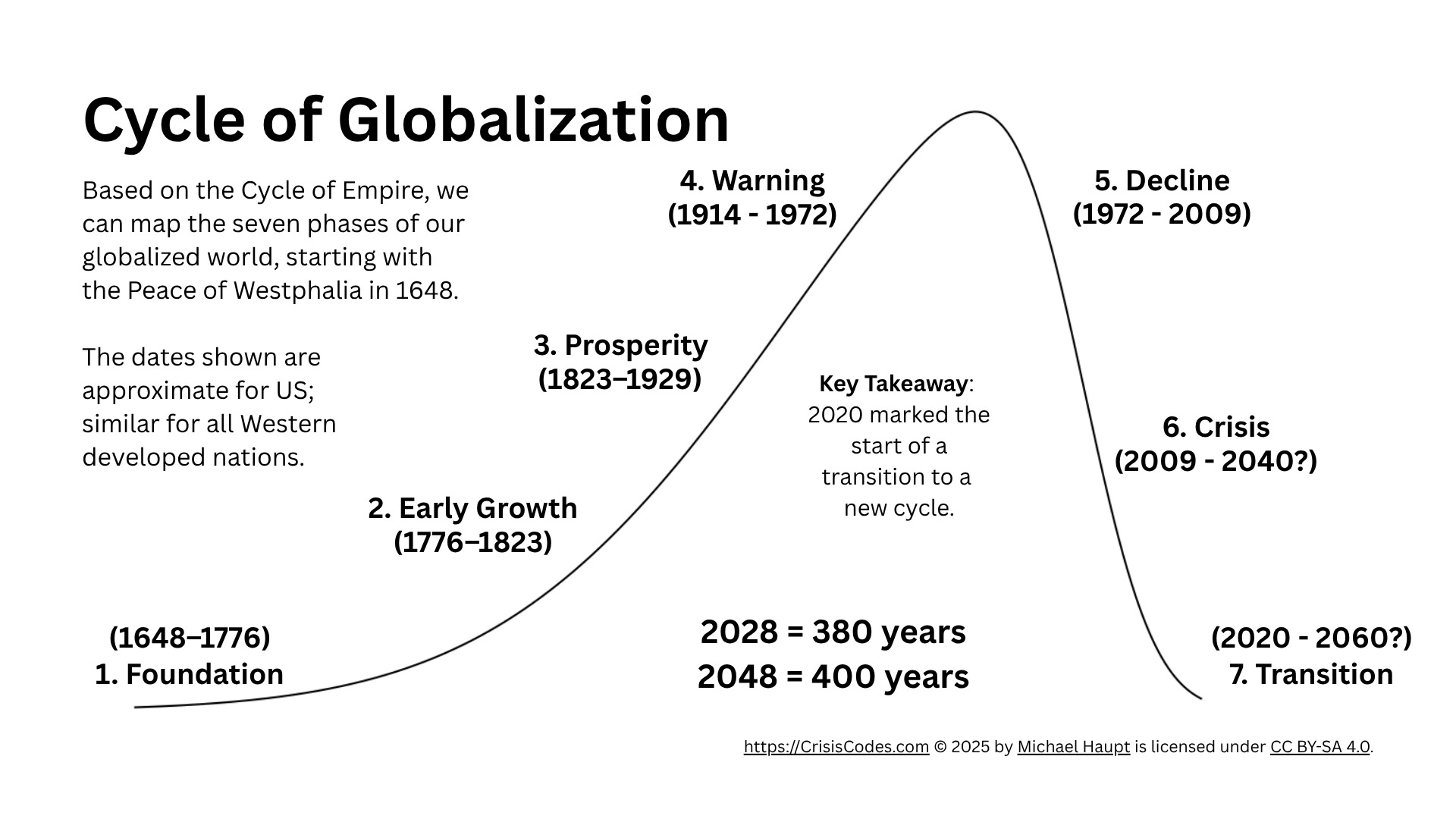
By late-stage, I mean any society in phases 5, 6, or 7 of the Cycle of Empire:
Collapsology is a transdisciplinary study of the inevitable collapse of complex societies induced by factors that include changes in climate, scarcity of resources, vast species extinctions, natural disasters, and a populist revolt against authoritarianism. Although the concept of civilizational or societal collapse has existed for many decades, collapsology focuses its attention on contemporary, industrial, and globalized societies. For a list of resources, see https://bit.ly/CollapseLit (be patient - takes up to 20 seconds to load).
The fascinating story of Alaric, a military genius who achieved the unthinkable: the sack of Rome in 410 CE:
Luther held to a form of the real presence (consubstantiation), believing Christ is physically present “in, with, and under” the elements. Zwingli argued for a symbolic or memorial view, viewing the bread and wine as representing Christ’s body and blood: https://lutheranreformation.org/history/luther-and-zwingli/
The failure of the German left to unite against Hitler is often used as a warning to those who fail to build unity with liberals in order to stop the far-right: https://cosmonautmag.com/2019/01/fighting-fascism-communist-resistance-to-the-nazis-1928-1933/
Overall, 61% of respondents said their countries became more divided during the pandemic: https://www.bloomberg.com/news/articles/2022-08-11/covid-19-and-politics-pandemic-deepened-countries-divisions-survey-says
Pastors Share Top Reasons They’ve Considered Quitting Ministry in the Past Year: https://www.barna.com/research/year-in-review-2022/
Harvard lecturer William Callison and Boston University professor Quinn Slobodian captured the political dimension by coining the term “diagonalism”: https://medium.com/@bellacaledonia/diagonalism-the-cosmic-right-and-the-conspiracy-smoothie-d827b1650e39
Worldview Orientations and Personal and Social Risk Perceptions for COVID-19 in a U.S. Population-Based Sample: https://pmc.ncbi.nlm.nih.gov/articles/PMC9670042/
A darkening spring: How preexisting distrust shaped COVID-19 skepticism: https://pmc.ncbi.nlm.nih.gov/articles/PMC8791533/
Libertarian Values & a Divide in the Republican Party: https://www.brookings.edu/articles/libertarian-values-a-divide-in-the-republican-party/
Identity politics is a game the left can’t win: https://www.bostonglobe.com/2023/09/04/opinion/freddie-deboer-identity-politics/ (paywall)
Pinsof, D., Sears, D. O., & Haselton, M. G. (2023). Strange Bedfellows: The Alliance Theory of Political Belief Systems. Psychological Inquiry, 34(3), 139–160. https://doi.org/10.1080/1047840X.2023.2274433
Moral Foundations Theory Explained by Jonathan Haidt: https://dividedwefall.org/the-righteous-mind-moral-foundations-theory/
Václav Havel: The Power of the Powerless: https://web.archive.org/web/20120107141633/http://www.vaclavhavel.cz/showtrans.php?cat=clanky&val=72_aj_clanky.html&typ=HTML
Hypernormalization describes a condition in which a false or surreal version of reality becomes so pervasive and accepted that it is treated as normal, even by those who know it is not. Over time, people become unable or unwilling to challenge this distorted version of reality, perpetuating its dominance. The term is closely associated with late-stage bureaucratic or authoritarian societies where the official narrative becomes increasingly divorced from reality, yet no one seems able to oppose or escape it. https://arapahoelibraries.org/blogs/post/what-is-hypernormalization/
Notes on: Everything Was Forever, Until It Was No More: https://jacobfilipp.com/hypernormalization/
Hannah Arendt: 5 Insights into Totalitarianism: https://philosophybreak.com/articles/hannah-arendt-5-insights-into-totalitarianism/
Terrorization relies on several psychological principles to achieve its effects. One key mechanism is learned helplessness, a concept introduced by Martin Seligman, where repeated exposure to uncontrollable aversive stimuli leads individuals to perceive their actions as futile, resulting in passive submission: https://www.psychology-lexicon.com/cms/glossary/53-glossary-t/22824-terrorization.html
Nova, Eszter. (2019). The Role of Fear and Learned Helplessness in Authoritarian Thinking. Interdisciplinary reinterpretation of the underlying thinking patterns of authoritarianism. Vol. 10.: https://www.researchgate.net/publication/339474273_The_Role_of_Fear_and_Learned_Helplessness_in_Authoritarian_Thinking_Interdisciplinary_reinterpretation_of_the_underlying_thinking_patterns_of_authoritarianism
Does Bypassing Internet Censorship in China Change Individual Beliefs, Attitudes, and Behaviors? https://sccei.fsi.stanford.edu/china-briefs/does-bypassing-internet-censorship-china-change-individual-beliefs-attitudes-and
Searching for Meaning in Chaos: Viktor Frankl’s Story: https://pmc.ncbi.nlm.nih.gov/articles/PMC8763215/
How the Irish Saved Civilization: https://www.irishamerica.com/2025/04/how-the-irish-saved-civilization/
How the Irish monks and saints helped save Europe: https://www.catholicworldreport.com/2023/03/16/232403/
The Benedictine Order: the spiritual foundation of the Christian West: https://relics.es/en/blogs/relics/benedictine-order
The resilience of Jewish communities living in the diaspora: a scoping review: https://www.frontiersin.org/journals/psychology/articles/10.3389/fpsyg.2023.1215404/full
Asabiyyah: The Power of Social Solidarity: https://medium.com/@sorooshm/asabiyyah-the-power-of-social-solidarity-1f4d2a59a1af
Ages of Discord: A Structural-Demographic Analysis of American History by Peter Turchin: https://theworthyhouse.com/2020/01/10/ages-of-discord-a-structural-demographic-analysis-of-american-history-peter-turchin/
Polanyi’s Paradox and the Shape of Employment Growth: https://www.nber.org/system/files/working_papers/w20485/w20485.pdf
“Espoused Theory” and “Theory In Use”: https://coachingleaders.co.uk/espoused-theory-and-theory-in-use/
Naïve realism (psychology): https://en.wikipedia.org/wiki/Naïve_realism_(psychology)
The bias blind spot: Perceptions of bias in self versus others: https://psycnet.apa.org/record/2002-10937-008
Why do we think we understand the world more than we actually do? https://thedecisionlab.com/biases/the-illusion-of-explanatory-depth
The Illusion of Explanatory Depth: https://www.edge.org/response-detail/27117
Social Imaginaries: https://idealsandidentities.com/2025/04/10/social-imaginaries/
Dunning-Kruger effect (psychology): https://www.britannica.com/science/Dunning-Kruger-effect
Exploring Søren Kierkegaard: Pursuing Authenticity and Existential Freedom: https://www.playforthoughts.com/blog/kierkegaard-philosophy


