
The Window
What happens when the system breaks — and everyone coordinates anyway


Why this essay? I’m busy working on a paper that seems relevant to our times. It’s called The Alpha Window. It explains the window of opportunity that opens up during a systemic shock. I’m writing it because I see a massive systemic shock about to engulf us, and little evidence of anyone addressing the window of opportunity. It’s a three-way theoretical synthesis of the intellectual space combining Kingdon’s Multiple Streams Framework,1 Holling’s Panarchy,2 and Geels’ Multi-Level Perspective.3 Unbelievably, this domain remains unclaimed, with no published paper integrating all three. It will be a dense body of research, not fit for Substack. So I thought telling a story would be a worthwhile interim approach.
This is a story about a mayor, a small town, and a fourteen month experiment that changed how I think about what’s unfolding right now.
But first, a confession. I’ve spent the past twenty years studying all kinds of frameworks: consciousness evolution, adaptive cycles, transition theory, policy dynamics, civilizational cycles, and many more. These are dense academic papers, all important work, but way outside of mainstream thinking. For most of that time, I missed the simplest thing those frameworks were trying to say.
People have objectives. When the official way of achieving those objectives stops working, people find another way.
That’s it. There’s nothing much more to what all these frameworks are trying to say.
What interests me, and what I think should interest all of us, is what happens in the gap, by which I mean the space between the old way of collectively achieving grand objectives (which is breaking down) and the new way (which will soon be imposed on us). It’s in that gap that world-changing things are decided. And we are in one right now.
Part I: A Mayor With a Theory
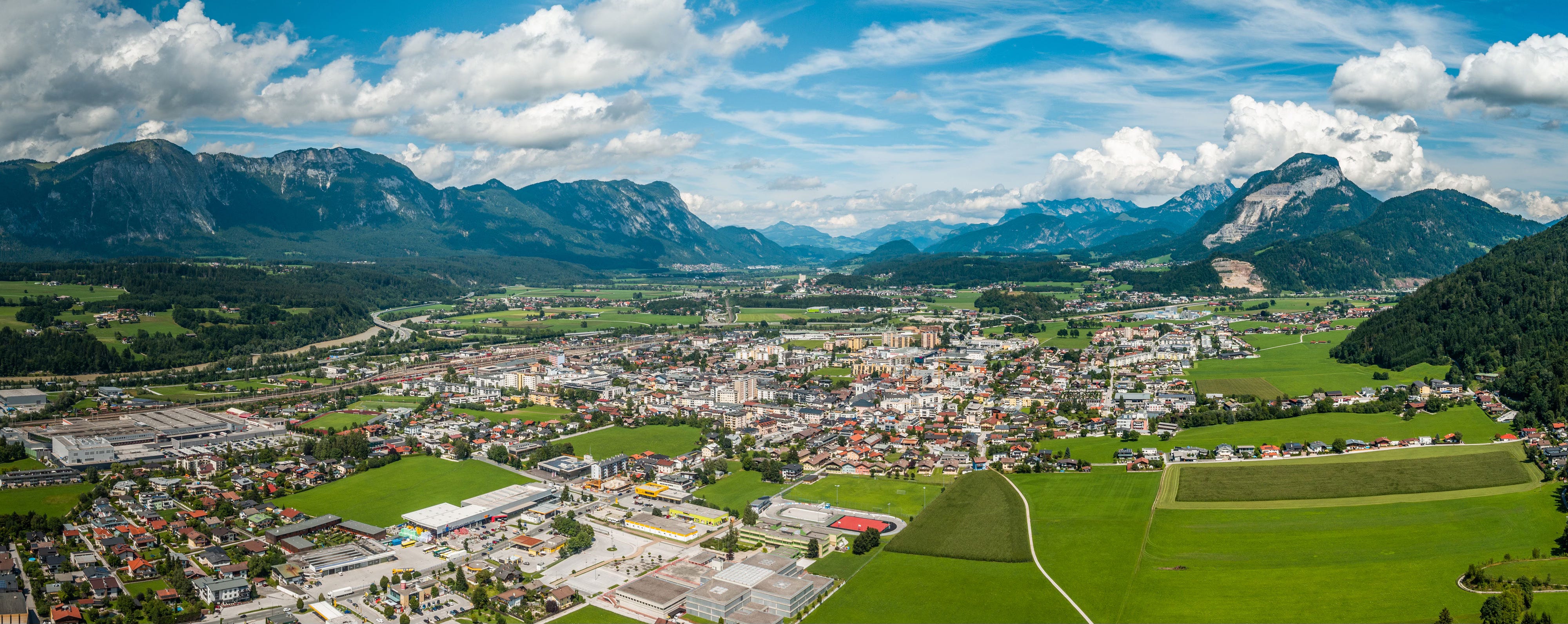
In 1932, the town of Wörgl in the Austrian Alps had a population of about 4,000 people and a problem that numbers alone can’t convey. A third of the workforce had no jobs. The town treasury was empty. Tax collection had collapsed, because people can’t pay taxes when they have no money. Public works had ground to a halt and roads were crumbling. The pipeline of projects that keep a small town functioning had simply stopped.
Michael Unterguggenberger was the mayor. He was a railway engineer by training and a Social Democrat by conviction. He’d been reading the work of an economist named Silvio Gesell for years… long before the crisis hit.4 Gesell had a specific idea about money: it should lose value over time, like bread or lumber or any other thing humans produce. If you hold bread too long, it goes stale. If you hold lumber too long, it rots. But if you hold money, it gains value. You earn interest on it. So people with money sit on it, and the economy seizes up.
Gesell proposed a fix. Make money expire. Give it a small cost for holding it, so people spend it rather than hoard it.
Unterguggenberger had this idea in his back pocket when the 1930s Depression arrived. He didn’t invent it during the crisis; he’d been carrying these ideas for years.
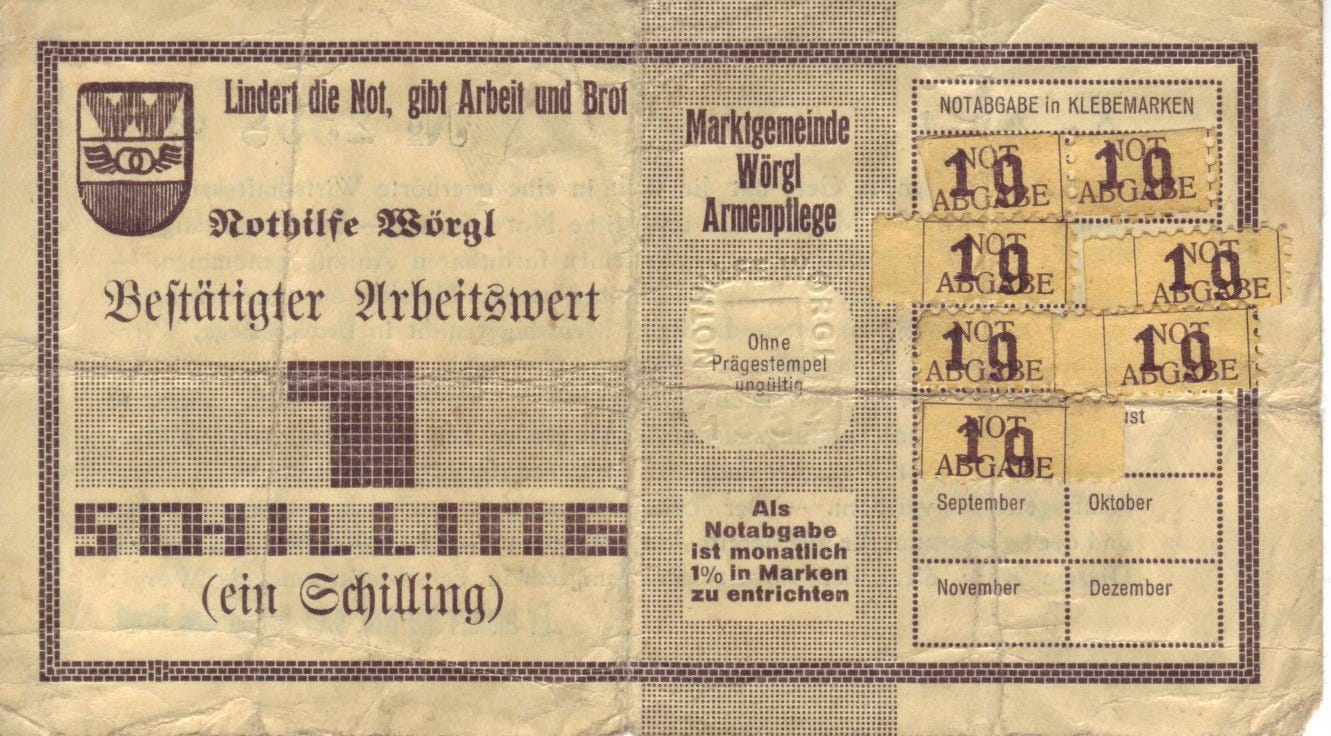
In July 1932, the town council voted unanimously to try it. Unanimously, across party lines that were, by any normal measure, completely incompatible. The town issued 5,000 schillings’ worth of a local scrip.5 Each note lost 1% of its value every month. To keep a note valid, you had to buy a stamp and stick it on the back. The tiny cost of one penny on the schilling meant nobody wanted to hold the notes. Everyone spent them as fast as they could.
What happened in that town is going to become relevant as the ripple effects of the Strait of Hormuz become more severe in the next 12-24 months.
The scrip circulated nine to ten times faster than the national currency. In a town running on 5,000 schillings of local money, tens of thousands of schillings’ worth of infrastructure got built. Roads were paved, a bridge was constructed, and a ski jump went up. Back taxes started flowing in: people paid early, sometimes months in advance, because holding the money cost more than paying the bill. Unemployment in Wörgl fell 16% in one year. In the rest of Austria, it rose 19%.
Over 200 other Austrian towns began preparing to copy the model.
Then the Austrian National Bank sued. The Administrative Court ruled in the bank’s favour. By September 1933, the experiment was dead.
The Wörgl Experiment was spectacularly successful, until centralized control mechanisms shut it down.
Part II: The Bit Nobody Talks About
I’ve told this story dozens of times. People love it, because it’s got everything: a scrappy underdog, measurable positive results, and a dramatic ending. But for years, I told it as a tragedy, a beautiful alternative crushed by the establishment.
That framing is wrong, or at least, it’s incomplete. Because Wörgl isn’t a one-off. The same story repeats, over and over, whenever citizens come together under severe economic challenges. It’s happened across countries, across centuries, and across completely different circumstances.
Argentina, 2001
The financial system collapsed and banks froze accounts. The peso devalued and millions of middle-class people suddenly couldn’t access their own money. Within weeks, neighbourhood exchange networks called Trueque — which had been running quietly since the mid-1990s with a few thousand participants — exploded to serve between two and six million people. Complete strangers were showing up at church halls and community centres, trading goods and services using locally printed vouchers. The networks hadn’t been built in response to the crisis. They already existed, but the crisis removed the final barriers to their adoption.
When the government stabilised the peso and the official economy restarted, the networks collapsed. The old system reasserted itself.
Switzerland, 1934
The WIR Bank, which was another Gesell-inspired complementary currency, conceived in the same Depression that killed Wörgl, launched. But the Swiss government didn’t shut it down. The WIR adapted so that it stopped looking like a protest movement and started looking like a boring business-to-business credit system. It survived, and it still operates today, quietly circulating billions of Swiss francs’ worth of trade among tens of thousands of small and medium enterprises. Economists have documented that WIR lending moves in the opposite direction to the mainstream economy. It expands when the regular economy contracts, cushioning downturns. It’s a built-in shock absorber hiding in plain sight.
Kenya, 2020
The Sarafu community currency is a digital token designed for low-income communities. It’s been running since 2018 with modest adoption, but when COVID hit and formal economic activity collapsed, Sarafu usage surged. Over 300,000 users and millions of transactions were recorded. People who couldn’t access national currency kept trading with each other using the community system.
The same pattern unfolds every time.
Part III: Why This Happens
Here’s what I’ve come to think is going on.
Economists like to argue about systems: austerity versus stimulus; central planning versus free markets. These arguments are important, but they happen at a level of abstraction that misses something fundamental about how humans actually behave.
Steven Landsburg once wrote that economics starts with observing the world with genuine curiosity, admitting it’s full of mysteries, and trying to solve them by accepting that human behavior usually serves a purpose.6
I’d push that one step further. When the systems people depend on stop delivering, people don’t sit around waiting for economists to fix the theory. They coordinate. They find each other. They build something that works, at the moment of need, in their neighborhood, with their people, using whatever materials are at hand.
This isn’t idealism. It’s been observed over and over again across many circumstances.
In Wörgl, it was a mayor with a theory and a town council willing to try it. In Argentina, it was housewives and retired engineers and unemployed factory workers showing up at swap meets with homemade bread and auto repair skills. In Switzerland, it was small business owners extending credit to each other outside the banking system. In Kenya, it was market traders accepting a token on their phones because the alternative was no trade at all.
Each of these cases looks different on the surface, but the common thread is that people have objectives: feed their families, maintain their businesses, and keep their communities from falling apart. In the past, when the normal channels for achieving those objectives broke down, people built new channels.
This pattern deserves a name, which will become more relevant as institutions start failing: Post-Institutional Coordination.
Not “anti-institutional.” That implies rebellion, and this isn’t rebellion. The mayor of Wörgl wasn’t trying to overthrow the Austrian state. The women running Trueque nodes in Buenos Aires weren’t anarchists. The WIR founders weren’t revolutionaries. All of them were pragmatists. The institution they depended on — the monetary system — had stopped doing its job. And so they coordinated around the failure.
The “post” matters. It means after. After the institution stops functioning. After the official channel seizes up. After the gap opens between what people need and what the system provides. What happens in that gap is coordination: human beings figuring out how to achieve their objectives together, using new tools, often without anyone showing them exactly what to do and without waiting for anyone’s blessing or permission.
Part IV: The Window and the Race
Now here’s the part that changed my thinking.
Every time one of these experiments emerged, two things happened simultaneously.
1 - The People
From grassroots, bottom-up initiatives, people built alternatives from below: local currencies, exchange networks, credit circles, and cooperative structures. They were always based on pre-existing relationships and pre-existing ideas. They were never invented from scratch in the moment of crisis. They were always the scaling-up of something that was already being practiced quietly, at the margins, by a small group of people who had been preparing — consciously or not — for exactly the moment of crisis.
2 - The Powers
From above, institutions moved to restore control. Central banks asserted currency monopolies. Governments imposed emergency regulations. International financial bodies attached conditions to bailout packages. They were always framed as restoring order. Always, in practice, reinstalling the system that had just failed — updated, patched, sometimes wearing new clothes, but structurally the same.
Both forms of initiatives emerge through a gap created by a crisis. That gap doesn’t sit empty; nature abhors a vacuum. The gap is a contested space and alternatives always emerge, because small groups of people always come together to find new ways of coordinating the objectives of humans. The only debate is whether those alternatives survive long enough to become permanent, or whether the old system reasserts itself before the new one can take root.
Think of it like a forest fire.
An old-growth forest burns. For a brief period, sunlight and warmth reaches the forest floor. Seeds that had been dormant for decades — unable to germinate under the shade of the dense canopy — suddenly sprout. This is the window of opportunity.
But the window doesn’t stay open forever. If the new growth establishes deep enough roots fast enough, a different kind of forest emerges. If it doesn’t, the species that dominated the old forest reassert themselves, often in degraded form, because the conditions that supported the original old growth have been damaged by the fire itself.
The Wörgl experiment was a seed that germinated. It grew quickly. It was producing visible results. Then the old canopy — the Austrian National Bank — cut it down at exactly the moment it was about to spread to 200 other towns. The Swiss WIR was a seed that germinated, grew more slowly, adapted its shape to look less threatening, and survived. It’s still growing today. The Argentine Trueque networks were seeds that germinated explosively, served millions, but hadn’t developed deep enough institutional roots to survive once the old system re-stabilized.
The decisive variable, the thing that determines which outcome occurs, is never the quality of the alternative. Wörgl worked brilliantly, but it was crushed anyway. The variable that matters is whether the alternative was far enough along, and structurally resilient enough, to absorb the counterattack.
Preparation beats purity. Every time.
Part V - Why This Matters Right Now
I don’t think I need to convince you that we’re in a period of institutional stress. You can feel it: in the economy, in politics, in the gap between what leaders say and what you experience in your own life, in the conflicting messages around the war in the Middle East. The systems that were supposed to deliver stability, prosperity, and a reasonable degree of fairness are visibly straining.
I’m not interested in arguing about why they’re straining. That’s a different essay. What interests me is the structural fact that when systems strain, the pattern activates. People start coordinating outside official channels. New structures emerge. Some of them are better than what they replace. Some of them are worse. And the old system fights to reassert itself regardless of which is which.
This is the window. We are in it.
The canopy is thinning. Sunlight is reaching the floor. The seeds are already sprouting: local food networks, community energy cooperatives, mutual aid groups, bioregional economies, new forms of exchange that bypass the infrastructure everyone assumed was permanent. Most of them are small, and most of them look marginal. Almost all of them are being built by people who can see what’s happening and refuse to wait for the official response.
Here’s what Wörgl, and Argentina, and Switzerland, and Kenya taught me.
The people building these alternatives aren’t dreamers. They’re the most practical people in the room. They’ve looked at their objectives: a functioning local economy, food on the table, and community resilience. Then they looked at the official channels for achieving those objectives, and they’ve made a rational calculation: those channels are not going to deliver. So they’re building new ones.
There’s a body of research on how they do this:
How human beings coordinate to meet their needs when institutions fail,
What determines whether those new structures survive or get absorbed back into the old system,
What role preparation plays,
What role institutional resistance plays,
What makes the difference between an experiment that lasts fourteen months and one that lasts ninety years.
It’s the emerging field of post-institutional coordination, and I think it matters more right now than almost any other question we could be asking.
The window has a shelf life. The forest floor doesn’t stay sunlit forever. There’s no question that people will coordinate: that’s as certain as gravity. The question is whether what they build will have deep enough roots to hold when the old canopy tries to close back over.
In The Valley of Grace, in the Western Cape of South Africa, a small group of us are trying to answer that question. Not in theory; on the ground. In a valley of about 25,000 people where the formal economy was never working for most residents in the first place. We’re building a bioregional economy: local production, local exchange, local governance of shared resources. It’s early, the documentation is sparse, and the outcomes are uncertain.
But the seeds are in the ground, and I’ve studied enough history to know that this is the part that matters. The theory and the frameworks don’t matter. It’s the seeds we plant that matter.
The window is open. The question is what we plant while the sunlight reaches the forest floor.
It’s time.
That’s all for this week. Remember to love the ones you’re with, and frame on!
Michael 💚
PS. I’m camping with my daughter and some of her friends this weekend, which is why the newsletter is early this week. No more laptop for the rest of the weekend. To those celebrating Easter this weekend, and to those in the middle of Passover, and those approaching Vaisakhi, the same wish: may something take root in the opening.
The multiple streams framework (MSF), developed by John Kingdon in 1984 (with a major update in 2010), is a well-respected approach for analyzing policymaking across a variety of policies and countries. Hundreds of English-language journal articles using MSF have been published demonstrating its versatility and theoretical richness. https://pmc.ncbi.nlm.nih.gov/articles/PMC8861624/
Panarchy proposes that it is useful to conceptualize systems in terms of interacting adaptive cycles. The adaptive cycle was an idea first proposed by Holling based upon his experience working and studying managed ecosystems (Holling 1986). https://www.researchgate.net/publication/37717304_Panarchy_Understanding_Transformations_In_Human_And_Natural_Systems
The Multi-Level Perspective (MLP) not only provides us with a way of mapping out a system on its different levels but also provides us with an account of change; how transitions may occur within socio-technical systems. In general, the MLP model attributes socio-technical transitions to the interaction of stabilizing forces at the regime level with destabilizing forces from both the landscape and niche levels. https://www.sciencedirect.com/science/article/abs/pii/S2210422411000050
Silvio Gesell (1862–1930) was a German-Argentine economist, businessman, and social reformer who developed a heterodox economic theory known as the Free Economy (Freiwirtschaft), which aimed to create a market economy without capitalism. His principles were centered on the belief that economic crises (deflation and unemployment) are caused by the hoarding of money, which functions as both a medium of exchange and a store of value. https://www.researchgate.net/publication/5088112_Silvio_Gesell’s_Theory_and_Accelerated_Money_Experiments
Modern conversion tools suggest 5,000 schillings would be around 419 USD today, but this does not accurately represent what 5,000 schillings could purchase in 1932. 5,000 schillings in 1932 was a substantial sum relative to typical incomes, even if nominal prices were depressed.
“Economics is all about observing the world with genuine curiosity and admitting that it is full of mysteries” ― Steven E. Landsburg, Armchair Economist: Economics & Everyday Life: https://www.goodreads.com/book/show/101446.Armchair_Economist
Michael this is a beautifully crafted paper that has put into words something I have been feeling and working on for some time. My view is that power is concentrated in the cities. Imagine your valley as a network of collaborative village-scale communities. Each community manages the land they live on to create an abundance of food, water, energy and housing. This abundance (supply exceeding demand) means the price tends to zero. This part is a gift economy, or more accurately a community credit, non-monetary economy. Create a local currency for trade between communities. https://polisplan.com.au
I agree that as a species humans are resilient. When systems fail, I am sure we will invent new ways.
My problem with your analysis has to do with how infrasturcture, like the Internet, other utilities, like gas, water, electricity, and gasoline, for examples, will be paid for with alt currencies or barter?