
The Break We Need to Make (and haven't yet)
A Framer OS response to Bollier, Hulst, Power & Seefeld on Monetary Systems and Bioregional Finance


Why this essay? There are two papers covered in this essay. I attempted to provide feedback directly on LinkedIn when the latest paper was published in December 2025. The (enforced) brevity of my posts created confusion and misunderstandings. This essay is a more nuanced version that unpacks my thinking further. It will be of interest to you if you’re involved in bioregional regeneration or have been interested in raising funding for a regen project. It will also interest you if you hold institutional or private wealth or want a macro-level view of the worldviews associated with money. It will be of particular interest if you’re a complementary currency designer.
Two recent publications represent the most serious attempts yet to rethink funding for bioregional regeneration. Power and Seefeld’s Bioregional Financing Facilities (2024) proposes a comprehensive institutional architecture that incorporates Bioregional Trusts, Venture Studios, Investment Companies, and Banks.1 The objective is to decentralize financial governance and connect capital directly to place-based grassroots regenerators. Bollier and Hulst’s Relationalized Finance (2025) goes further, naming the ontological clash between capitalist finance and living systems.2 The paper proposes structures like transvestment, regrantor funds, and socio-ecological markets that take relational value seriously.
Both bodies of work matter deeply. Power and Seefeld correctly identify that “closing the nature finance gap alone is not sufficient” and that where resources flow and who decides matters as much as the volume of funding. Bollier and Hulst acknowledge what most regenerative finance proposals avoid: that the shift required is paradigmatic, demanding what Bollier calls an “OntoShift” in how we understand value itself.
And yet both contain a concession that, once examined, reveals a structural gap in their architecture. Bollier and Hulst write that the new financial instruments remain “inescapably tied to national fiat currencies, alas.” Power and Seefeld acknowledge that “the current financial system was designed to serve colonialism, imperialism, and capitalism.”
That “alas” carries the weight of the entire challenge. And Power and Seefeld’s acknowledgment, precise as it is, stops one sentence short of the conclusion our moment demands.
Both concede that the regenerative structures are being designed to operate within a monetary system whose architecture encodes the very worldview the proposals aim to transcend (perpetual growth on a finite planet). I want to suggest that this concession points toward a design principle both frameworks lack. I want to press further by suggesting that without it, the bioregional finance proposals risk reproducing what they intend to replace.
Our Monetary System has Coercion Baked into its DNA
The commonly-accepted story says money evolved from barter, through coinage, to modern finance, implying a natural progression toward market efficiency. The anthropological evidence says otherwise.
David Graeber’s Debt: The First 5,000 Years (2011) established that credit and debt preceded coinage, and that coinage emerged within what he called the “military-coinage-slave complex” of the Axial Age.3 Mercenary armies needed payment. Large-scale slavery provided the labor surplus. The monetary system and state coercion crashed onto the world stage simultaneously.
James C. Scott’s Against the Grain (Yale, 2017) provides the archaeological complement.4 Early states were “population machines” dependent on unfree labor. Grain was the preferred crop because it was “visible, divisible, assessable, storable, transportable, and rationable.” This made grain uniquely suited to taxation and extraction. Charles Tilly’s foundational work framed it bluntly: state formation was structurally analogous to organized crime.5
The mechanisms of extraction evolved over time. Colonial hut taxes first imposed in South Africa forced populations into wage labor.6 Debt bondage replaced legal ownership (chattel slavery) by controlling laborers through fabricated or insurmountable debt. Our contemporary monetary system compels market participation through the imposition of income tax. The basic function of money has been continuous across five millennia: securing labor and resources for material growth through forms of coercion that adapt and abstract while preserving their extractive purpose.7
What I am suggesting is that every monetary system since the Neolithic Revolution has served the steep phase of civilization’s S-shaped growth curve. Every one has required some form of coercion to do so.
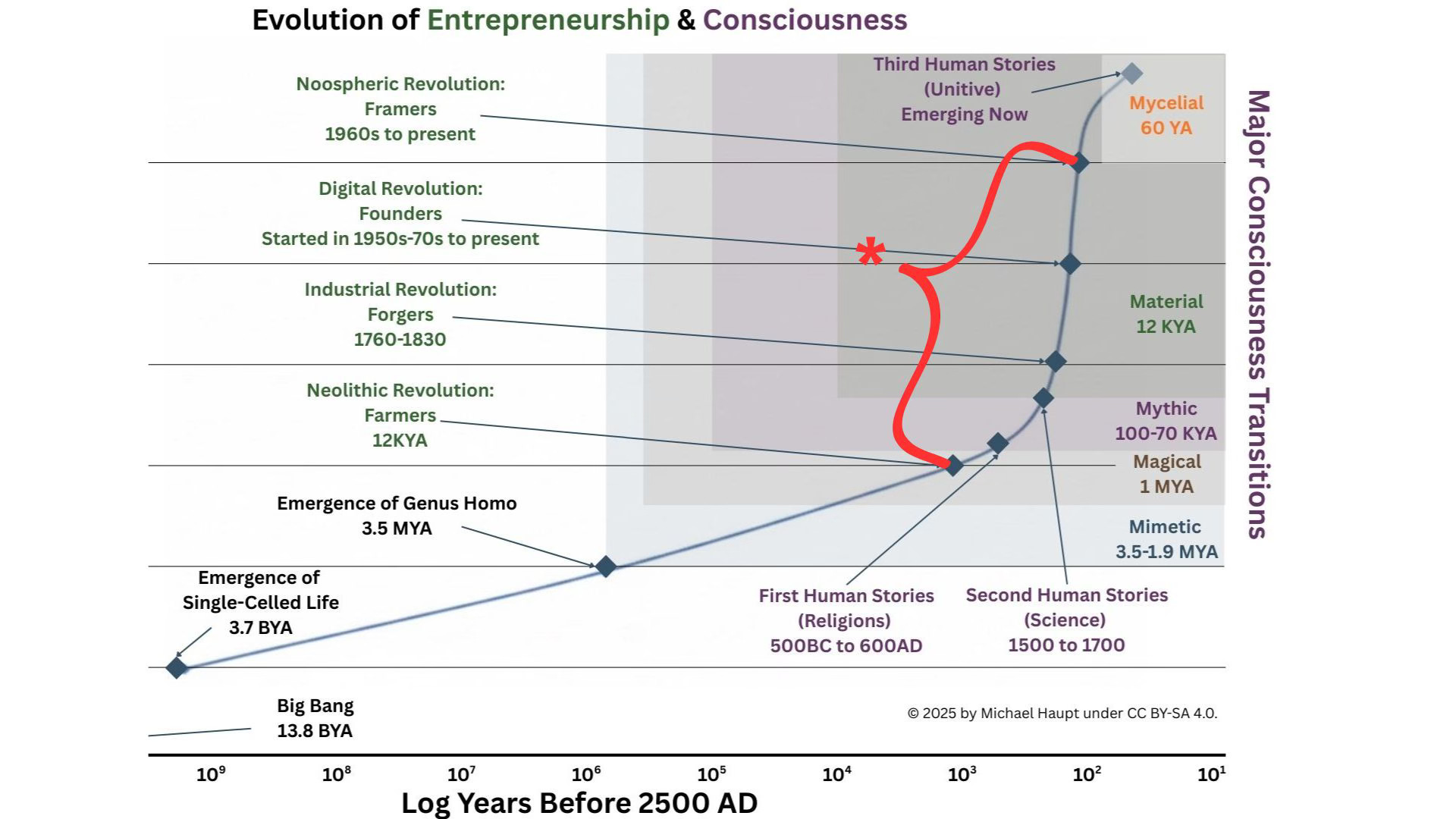
This is the coercion architecture that both bioregional finance publications propose to build within.
Money Encodes a Worldview
Zelizer (American Journal of Sociology, 1989), Ingham (Review of Social Economy, 1996), and Guyer (PNAS, 2012) have established a scholarly consensus: money carries a worldview.8 Every monetary architecture encodes assumptions about what counts as value, what relationship time has to exchange, and what purpose economic activity serves. Fiat currency issued as interest-bearing debt presupposes that tomorrow must repay today with surplus. That presupposition shapes everything downstream: fiduciary duty, risk assessment, return expectations, and what counts as a “reasonable” return on investment.
Nisbett and colleagues demonstrated in Psychological Review (2001) that cultural worldviews shape cognitive processes themselves.9 These cognitive processes determine what counts as relevant, what possibilities are visible, and what inferences feel rational. Koltko-Rivera’s review in Review of General Psychology (2004) confirmed that worldviews function as assumptions about reality with powerful effects on cognition and behavior.10
Based on the research, my counterintuitive claim is that those who build regenerative financial instruments while remaining embedded in the fiat monetary system will perceive, reason, and design through the worldview that system encodes. They will measure relational value through financial proxies. They will structure bioregional commons with return expectations. They will create transvestment vehicles governed by fiduciary norms calibrated to compound growth. They will do this unconsciously, because the worldview operates below the threshold of awareness.
What the Bioregional Movement Names… and What it Refuses to Name
The bioregional finance movement has earned real credibility. Power and Seefeld’s twelve design attributes represent rigorous institutional thinking.11 Their case studies, from Salmon Nation to Hawai’i Investment Ready to the Golden Bay work in Aotearoa, demonstrate that bioregional coordination isn’t merely theory. It is practice, tested under real conditions, and producing real results.
Bollier and Hulst push deeper. Their concept of transvestment, being money transferred from capitalist circuits to commons-stewarded regimes with different logics, names the directionality of the shift. Their regrantor fund model, designed to buffer commons from transactional demands and enable autonomous judgment, addresses a genuine structural problem. Their invocation of Gibson-Graham’s economic iceberg is intellectually precise.12
And yet there is a pattern I believe needs calling out. Both frameworks name colonialism, imperialism, and capitalism as the financial system’s origins. Both reference Indigenous wisdom about reciprocity and relational value. Both propose structures designed to insulate regenerative work from extractive logic. And both, at the decisive moment, stop short.
Power and Seefeld propose to channel capital from the existing system through better intermediaries. Their BFF architecture is designed to receive, transform, and deploy capital that originates in, and remains denominated in, the very monetary system whose colonial and imperial DNA they have identified. Bollier’s regrantor fund insulates but does not replace. It creates a buffer between fiat money and the commons. This means the commons receives its lifeblood through a filter, but the blood itself carries the pathogen.
Neither framework says what needs to be said plainly: the monetary system bioregions are building within is not merely “designed to serve colonialism, imperialism, and capitalism.” It is a slavery-based architecture. Its lineage runs from Axial Age coinage minted by slave labor, through colonial taxation designed to force populations into wage dependence, through contemporary debt-money that compels participation through structural coercion. The mechanism has abstracted but the core function has not.
Buckminster Fuller’s dictum is quoted approvingly by Bollier:
“You never change things by fighting the existing reality. To change something, build a new model that makes the existing model obsolete” — Buckminster Fuller
Fuller’s instruction contains a prerequisite the bioregional movement has not fulfilled: you have to be honest about what the existing model is before you can make it obsolete. If you name the existing model as “extractive finance” or “capitalist logic” but will not name its foundation, you have described the branches while leaving the root untouched. The root is a slavery-based monetary architecture.
My core argument is that this omission is a failure of nerve. And it matters, because anything less is spiritual bypassing. We (and I include myself because I have done this for the past decade) use regenerative language, Indigenous references, and relational ontology to avoid confronting the structural foundation of the very system that is itself becoming obsolete, as we near the tapering off of the S-curve referenced earlier.
Appropriate Technology for a Living World
E.F. Schumacher argued in Small Is Beautiful (1973) that technology must be appropriate to its context. That means scaled to human need, fitted to ecological reality, designed for the purpose it serves. He wasn’t anti-technology, but he was certainly anti-inappropriateness. A tool designed for extraction and coercion cannot serve regeneration merely by being wielded with good intentions.
Apply Schumacher’s test to the monetary substrate. A monetary system designed across five millennia to secure labor through coercion — however abstracted that coercion has become — is inappropriate technology for the top of the S-curve. I’m not suggesting this merely as a metaphor. It is a biological statement (thank you Elisabet Sahtouris.) It is a social engineering statement. You would not irrigate a food forest with contaminated water and expect the harvest to be clean. You would not build a mycelial network on a substrate designed to produce monoculture.
The point I am making is that a slavery-based monetary system was appropriate during the steep part of our S-curve, but it is no longer. Perhaps it will help to think of planned obsolescence being part of the monetary design, just as it is part of an iPhone’s design.
The bioregional movement understands appropriate technology in every domain except money. It designs governance for watersheds, not political jurisdictions. It organises food systems around soil biology, not commodity markets. It structures stewardship around ecological boundaries, not property lines. And then it denominates all of this in a currency whose architecture requires compound growth on a finite planet, issued as debt by institutions whose legitimacy derives from the state’s monopoly on coercion.
What I am pointing out is the evolutionary incoherence. And I am suggesting it is the bioregional movement’s responsibility to resolve it. No one else will. The conventional financial system has no incentive to name its own coercion lineage. Governments will not dismantle the monetary architecture through which they exercise structural power. Academic economics will not challenge the substrate on which its models depend. If the bioregional movement — which has already done the hardest intellectual work of naming ecological destruction, designing commons governance, and articulating relational value — will not take this final step, the step will not be taken. And we will be coopted like the sustainability movement was.
Rupture as the Design Principle
My proposition is as follows: Unless the design of regenerative financial systems establishes as a first principle a clean break between the existing monetary architecture and a new one, the regenerative proposals will be absorbed by the worldview they aim to transcend. The coercion-based architecture will metabolize relational value into its own logic, the way it has metabolized every previous reform: green bonds, ESG criteria, impact investing, carbon markets, and the like.
Gregory Unruh’s concept of the Techno-Institutional Complex (Energy Policy, 2000) documents exactly this dynamic: reform within locked-in systems reinforces the underlying architecture rather than transforming it.13 Abson and colleagues (Ambio, 2017) established that most sustainability interventions target shallow leverage points while neglecting deep ones.14 The monetary system operates at Donella Meadows’ leverage point 2, or paradigm. Adjusting parameters within it operates at leverage points 10–12.15
Bollier’s OntoShift is the evolutionarily coherent instinct. He treats it as something that emerges through the practice of commoning and bioregional engagement. The cognitive science suggests an additional requirement: participants need the capacity to see that they are operating from a worldview before they can shift it. The monetary system is specifically designed to be invisible as a worldview, by presenting itself as neutral infrastructure rather than a carrier of assumptions about reality. Some will flinch from this naming. They will treat “slavery-based monetary architecture” as rhetorical excess. It is a structural, systemic description, not an overreaction. Those who cannot hold it need to do deep worldview work before they design the alternative. The capacity to name what is must precede the capacity to build what comes next.
What does this clean break look like in practice?
Fortunately the empirical evidence already exists. Mattsson, Criscione, and Ruddick published data in Scientific Data (Nature, 2022) documenting 55,000 users and 300 million units transacted in a community-issued digital currency in Kenya.16 Lagoarde-Ségot’s formal modeling in Humanities and Social Sciences Communications (Nature, 2024) demonstrated that complementary currencies enhance systemic resilience and reduce ecological footprint.17 Gómez’s research established that monetary plurality, by which he means multiple currencies serving different purposes, has been the historical norm, and that monoculture money is just as much an aberration as monoculture food is.18
Bioregionally issued currencies, designed by communities around their own ecological and social realities, represent the monetary expression of what both Bollier & Hulst and Power & Seefeld propose at the governance level. These currencies encode different assumptions about value. They create different cognitive environments for their participants. They make visible what fiat currency renders invisible: that money is a social technology carrying a worldview, and that the worldview can and must be consciously chosen.
Power and Seefeld’s BFF architecture, particularly the Bioregional Bank concept with its capacity for currency issuance, contains the seed of this clean break. Their references to nature-based currencies and eco-credits gesture toward it. But the gesture remains embedded in a framework that treats fiat capital as the primary resource to be channelled, not the primary substrate to be replaced. The break requires that bioregionally issued currency move from peripheral innovation to foundational design principle. The currency isn’t an add-on to the BFF architecture. It is its monetary foundation. And bioregions should design their currencies competitively, in the same way markets compete, with the core difference being that the competition serves evolutionary coherence towards higher forms of collaboration, cooperation and human coordination. This is the missing piece that currently makes bioregional Networking less compelling than corporate and startup Markets, covered in David Ronfeldt’s TIMN model.19 But it can be easily addressed, once we see it and name it.
Consciousness Itself is at Stake
My boldest claim is that the monetary system we operate within constrains what we can perceive, what we can value, and what we can become.
A system designed to secure labor through coercion (even if abstracted through, for example, taxation or inflation) produces participants calibrated for extraction, accumulation, and competitive advantage. These are cognitive orientations, embedded through daily participation in the monetary system’s logic, reinforced by every transaction, every investment decision, every measure of “success.”
The evolution of human consciousness toward relational awareness, ecological perception, intergenerational responsibility, and genuine reciprocity requires a material substrate that supports it.20 Slavery-based monetary architecture is a material substrate designed for a different purpose. Building regenerative structures on top of it is planting a food forest in contaminated soil. The roots absorb what the soil contains.
In regenerative agriculture, hemp is planted in contaminated soil specifically to draw out heavy metals and toxins through its root system. The process is called phytoremediation. The remarkable thing is that the resulting plant matter is then used to build hempcrete: housing material for the structures that replace what contaminated the land in the first place. The remediation produces the building material. The composting and the construction are one process.
This is what is needed in the monetary system. The work of extracting the coercion-based worldview from participants’ perception isn’t a preliminary step that only happens before the real work of currency design. It is the process that produces the material from which freedom-based monetary architecture gets built. Worldviewing work isn’t upstream of monetary design in the sense of coming first and then ending. It is upstream the way mycorrhizal networks are upstream of the forest. It is the substrate from which everything else grows. It is a process which requires conscious work to convert and transform the old worldview, or as Vanessa Andreotti calls it, Hospicing Modernity.21
Incremental reform allows the old worldview to persist as the operating environment while regenerative proposals are layered on top. The proposals become features of the existing system rather than expressions of a new one. The bioregional commons becomes a line item in a portfolio. Transvestment becomes a tax-efficient vehicle. The regrantor fund becomes a philanthropic structure governed by the norms of the world it was designed to buffer against. The OntoShift stalls at the threshold because the monetary substrate keeps pulling perception back toward the assumptions it encodes.
Bollier, Hulst, Power, and Seefeld have described a destination worth reaching. The design principle I am proposing addresses the pathway. A clean break from the monetary architecture that has served material growth through coercion for five thousand years. And the conscious construction of monetary systems designed to serve what comes next: the evolution of consciousness itself, expressed through bioregional coordination, reciprocity, and care for the living systems that sustain us.
My Role
I want to be transparent about two things this argument has clarified in my own thinking and practice.
The first is what I don’t do. I am not a currency designer. I don’t know how to interface complementary currencies with existing economic infrastructure, navigate regulatory frameworks, or build the technical architecture of bioregional monetary systems. That work belongs to people with expertise I don’t possess, and fortunately there are hundreds, if not thousands already actively developing appropriate technology.22
What I do is upstream.
The break this essay describes is not, at its root, a monetary design challenge. It is a worldview challenge. The reason the bioregional movement stops one sentence short of naming slavery-based monetary architecture isn’t because it lacks financial understanding and expertise. It is because the worldview installed by the system prevents participants from seeing the system. You cannot design a freedom-based monetary architecture while perceiving through the cognitive lens of a coercion-based one. The design follows the seeing, not the other way around.
This is the work I now do. I run Worldviewing Workshops that give participants the capacity to excavate and make visible the worldview they currently operate from, name its assumptions, and then trace those assumptions to their structural origins in monetary and institutional architecture. This gives them the ability to construct, deliberately and with full awareness of what they are choosing and what they are composting, a worldview adequate to the transition ahead of us. The workshop does not produce answers. It produces the perceptual capacity without which no answer holds.
We ran our inaugural workshop earlier this month with 15 participants. We’ve refined the next workshop based on lessons shared. The next one takes place on March 11th and 18th. There are still a few places left.
The second thing this argument has clarified is who this work is for.
I’m evolving to work with institutional and private wealth holders who feel enslaved by their financial capital. That word is not rhetorical. I’m hearing more and more from nextgen heirs who need meditation (and sometimes medication) to survive inheriting industrial dynasties linked to extraction and coercion. They are feeling the weight of a monetary worldview pressing on their consciousness without a framework to name it. The family office principals planning to restructure or transfer wealth in the next decade aren’t responding with much enthusiasm to the idealism often found in bioregionalism. They are responding to the felt experience that the architecture they operate within is incompatible with what they now perceive about the world.
Contrary to what their financial advisors think, their liberation doesn’t begin with portfolio restructuring. It begins with seeing. I’m talking about worldviewing (as a verb that represents an ongoing process) that expands to include monetary architecture as a first-order design variable. The work has to address the capacity to name the coercion encoded in the substrate without flinching. And from that ground; that cleared, honest, unflinching ground; the downstream work of wealth conversion, currency exchange, institutional architecture, and bioregional finance becomes possible. Not before.
This is what my work is now geared towards. It isn’t about career change or personal transformation. It’s about liberation. And it begins where the bioregional movement’s current proposals end: at the break we haven’t made.
That’s all for this week.
Remember to love the ones you’re with and,
Frame on!
Michael
Michael Haupt works with institutional and private wealth holders who feel enslaved by their financial capital. His practice, worldviewing, includes monetary architecture as a first-order design variable. Twenty years building global telecoms and satellite systems for Telefónica, Vodafone, Iridium, and other household names taught him how systems lock in behavior. Twenty years of consciousness research taught him how addiction to a harmful system can be cut loose. He leads the Valley of Grace bioregional regeneration project in rural Western Cape, South Africa, where the monetary question is foundational rather than peripheral.
References & Further Reading
The full research base underpinning this essay, consisting of 93 peer-reviewed papers across eleven claim areas, is detailed in an upcoming paper, What Your Money Believes: Coercion, Worldview, and the Bioregional Alternatives (Haupt, 2026). Annotated bibliographies available on request.
The book was followed by the 45th Annual E.F. Schumacher Lecture in November 2025, and you can find a recording here: https://centerforneweconomics.org/events/the-45th-annual-e-f-schumacher-lecture/. The book can be downloaded here: https://www.biofi.earth.
The paper can be downloaded here: https://www.bollier.org/files/misc-file-upload/files/Relationalized_Finance_essay_version_1.0_December_8_2025.pdf. In a LinkedIn discussion on February 25th, 2026, the lead author says the following: “I think it’s a fantasy to think that serious bioregional strategies, in these pre-transition times, will be able to divert significant sums of money from existing capitalist circuits of finance.” It is this ‘fantasy’ this essay addresses directly.
The book can be found on Amazon https://www.amazon.com/dp/1612191290 and I’ve provided extensive research notes on (I believe) the most important chapter, Chapter 8, The Cycles of Money: https://bit.ly/Debt5000
Against the Grain: A Deep History of the Earliest States by James C. Scott (2017) is an account of all the new and surprising evidence now available that contradicts the standard narrative for the beginnings of the earliest civilizations: https://www.amazon.com/dp/030024021X. I prefer it to the more recent The Dawn of Everything: A New History of Humanity by David Graeber and David Wengrow (2022).
Tilly, C. (1985). “War Making and State Making as Organized Crime.” In Bringing the State Back In, edited by Peter Evans, Dietrich Rueschemeyer, and Theda Skocpol, 169–191. Cambridge: Cambridge University Press. Classic political sociology essay arguing that European state formation was structurally analogous to organized crime: states emerged through coercion, extraction, and the monopolization of violence. War-making required revenue extraction; revenue extraction required population control. States that could not extract effectively were eliminated by those that could. https://www.antoniocasella.eu/nume/TILLY_1985.pdf
One of the central pillars of colonisation was tax. The European powers did not want Africa to be a drain on their treasuries, and they wanted the colonies to pay their own way. They also wanted people to enter into the cash economy. Taxation was a way of driving people into working for money. https://www.bbc.co.uk/worldservice/africa/features/storyofafrica/11chapter10.shtml
The full research base, drawing on 30+ peer-reviewed papers across this claim area, is detailed in an upcoming paper What Your Money Believes.
Zelizer, V.A. (1989). "The Social Meaning of Money: 'Special Monies'." American Journal of Sociology, 95(2), 342–377. DOI: 10.1086/229272. Money is not homogeneous but socially shaped — different monies carry different cultural meanings and operate under different rules. The assumption of monetary neutrality is itself a worldview claim.
Ingham, G. (1996). "Money Is a Social Relation." Review of Social Economy, 54(4), 507–529. DOI: 10.1080/00346769600000023. Money is fundamentally constituted by social and political structures, not a neutral technology. Different monetary architectures encode different social relations.
Guyer, J.I. (2012). "Soft Currencies, Cash Economies, New Monies: Past and Present." Proceedings of the National Academy of Sciences, 109(7), 2214–2221. DOI: 10.1073/pnas.1118397109 Published in PNAS, this paper analyses the plurality of monetary forms across African economies, showing how different currencies serve different social functions and encode different assumptions about value and exchange. Demonstrates that monetary monoculture under a single state-issued fiat currency is a recent historical imposition, not an evolutionary endpoint.
Nisbett, R.E., Peng, K., Choi, I., & Norenzayan, A. (2001). “Culture and systems of thought: Holistic versus analytic cognition.” Psychological Review, 108(2), 291–310. DOI: 10.1037/0033-295x.108.2.291 Landmark paper demonstrating that cultural worldviews fundamentally shape cognitive processes — not just opinions. Shows East Asians use holistic cognition (attending to context, dialectical reasoning) while Westerners use analytic cognition (focus on objects, formal logic). These cognitive styles are “embedded in different naive metaphysical systems and tacit epistemologies.”
Koltko-Rivera, M.E. (2004). “The psychology of worldviews.” Review of General Psychology, 8(1), 3–58. DOI: 10.1037/1089-2680.8.1.3 The most comprehensive psychological review of the worldview construct. Defines worldviews as “assumptions about physical and social reality that may have powerful effects on cognition and behavior,” distinguishing worldviews from schemas and outlining an integrated theory relating worldviews to personality, motivation, affect, cognition, behavior, and culture. Directly supports the “interpretive operating system” metaphor.
1. Aim to align with living systems principles and Indigenous wisdom
2. Serve the realization of the Bioregional Regeneration Strategy
3. Implement an inclusive and participatory governance structure that represents the bioregion
4. Work to shift power imbalances
5. Be transparent and enable empowered participation
6. Leverage an integrated capital structure that embeds regenerative principles
7. Treat growth and returns as a means, not an end
8. Raise from mission aligned funders/investors
9. Provide aggregation and matchmaking
10. Apply an integrated approach to sensing and MRV
11. Invest in storytelling
12. Engage in partnerships, place-based citizen-stewardship, and the community of practice
Diverse Economies Iceberg by Community Economies Collective shows the vast economy of care, gift, mutual aid, and ecological stewardship that operates beneath market visibility.
Unruh, G.C. (2000). “Understanding Carbon Lock-in.” Energy Policy, 28(12), 817–830. DOI: 10.1016/S0301-4215(00)00070-7. The “Techno-Institutional Complex” demonstrates how incremental reform within locked-in systems reinforces rather than transforms the underlying architecture. By analogy, reforming debt-based fiat money — green bonds, ESG criteria, impact investing — reinforces rather than replaces the growth-encoding monetary architecture.
Abson, D.J. et al. (2017). “Leverage Points for Sustainability Transformation.” Ambio, 46(1), 30–39. DOI: 10.1007/s13280-016-0800-y. Most sustainability interventions target shallow leverage points. Monetary reform within existing architecture = parameter adjustment. New monetary architecture = paradigm-level intervention.
Leverage Points are places within a complex system (a corporation, an economy, a living body, a city, an ecosystem) where a small shift in one thing can produce big changes in everything. Donella Meadows introduced 12 places to intervene in a system to achieve change and ranked them from easiest and least effective to most difficult yet most effective. https://bit.ly/LevPoints
Mattsson, C.E.S., Criscione, T., & Ruddick, W. (2022). “Sarafu Community Inclusion Currency 2020–2021.” Scientific Data (Nature), 9, Article 426. DOI: 10.1038/s41597-022-01539-4. Describes a dataset of ~55,000 users and 300 million Sarafu in transactions for a digital complementary currency in Kenya. Published in Nature’s data journal, this provides high-quality empirical evidence that community-issued currencies can facilitate significant economic activity in marginalized areas.
Lagoarde-Ségot, T. & Music, A. (2024). “Ecological Money and Finance — Upscaling Local Complementary Currencies.” Humanities and Social Sciences Communications (Nature), 11, Article 554. DOI: 10.1057/s41599-024-02993-8. Develops a 106-equation post-Keynesian stock-flow consistent model (Philia 1.0) to analyze the systemic implications of complementary currencies. Simulations show “enhanced capacity for evolution, resilience, and fitness for evolution, lower carbon, energy, and material footprint, and improved financial stability.” The most sophisticated formal modelling of monetary diversity to date.
Gómez, G.M. (Ed.) (2018). Monetary Plurality in Local, Regional and Global Economies. London: Routledge. Comprehensive edited volume reviewing the theory and practice of monetary plurality across scales. Establishes that “in historical and comparative perspective, it is monetary plurality that prevails: different monies coexist side by side, serving different purposes, in most economies throughout most periods.” Monetary monoculture is the historical exception, not the rule.
The TIMN model is a theoretical framework that categorizes the evolution of societal organization into four fundamental forms: Tribes, Institutions, Markets, and Networks. Each of these forms represents a distinct system of beliefs, structures, and dynamics that influence how societies are organized and function. For more detail, see The Evolution of Human Coordination and Cooperation.
I cover the evolution of human consciousness in my Substack on Mycelial Consciousness:
Mycelial Consciousness

For 3.7 billion years, life on Earth has been evolving toward something remarkable: the capacity for all living beings to communicate directly with one another. We are now entering the next stage of this journey. I call this stage Mycelial Consciousness
Hospicing Modernity: Parting with Harmful Ways of Living by Vanessa Andreotti Machado De Oliveira (2021): https://www.amazon.com/dp/1623176247
I used to accurately track what I call Tools for Bioregional Sovereignty, but the pace of development is accelerating so quickly I can no longer keep up. See https://bit.ly/BioSovTools
Dear Michael,
I agree with nearly all of your argument here. Where we diverge is in the false claim that people are not working to redesign money as it relates to the bioregional movement. The history of local currencies is deeply embedded in the history of bioregionalism. This is interwoven into a 40+ year flow of local experiments.
More recently, there have been communities like the SEEDS crypto money for regeneration that attempt to redesign money. They have grown toward and into bioregional thinking. Tyler Wakefield was very active in that community before he met Samantha Powers.
Also I'll just add that the real work of bioregional funding ecosystems that we do with many people around the world is completely absent from both writings that you reference to make your argument. The BioFi book was written with multiple moments of overt exclusion of our work. They knew about us and were quite intentional to exclude reference to what we were doing. In the case of the work done by David Bollier and Natasha Hulst, they simply weren't aware of our work and would like to learn more about it.
So the best practices and most advanced efforts in this realm are not part of the two writings you make your argument around.
All of this said, I agree with where you are going and see the deep work of redesigning money as fundamental. I suspect the authors you referenced would agree with this too.
Onward, my friend.
I switched to a green bank last year. It’s called beneficial state bank. I was surprised that a lot of small credit unions lend out their investments to big banks without the consumers consent. That’s why I went with a green bank that invests in home loans in low income communities and of course no investment in the prison industrial complex. I have been waiting for more to make the jump. I used the commons app to identify where I could make the most impact in changing and have systematically (since the election haha) aligned with entities outside of our current sick system.
Thanks for this comprehensive article. Im looking forward to more people joining us on this journey.