
Mycelial Consciousness
The next leap in the undeniable evolution of consciousness

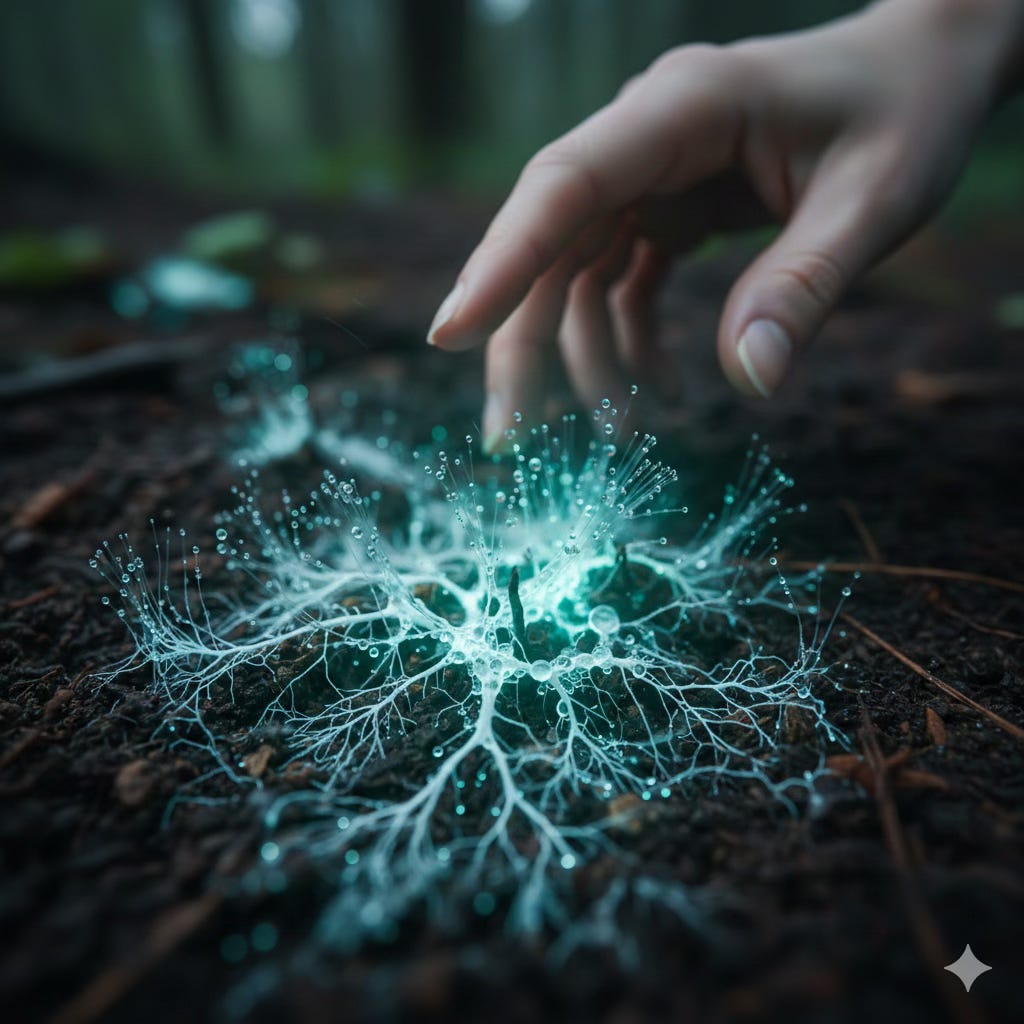
For 3.7 billion years, life on Earth has been evolving toward something remarkable: the capacity for all living beings to communicate directly with one another. We are now entering the next stage of this journey. I call this stage Mycelial Consciousness. Some call it Planetary or Gaia Consciousness.
The process, over ~3.5 million years, has unfolded through four stages:
Mimetic ⇢ Magical ⇢ Mythic ⇢ Material ⇢ Mycelial.
Material Consciousness emerged ~12,000 years ago with the Neolithic Revolution and Mycelial in the late 20th century with the Cognitive Revolution.
Mycelial Grounding Principles
To understand the importance of what’s unfolding, we need a basic understanding of the following significant bodies of research:
Major Evolutionary Transitions (evolution biology)
The Evolutionary Impulse (philosophy & religion)
Cognitive METs (consciousness studies)
The Four Revolutions (anthropology & cultural evolution)
1. Major Evolutionary Transitions
Biologists have identified Major Evolutionary Transitions (METs) as pivotal events that fundamentally reshape life and increase complexity. Single-celled organisms becoming complex life forms is one example, unfolding over 3.7 billion years. But METs aren’t limited to biology. In human systems, they describe shifts in how we store, transmit, and process information: from oral traditions to writing, printing presses to computers. Each transition enables new levels of coordination and collective intelligence. Let’s explore in more detail.
2. Cognitive METs
Over millions of years, human consciousness has evolved through distinct stages, each enabling new forms of coordination:
From Mimetic Consciousness (~3.5 - 1.9 million years ago), where our ancestors communicated through gesture and ritual, we progressed to
Magical Consciousness (~1 million years ago): Characterized by animistic, participatory engagement with the world and then
Mythic Consciousness (~100,000 to 70,000 years ago): The rise of spoken language and narrative-based meaning-making.
Material Consciousness (from ~12,000 years ago with the Neolithic Revolution to present): The externalization of memory through writing, print, and digital media, enabling abstract symbolic thought.
Mycelial Consciousness (late 20th century onward with the Cognitive Revolution): A decentralized, networked cognition modeled on fungal mycelium, enabling distributed knowledge creation and coordination.
As we progressed through each stage, our ability to coordinate the collective actions of large numbers of people gradually improved. The question is, How did these coordination mechanisms come into existence?
To try and answer this question, there is one more term we need to understand, and that is the Evolutionary Impulse.
3. The Evolutionary Impulse
There is an “Invisible Hand” driving METs. I call this underlying drive the Evolutionary Impulse. It’s an organizing principle within living systems that pulls them toward greater complexity and deeper connection. Whether you understand this through biology, philosophy, or spiritual traditions, the pattern is self-evident: life strives toward more elegant forms of relationship.
4. The Four Revolutions
These cognitive transitions parallel a material evolution in human enterprise. As our consciousness expanded, so did the domains in which we could create value.
The Four Revolutions describes the evolutionary trajectory of entrepreneurship across four major revolutions, tracing humanity’s movement from tangible, land-based value creation to increasingly abstract domains — culminating in consciousness itself as the emerging entrepreneurial frontier.
Here are the four types of entrepreneurs that emerged with each revolution:
Farmer - Neolithic Revolution
The first entrepreneurs turned agricultural knowledge into surplus goods for trade. Direct relationship with land, limited geographical scope, physical proximity requirements, resource extraction tied to local ecosystems. The domain is soil—no abstraction.
Forger/Factory Owner - Industrial Revolution
Entrepreneurs transitioned from direct producers to managers of complex systems. Manufacturing became centralized and mechanized, severing direct links between entrepreneurs and physical production. Global supply chains replaced local dependencies. Entrepreneurial focus shifted to managing production, innovation, and markets. The domain is factory—low abstraction.
Founder/Fixer - Digital Revolution
Digital entrepreneurship created unprecedented abstraction. Value creation through software, platforms, and intellectual property. Global reach without physical presence. Network effects became the primary source of value—facilitating connections rather than producing physical assets. The domain is servers—medium abstraction.
Framer - Cognitive Revolution
The emerging entrepreneurial frontier operates directly on consciousness itself. Framers create value through platforms and practices that enhance collective intelligence, facilitate accelerated learning and adaptation, enable co-creative evolution, and integrate past-present-future perspectives. The domain is consciousness—high abstraction.
Now that we’ve understood MET’s, the evolution of consciousness, the Evolutionary Impulse, and the four entrepreneurial revolutions, let’s take a closer look at the next form of consciousness: Mycelial Consciousness.
Mycelial Consciousness — A Working Definition
Mycelial Consciousness is the inevitable next stage in humanity’s evolutionary arc toward planetary consciousness, propelled by the same Evolutionary Impulse that has shaped 3.7 billion years of increasing complexity. As the emerging fifth Cognitive Major Evolutionary Transition, it represents our evolution toward networked coordination patterns that mirror nature’s wisdom, enabling regenerative human systems to participate consciously in the larger web of life while fostering innovation and resilience.
Mycelial Consciousness mirrors the sophisticated coordination patterns found in fungal networks and is characterized by:
Adaptive Network Intelligence: Like mycelial networks that dynamically respond to environmental changes, this consciousness enables fluid, responsive coordination across human systems through distributed yet interconnected nodes of awareness.
Living Systems Integration: The ability to consciously participate in and learn from Nature's proven coordination strategies, particularly the balanced, regenerative patterns exemplified by fungal networks in forest ecosystems.
Nutrient-Like Information Flow: Similar to how mycelial networks distribute resources and information through forest ecosystems, this consciousness facilitates the efficient and equitable flow of knowledge, resources, and support across human networks.
Resilient Interconnectivity: Development of robust, redundant connections that, like the “Wood Wide Web” popularized by Suzanne Simard, create resilient systems capable of adapting to disturbance while maintaining essential functions.
Boundary-Spanning Mediation: The capacity to bridge and integrate across different systems (biological, social, technological) just as fungal networks mediate relationships between diverse species in forest ecosystems.
Regenerative Organization: A shift toward organizational patterns that enhance the vitality of the whole system, mimicking how mycelial networks support forest health and regeneration.
Distributed Yet Coherent Processing: Like the distributed intelligence of fungal networks, the ability to process information and coordinate responses across multiple nodes while maintaining system coherence.
Balance of Efficiency and Exploration: Capacity to simultaneously maintain established connections while exploring new possibilities, mirroring how mycelial networks optimize resource distribution while expanding into new territory.
Multi-Scale Integration: Understanding of how local actions and patterns influence larger system dynamics, similar to how individual fungal connections contribute to ecosystem-wide resilience.
Symbiotic Development: Recognition of and participation in mutually beneficial relationships across different scales and types of systems, reflecting the sophisticated symbiotic partnerships facilitated by fungal networks.
References
Deep dive: https://bit.ly/MetaCon and https://bit.ly/M-E-T
The Mycelial Network and Human Evolution: