

Why this essay? The past week was, for me, mind-blowing. It started with a simple thought/meditation/intention: What am I willing to shift/adapt/embrace personally that will unlock the abundance for all we sense in our valley but haven’t yet been able to tap into? The question itself came from a series of conversations I’ve been having over the past few months — thanks JP! This essay is an attempt to unpack what feels like a significant shift for our (and potentially other) BioHubs that unlocks economic value in rural areas in entirely novel ways. There may be errors in how I’ve interpreted what came through as a powerful download. These errors are mine alone, and I’d be grateful if you’d point out where I’m missing something.

Background
As usual, a few context-setting snippets so that the remainder of the essay makes more sense.
Protective Illiquidity. Last week’s essay explored the challenging land tenure situation we’re navigating in our valley.1 I described the blockage as a blessing in disguise, because it means the land hasn’t fallen prey to commercial over-development. That means it remains available for other forms of value creation in which the value created remains in the valley.
Seeing Like a State. Published in 1998, Seeing Like a State: How Certain Schemes to Improve the Human Condition Have Failed by political scientist James C. Scott explores why large-scale, top-down government plans to reshape society and nature often end in disaster.2
TIMN → TIME. If you’ve been following my work for a while, you’ll know that I’m a big fan of David Ronfeldt’s TIMN framework that explains the evolution of forms of human coordination.3 In the conversations I’m having recently with groups in our valley, I’ve found it easier to replace the +N form (Network) with +E, to mean Emergent. It just saves having to explain some of the uncertainty around the word “Network.” This change isn’t endorsed by David, because I’ve not yet had a chance to catch up with him recently. However, this simple shift has unlocked significant coordination activities around the simple slogan: It’s About TIME, which echoes the deep yearning for change from a rapidly growing group of people.
[Edit: 11 Aug, 2026, after I made an inaccurate claim about the link between the two concepts mentioned] Promise Theory developed by Mark Burgess and Jan Bergstra, is a formal theory of voluntary cooperation among autonomous agents.4 Commitment Pooling, developed by Will Ruddick and grounded in ancestral rotating labor traditions across East Africa, is an economic protocol for curating and exchanging pooled resources within communities.5 The two frameworks helped me understand Sahtouris’ claim that ‘collaboration is cheaper than competition’ from entirely different starting points: that cooperation works when it’s voluntary, and that systems built on this foundation can coordinate resources without central command. Both Promise Theory and Commitment Pooling can be used to model the behavior of a community working together on societal challenges in ways that create economic value. The remainder of this essay explains how.
Water as Wisdom-keeper and Governance Holder. This is a big topic, and one I’ll unpack in future essays. For now, I just want to introduce the work of Stef van Dongen and Victoria Engelhorn in the Muga watershed in Catalonia, Spain.6 (Thanks for the hat tip, GS!) Their approach is based on earlier work by Professor Millan Millan’s concept of a Two-Legged view of Climate.7
The TIME Reader. Inspired by the principle of the book Seeing Like a State, I wondered if there exists a collection of books that describe Seeing Like a Tribe, Seeing Like Other Institutions, and Seeing Like a Market. I couldn’t find a definitive list, so I’ve now assembled just over 20 significant and timeless books into just such a reading list, called The TIME Reader.8
Now let’s dive into novel way residents in rural areas can create significant economic value. I’ll first walk through the theory and then use our valley as an example so you can see the theory in action.
1. The Evolution of Nodes of Coordination
A few days ago I introduced the Bio-revolution in the context of three previous revolutions:
Agri-revolution (12,000 years ago, which mechanized farming and high-yield crops)
Indus-revolution (250 years ago, which scaled manufacturing via steam, coal, and automation)
Digi-revolution (50 years ago, which connected the world through computers, the internet, and data, changing how we share information, run businesses, and automate tasks)
Bio-revolution (currently emerging, which organizes activity around a defined watershed)
The important observation is that every revolution develops around a node, which is the physical place where the era’s coordination logic materializes or concentrates. Each node also externalizes certain costs.
The Agri-node began with a community settling in a particular place, which held kin, land, water, and labor. That coordination collectively produced surplus for the first time in recorded history. That surplus led to the emergence of the granary, and the granary led to the temple, and the temple gave birth to the state. I want to propose that this coordination node was a specific parcel of soil. Its optimization target was caloric yield per unit of land. Its time horizon was seasonal and generational. The costs the agri-node externalizes is the substrate it depends on: soil depletion, downstream water quality, and the untamed/untouched commons the soil was separated from.
The Indus-node has shifted location over time from the farm to the mill, then to the company that owned the mill, then to the exchange where the shares of the company were traded. By the middle of the nineteenth century, the stock market had become the node because it’s where ownership decouples from operation. The farmer who owns the farm is replaced by the shareholder who owns a claim on a factory the shareholder will never enter, run by managers the shareholder will never meet, producing goods the shareholder may never see.
What is coordinated is capital, risk, and claims across financial time.
What is optimized is return on capital.
What is externalized is anything that isn’t tracked in the accounting department’s record-keeping: labor conditions, biosphere depletion, and the coherence of the communities the labor is drawn from.
The Digi-node is the data center. Personal computers and smartphones and the platforms that run on them are the endpoints, but the data center is where the coordination of attention, behavior, information, and computation happens. Its optimization target is prediction accuracy, which is another name for human coordination at scale. Real-time coordination is the design goal. The length of elapsed time between stimulus and response (a time period once filled by human deliberation and evaluation) is the field the industry is now competing to fill. The cost this form of coordination externalizes is energy and water. The grid is being asked to double its capacity in a decade to serve loads that produce no material good. Hyperscale data centers emerging globally consume watershed capacity at rates that break local hydrological budgets. The state permits this activity because, as we saw from the context-setting, the state thinks like a state (increased revenue) and the market thinks like a market (increased profits). No amount of reasoning or protestation can change the underlying incentives. Prices have shifted from goods to attention, and from capital to compute. Costs have been externalized to communities. This is the bad news.
The observation that comes from the evolution of coordination nodes is the increasing abstraction of the real cost of coordination. Each solved its coordination challenge by displacing those costs onto the substrate the next node would organize. The community’s substrate was soil. The stock market’s substrate is a claim. A claim is a promise about the future written down and made tradable. Claims can be manufactured in unlimited quantities; soil (and all natural capital) cannot — they have biophysical limits.
For two and a half centuries, the stock market’s coordination worked because the biosphere could absorb what the accounting department couldn’t price. The forests were still there, the oceans and all that swam in her remained abundant, and the atmosphere still supported life. The costs the stock market externalized were allocated to substrates that seemed inexhaustible (and in the beginning they were). Now the costs of water and energy (traditionally handled by the state) have been externalized to communities. The substrate below these communities can no longer absorb the cost. This is the point at which societies typically collapse.
2. The Bio-revolution, with the BioHub as Node
The BioHub is the physical anchor of the fourth node of coordination, and it’s the context that transcends the mainly ecological focus of most bioregional regeneration initiatives to include an economic focus. It does this by making promises and commitments to the parties who have externalized the costs of the Digi-node to rural communities, in exchange for economic rewards.
The BioHub name is fairly recent. The paper that formalized it was published by Metabolic in May of this year, building on work by Ernesto Van Peborgh, Samantha Power, Leon Seefeld, and others.9 The idea itself has been bubbling along below the surface of the regenerative movement for at least fifteen years, using different vocabularies.
A BioHub is a place-anchored coordination point that organizes activity around a defined watershed, in response to rapidly escalating externalized costs. It is the cradle that nurtures the land, water, biological cycles, and human creativity and ingenuity together as a single coordination node. It operates at the scale of the bioregion, which is the scale at which biological time is actually meaningful and measurable.
The BioHub includes the soil, and that inclusion completes the cycle of the evolution of coordination. Soil was the first coordination point; the BioHub is the first that can hold the soil inside a frame the farm alone couldn’t justify because the only service the farm priced was the provision of calories. Soil now becomes the substrate from which water and energy are priced. Stated differently, the provision of calories is now less profitable than the provision of kilowatt-hours (kWh). The land continues the same relationship to the Institution (state) and the Market (big tech) and the Digi-node, but this time on their pricing terms. The BioHub folds them all in by providing services no other coordination node can adequately provide. Data centers continue to run inside the BioHub’s energy and water budget, but what changes is which coordination node determines the prices for their services.
The BioHub coordinates living systems inside a defined watershed. It optimizes for the continued viability of the substrate it depends on. It externalizes nothing the previous three coordination nodes haven’t already exhausted.
This is the essence of the download that arrived earlier this week.10 This is a very big deal, and I hope my explanation is sufficient to crystallize for you how important this awareness is. In essence, the BioHub is the first coordination form that cannot displace its costs, because there is no substrate below it to receive them. The externalities have to come home, and this creates a huge opportunity for those BioHubs that are sufficiently coordinated to play the role being offered them.
Before I continue, here’s an AI-generated summary table of the four forms of coordination. I’ll unpack this in subsequent essays, but I thought it could be valuable at this point.
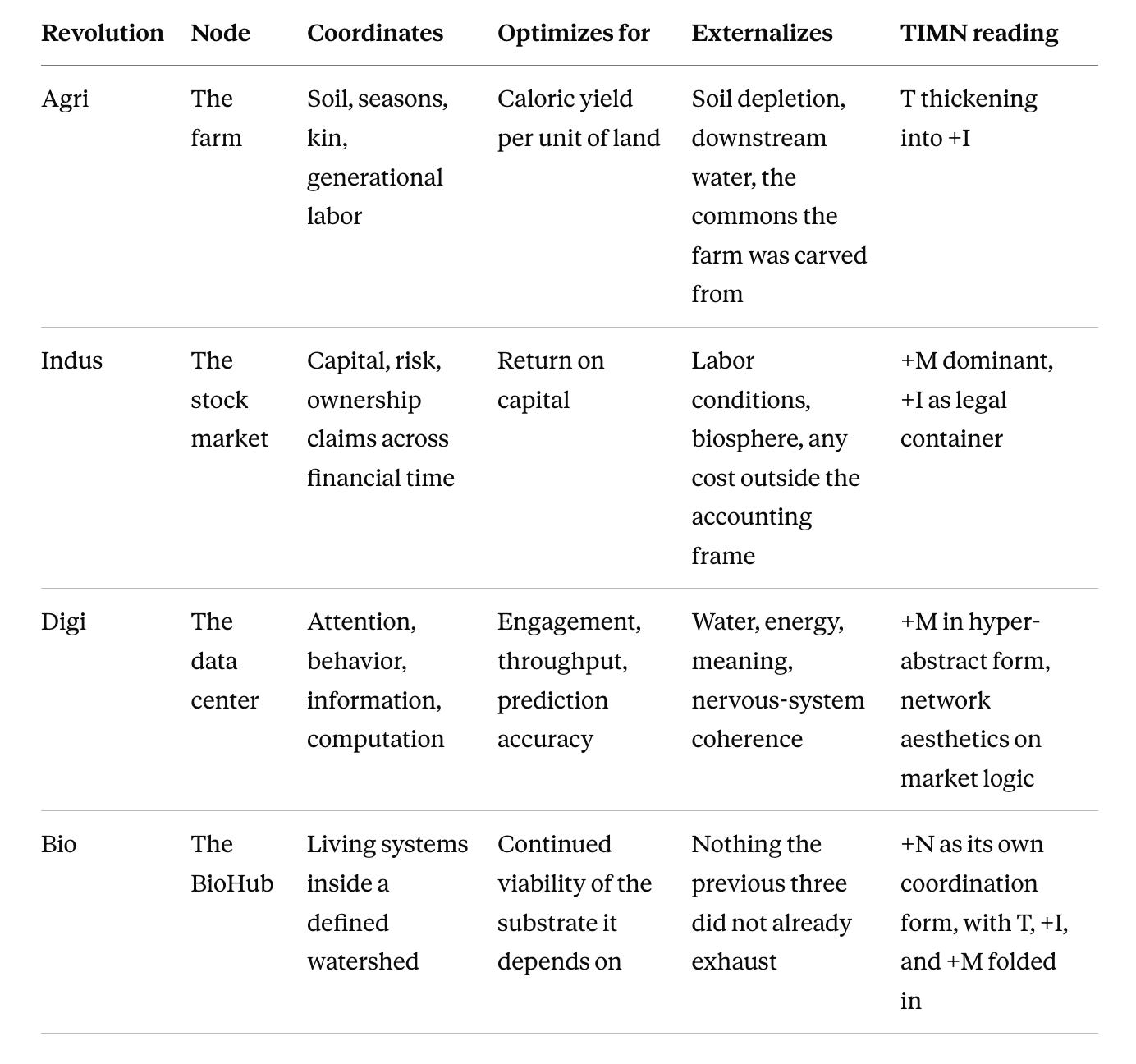
What the column called “Externalizes” shows is a running debt. Each era’s externalities column is what the next era inherited. The Bio row is where the running debt becomes due, because there is nowhere further to send it. This debt that must now be repaid is what creates the economic value for the BioHub.
Let me make this more tangible by showing what promises our BioHub could offer to both the Market and the State. Loosely, the offer has previously been called Payment for Ecosystem Services (PES). In the past PES has been described as a type of market-based instrument that is increasingly used to finance nature conservation. The proposition now is that PES is a service offered by rural communities to coordination forms that desperately need what only rural areas can provide: energy and water. And we’ll provide those services based on terms and conditions the BioHub determines, because there’s nowhere else these services can be provided. It’s called a natural monopoly, a term the Market knows all too well, but this time with a twist.
3. The Valley of Grace as an Example BioHub
Consider the catchment area of the Riviersonderend (the river that runs through the Valley of Grace).
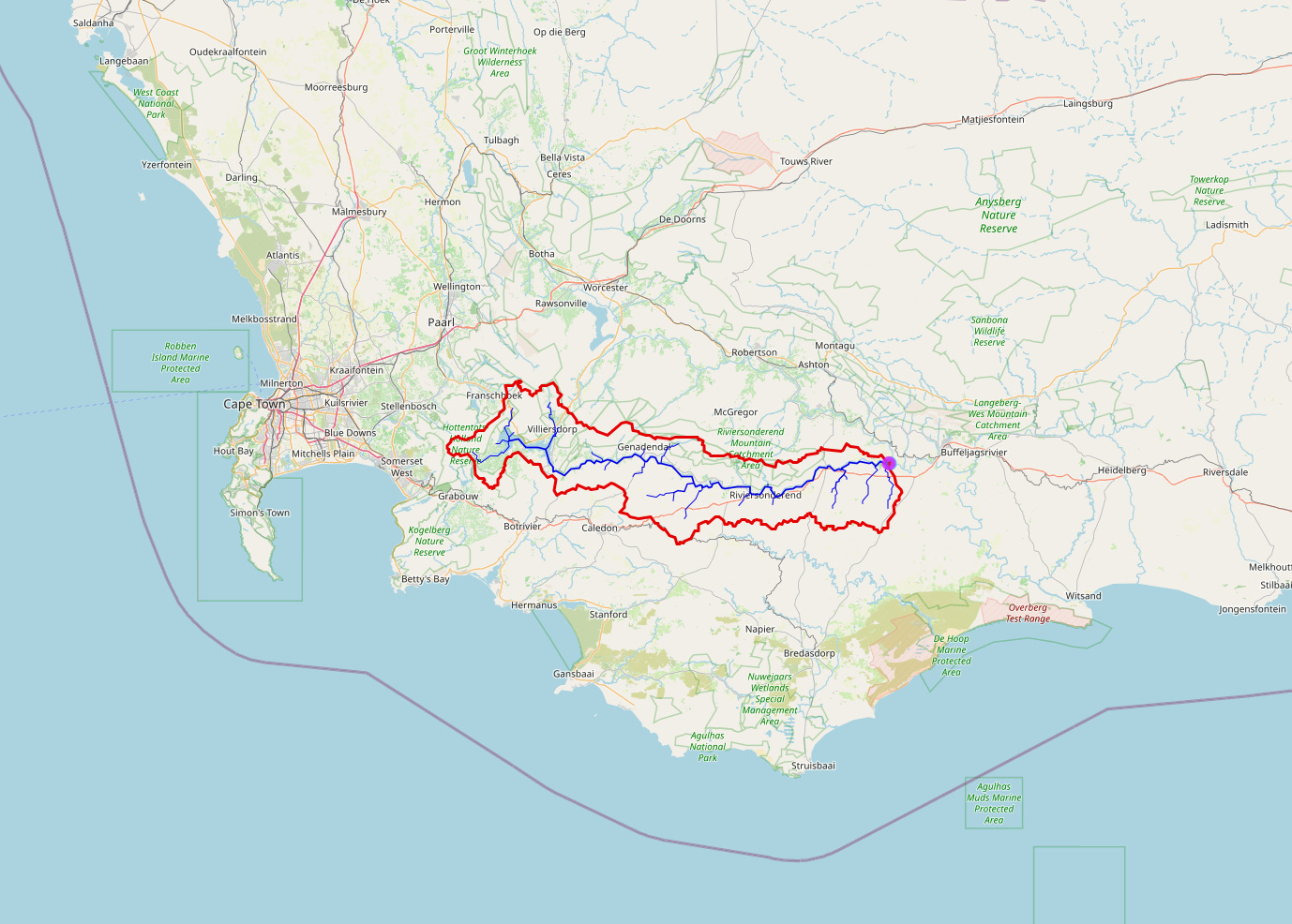
It runs from the Franschoek Mountains above Cape Town in the west, through the Theewaterskloof Dam, through the fynbos slopes below Genadendal and Greyton and out toward the Breede River and eventually empties into the sea at Witsand to the east. The river system carries two commitments that most of the residents along its banks don’t know about. The first is to Cape Town, which draws roughly half its water from the dam. The second is to the estuary at Witsand, where a minimum freshwater flow keeps a functioning ecosystem alive at the river mouth. Both commitments are binding, thanks to the National Water Act.11 Only one of them generates municipal revenue. The other commitment is a public good with no price tag, and every dry season creates a tension between the City of Cape Town and the estuary. In other words, there’s a structural risk housed in the river system.
Ward 2 of Theewaterskloof Municipality, which covers 69,000 hectares of mountain, mission village, farmland, and river, is home to the BioHub of The Valley of Grace. The municipality is under a Provincial Financial Recovery Plan and the largest landholding has unresolved communal tenure dating back to 1998. As a result, much of the land has lain fallow and soil quality is questionable.
The question the BioHub is currently asking is what commitments each actor can pool toward outcomes that no single actor can produce.
Three Commitment Pools in the Valley
The water pool
The estuary commitment and the metropolitan commitment compete only under scarcity. Under conditions of abundance, both commitments can be easily honored. Periods of abundance can be increased through conscious human activity on the slopes, along the tributaries, and along the riparian corridors that feed the dam from above and the river below the dam. Infiltration on the fynbos slopes, alien clearing across the protected area complex, riparian repair on the feeder streams, and agroecological transition on cultivated land each produce additional baseflow downstream of the dam. Focussing on the hydrological cycle and the sea air coming in from the south and being forced upwards by our mountains could stabilize annual rainfall variations. Additional rainfall and baseflow are what lets more water reach the estuary without cutting the metropolitan draw, and what lets more be committed to the metropolis without stripping the estuary. Stated differently, every stakeholder along the river ecosystem are also contributors to the instrument that reduces the structural risk and resolves any potential conflict.
This is where the failed land negotiations become useful again.12 The Transformation of Certain Rural Areas Act treated communal land as farming land. On the largest holding in the catchment area, farming has produced nothing meaningful in a quarter of a century. When one views that same hectarage as an ecosystem services asset, a different picture emerges. The land is a hydrological contributor, a carbon sink, a biodiversity reserve, and a heritage estate. The Department of Agriculture has said funding is available for exactly this reframe. Communal tenure that has resisted commercial buyout for a generation turns out to be well suited to holding a long-duration ecological commitment. The pool takes the contribution and remunerates the contributor. The metropolitan user pays into the pool for the outcome.
The energy pool
Solar and wind are Market-driven capital answers to an infrastructural question. They arrive as equipment, generate output on a private balance sheet, and export value out of the catchment area. A river is a different kind of asset. The gradient from the headwaters to the confluence is a piece of geography that belongs to nobody and yet does work for everybody. Run-of-river micro-generation, sediment management, weir maintenance, and riparian shading that keeps water temperatures within ecological range are all components of a single infrastructure whose primary function is the river’s ecological integrity and whose secondary yield is dispatchable energy.
Held as a commitment pool, the river remains an ecological system that also generates power.
Held as a private asset, it becomes a power asset that also degrades an ecological system.
The pool lets small generators, ecological monitors, farm-scale users, and grid interconnectors each contribute a commitment and each draw an entitlement. The generation asset is publicly held. The obligation to keep the river alive is publicly held with it.
The tourism pool
Cape Town will absorb tens of millions of domestic and international visitors in the current planning cycle. The city’s carrying capacity for that traffic is already breached on peak weekends (some would say every weekend). Every visitor the bioregion can appeal to is a visitor the city doesn’t have to provide water and other infrastructure for. The bioregional offer works as a decompression instrument: a distributed set of small settlements, heritage sites, conservation areas, and food-growing landscapes that a metropolitan visitor can move through for two days, four days, a week, before returning to the city. A pooled tourism offer means each actor in the bioregion (a mission museum, a hiking trail, a farmstay, a fynbos reserve, a Saturday market, a citizen science project) commits a share of visitor capacity into a common ledger. Revenue accrues to the contributor. Coordination accrues to the pool. The city is a beneficiary of a system it doesn’t own.
What Commitment Pooling Achieves
Commitment Pooling is a coordination form that predates the corporate balance sheet by several centuries and postdates it by however long the current arrangement lasts. Its logic is simple. Under a real division of labor, contributors put forward goods, services, hours, or ecological function into a shared pool. Participants draw on the pool by virtue of membership and contribution. Market price doesn’t govern the draw. State allocation doesn’t govern it either. The pool is a fourth coordination form sitting alongside kinship, institution, and market. The BioHub is the node that holds this coordination form. None of the other three can handle the coupling between an upstream hectare and a downstream tap.
The instrument I’ve described will become increasingly important, especially as the Decade of Dramatic Disruption creates pain points more severe than we’ve already seen. A municipality under financial recovery cannot fund watershed restoration. A conservation authority cannot underwrite tourism marketing. A private farm cannot sell hydrology into a market that has no way to price it. Communal land held under a failed farming statute cannot generate a revenue stream from its ecological function. Each actor is stuck at the edge of what its own coordination form allows. The pool is what makes the entire ecosystem productive.
The Emergent Coordination Form
In the Valley of Grace this is slowly becoming visible.
A conservation society and a communal governance body are co-authoring a tourism proposal that treats a leopard corridor, a mission museum, and a citizen science project as a single offer.
A wind farm’s community development mandate is being routed toward heritage upgrades in the settlements its grid connection passes.
A food forest is being drafted as the founding group of a savings pool that will, over time, become a chartered financial commons.
Communal land that has sat immobile under a farming statute is being reread as the ecosystem services asset it always was.
A river that has been managed as a source of municipal water is being reimagined as an infrastructure that owes an estuary its ecological share and owes a metropolis its urban share, with upstream restoration as the instrument that keeps both promises intact.
None of this is anywhere near finalized and most of what I’ve described is tenuous, fragile even. The only point I’m making is that the Emergent coordination form is available. A bioregion becomes a BioHub when a specific place questions what its actors could contribute that shifts from ownership of infrastructure to commitment into the pool the infrastructure requires.
This is what Seeing Like a BioHub looks like, and it’s entirely different to Seeing Like a State. It’s night-and-day different to Seeing Like a Market.
That’s all for this week.
Over the coming weeks I’ll dive into further details about this Emergent form of coordination. Next week, I’ll share a BioHub diagnostic, which will help anyone in a bioregion identify whether they ‘see’ as a Tribe, Institution, Market, or Emergent. Early testing has raised some pretty interesting results.
Until then, remember to love the ones you’re with, and frame on!
Michael 💚
Protective Illiquidity

Why this essay? There’s a lot going on right now, and one could easily make the case that everything is hopeless. But the worse things get, the more optimistic I become. A breakdown makes space for genuinely new ways of thinking about challenges to emerge. That’s what happened this week. A meeting between two initiatives in The Valley of Grace that have…
I admit that I’ve not yet read the book, but it has been recommended a number of times: https://www.amazon.com/dp/0300078153. What I like, though, is the principle of looking at a particular challenge through the lens of the state. What seems like a nonsensical course of action sometimes makes more sense when you understand how the state operates. You can also access a PDF from a link mentioned in footnote 7: https://bit.ly/TIME-read.
I reference TIMN extensively. It’s a model of how human coordination forms have evolved through the ages. If you’re a new reader, you may want to first get a sense of the model: https://bit.ly/TIM-N
When I first published this essay I included a sentence which said, “Will Ruddick has expanded Promise Theory into Commitment Pooling.” This is incorrect and I’ve now updated the paragraph to remove this inconsistency. Learn more about Promise Theory here: https://bit.ly/42yKn7T
For Ruddick’s views on Commitment Pooling and his experience in West Africa, see his 2025 book, Grassroots Economics: Reflection and Practice: https://grassrootseconomics.org/book/
A large part of their work has to do with restoring the hydrological cycle across the Spanish plains, and approach I am gearing up to introduce in our valley. See an overview of their inspiring work, as well as a 30-min documentary, here: https://bit.ly/Muga-Wshed
Professor Millan Millan’s concept of a Two-Legged view of Climate is a holistic understanding of climate dynamics that integrates two critical components: the land-use leg and the emissions leg. For an overview of a significant body of work done in Spain, see https://bit.ly/2LegClim
The TIME Reader lists the most important books of all time, categorized by David Ronfeldt’s TIMN model: Tribes, Institutions, and Markets, with a fourth category called Emergent. Most of the books have a PDF available. Here is the quick list, with full descriptions and links available here: https://bit.ly/TIME-read.
Ibn Khaldun, The Muqaddimah: An Introduction to History (1377)
E.E. Evans-Pritchard, The Nuer (1940)
Benedict Anderson, Imagined Communities: Reflections on the Origin and Spread of Nationalism (1983)
Sebastian Junger, Tribe: On Homecoming and Belonging (2016)
Joseph P. Forgas et al. (eds.), The Tribal Mind and the Psychology of Collectivism (2024)
Max Weber, Economy and Society (1922)
James Scott, Seeing Like a State: How Certain Schemes to Improve the Human Condition Have Failed (1998)
Robert Jackall, Moral Mazes: The World of Corporate Managers (1988)
David Graeber, The Utopia of Rules: On Technology, Stupidity, and the Secret Joys of Bureaucracy (2015)
Chester I. Barnard, The Functions of the Executive (1938)
Karl Polanyi, The Great Transformation (1944)
Michael J. Sandel, What Money Can’t Buy: The Moral Limits of Markets (2012)
Friedrich Hayek, The Road to Serfdom (1944)
Milton Friedman, Free to Choose: A Personal Statement (1980)
Albert O. Hirschman, Exit, Voice, and Loyalty: Responses to Decline in Firms, Organizations, and States (1970)
Elinor Ostrom, Governing the Commons: The Evolution of Institutions for Collective Action (1990)
Yochai Benkler, The Wealth of Networks: How Social Production Transforms Markets and Freedom (2006)
David Bollier, Think Like a Commoner: A Short Introduction to the Life of the Commons (2014)
Robin Wall Kimmerer, Braiding Sweetgrass: Indigenous Wisdom, Scientific Knowledge and the Teachings of Plants (2013)
Samantha Power & Leon Seefeld, Bioregional Financing Facilities: Reimagining Finance to Regenerate Our Planet (2024)
I’ve provided a summary of the evolution of the BioHub concept, including a link to the latest iteration, here: https://bit.ly/Biohubs
In case you missed it, I planted the seed here:
Whoa! Download Alert 🤯

Why this out-of-the-blue heads-up? A ‘download’ is a sudden burst of deep insight or a feeling of total connection. It feels like your mind instantly receives a massive file of new ideas, grand truths, or creative visions all at once, rather than learning them step-by-step. Academically, it’s known as an ‘expanded awareness event.’ I’m currently process…
South Africa's National Water Act 36 of 1998 is the fundamental legal framework governing the nation's water resources. It abolishes private ownership of water rights, designating the national government as the public trustee of all water resources to ensure sustainable, equitable, and efficient management for all citizens.
I called this failure Protective Illiquidity in last week’s essay.
Not that I am for a carbon tax, but wonder, for clarification, if this would be an example of Payment for Ecosystem Services (PES)?
I do not understand this:
"A conservation society and a communal governance body are co-authoring a tourism proposal that treats a leopard corridor, a mission museum, and a citizen science project as a single offer."
How do the three services balance off incomes for services rendered? And what is their ROI?
Such a chock full of useful information and concepts for change! I am still in progress with it.
But want to mention "gift economy" and accompanying neighborhood sharing circle.
The "neighborhood' is defined as "reachable by walking or by bicycle." People gather monthly to share a pot-luck meal. They circle up afterwards. The power object is passed around the circle and each person who holds it gets the opportunity to share what they need by way of a thing or a service. After this there is a milling about time where those who have what a person needed hook up.
For example, an elderly lady needs help taking down the screens and putting up her storm windows. Two younger and stronger guys wind up helping her do this.
There are no money exchanges---it is all gifts within the neighborhood. A community biuilding device.