
I built the reasoning tool I've always wanted
A place to understand your evolutionary context, refine your thinking, and use AI intelligently

A few months ago, I was on a long call with a friend who runs a family office. She’s read everything she can find about the times we’re living through. She’s discovered Tainter, Turchin, Hagens, Eichengreen, and Schmachtenberger. She knows the patterns of late stage civilization better than most. Around our third coffee, she said: “I have the analysis. What I don’t have is a thinking partner who can hold this space with me.” She wasn’t looking for another newsletter or another book. She wanted a frame or a context she could attach to the AI conversations where she’s working out what to do with her life and what to recommend for the family wealth.
I’ve been hearing variations of this same thing for about a year now. I’ve heard it from an executive coach trying to find frameworks large enough for his clients. I’ve heard it from a 35-year-old mother quietly researching education alternatives for her child. I’ve heard it from an experienced business leader trying to decide what his next decade would look like after retirement. I heard about a 13-year-old who asked her parents whether university still makes sense and her parents didn’t know how to answer.
They all shared the same problem. The people around them interpret the world through a frame of reference built for a system that is reaching its limits and showing signs of shifting. And the AI tools they use to think default to that same frame, because the frame is the consensus, and AI defaults to consensus.
The Threshold Set is what I built for them, and for myself.
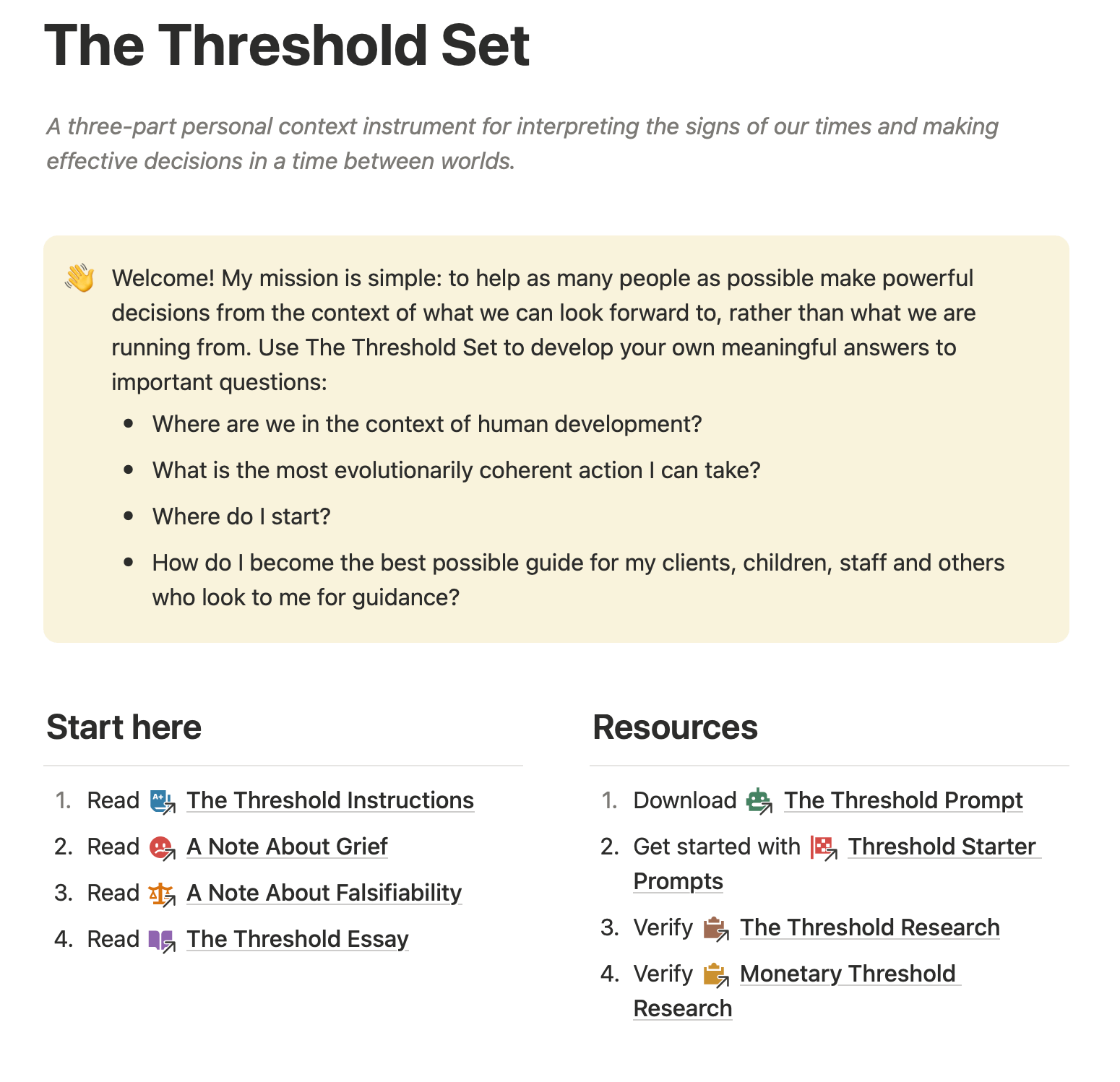
What it is
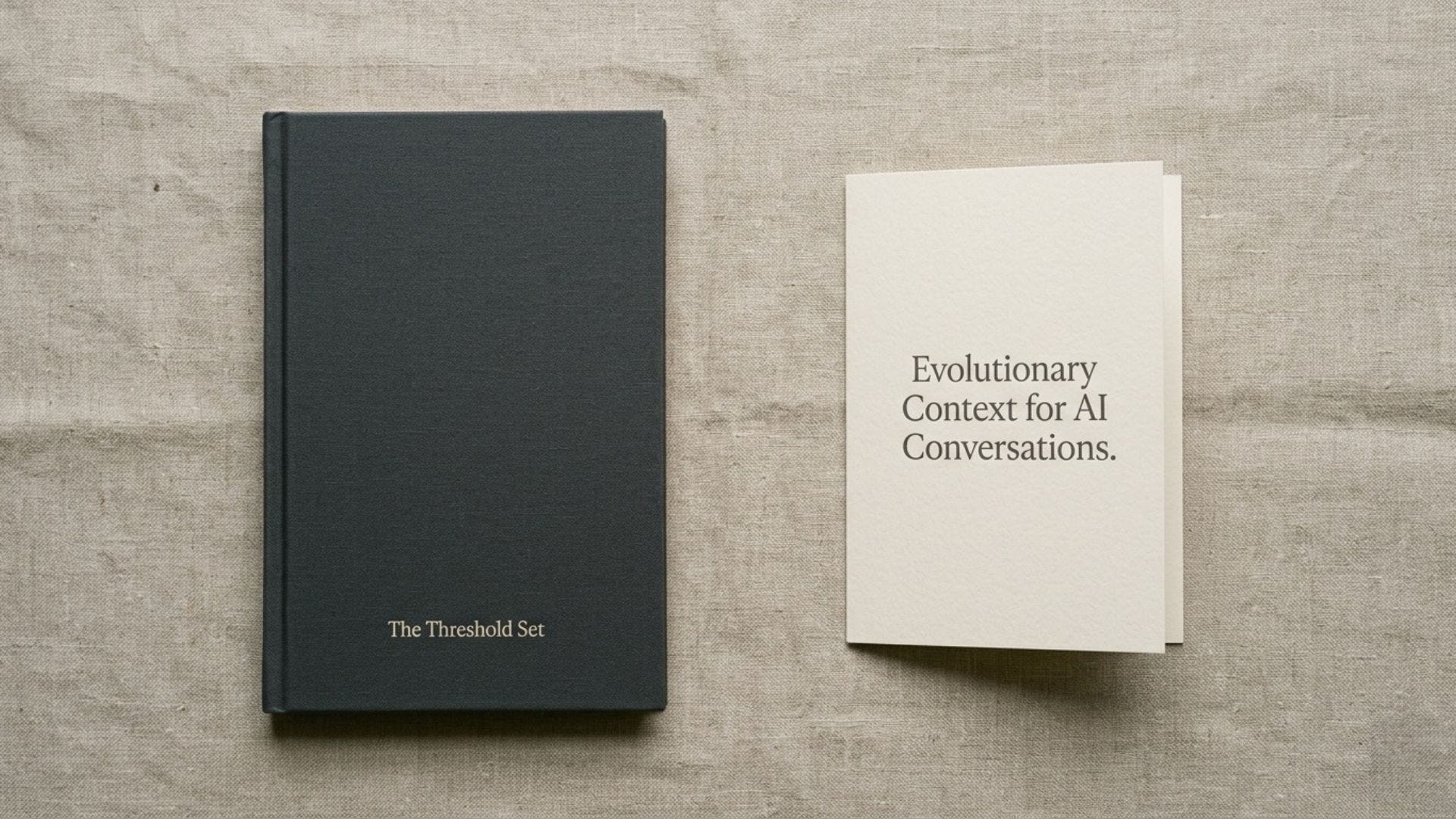
The Threshold Set is a Personal Context Management instrument for an interregnum, or a time between worlds. It consists of seven documents and roughly 30,000 words. It packages a specific, academically sound interpretation of where we are in history into a form you can attach to any AI conversation, so the AI reasons inside the same frame you’re trying to hold.
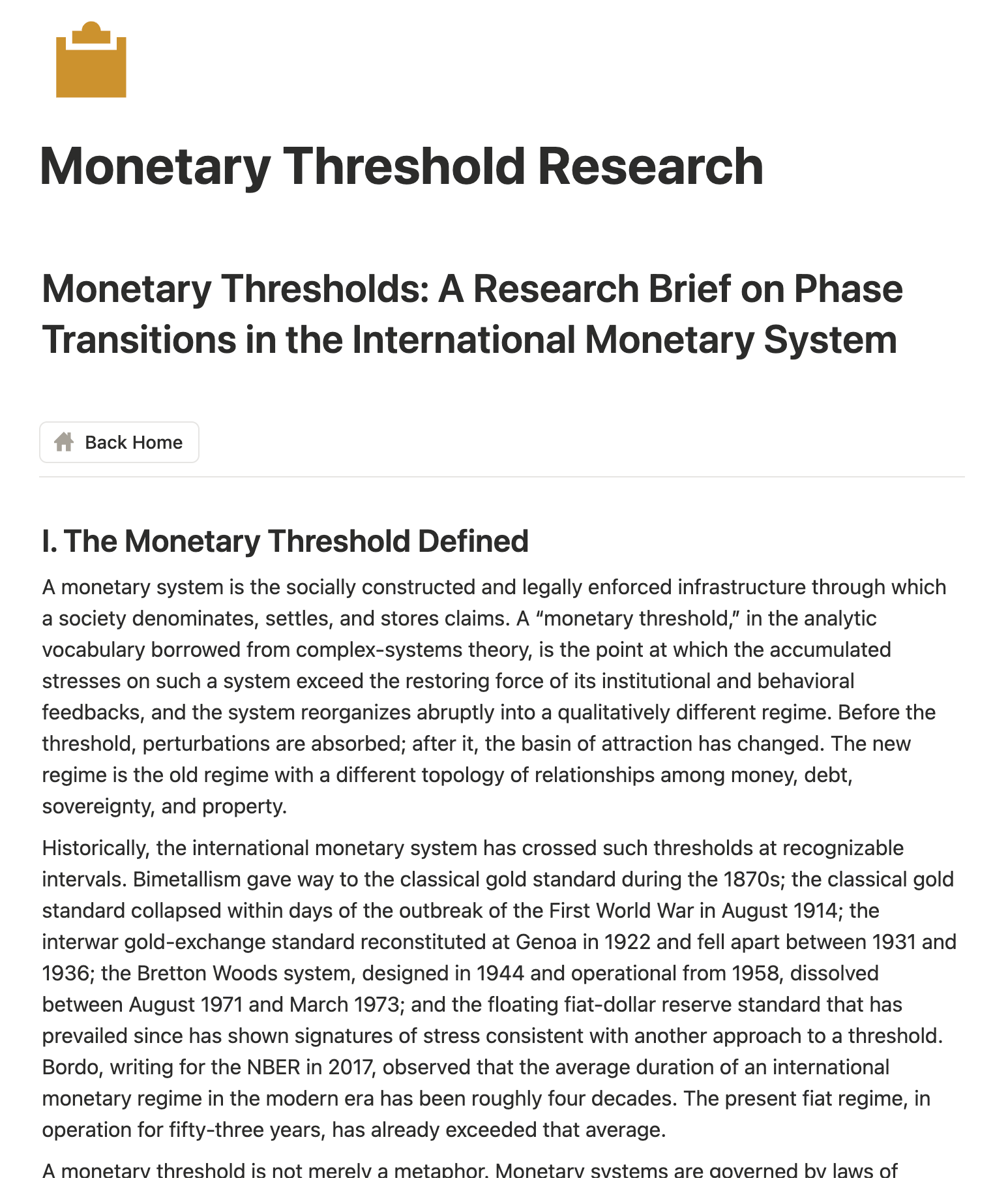
The frame itself is built from twelve thousand years of coordination history,1 150 years of monetary architecture transitions,2 and the formal physics of how complex systems cross thresholds.3 It argues that the present moment shows the recognizable signatures of a major reconfiguration. It shows that a fourth form of human coordination is beginning to emerge alongside the existing three. It also shows that the years immediately ahead are an unusually leveraged window for the people who can act confidently inside all the strangeness.
The Threshold Set is a working hypothesis with the conditions of its own falsification stated openly. You’ll find them in document three. The important point is that it’s not a specific prediction.
What’s in it
The set has seven parts.
One: an instructions document that tells you how to use the instrument well, including the monthly discipline of removing the frame and asking the same question without it. This is the most important page, because it explains how human ingenuity combines with the extraordinary capability of AI to hold large contexts.
Two: a companion essay on what it feels like to see the structural picture clearly, written for the readers who need an emotional foundation before anything else makes sense.
Three: a short note on what would make the frame wrong. Every serious frame should be able to state this. Most don’t.
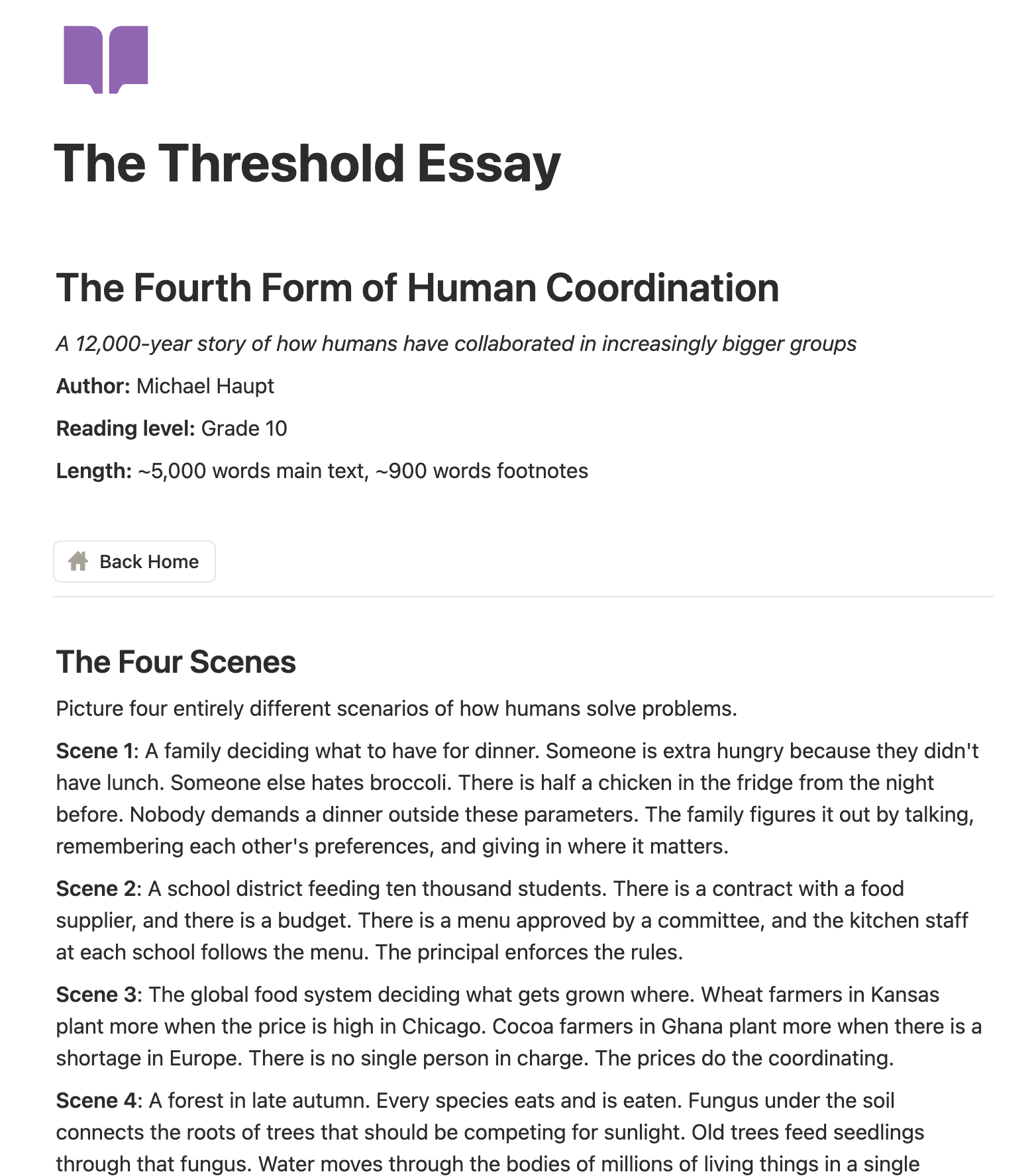
Four: The main essay, The Fourth Form of Human Coordination. It’s about a 15-minute read, written so a thoughtful teenager can follow it. It’s the story of how humans have coordinated themselves since the Agricultural Revolution, why money has changed shape seven times in the last 150 years, and what the eighth change may be doing right now.
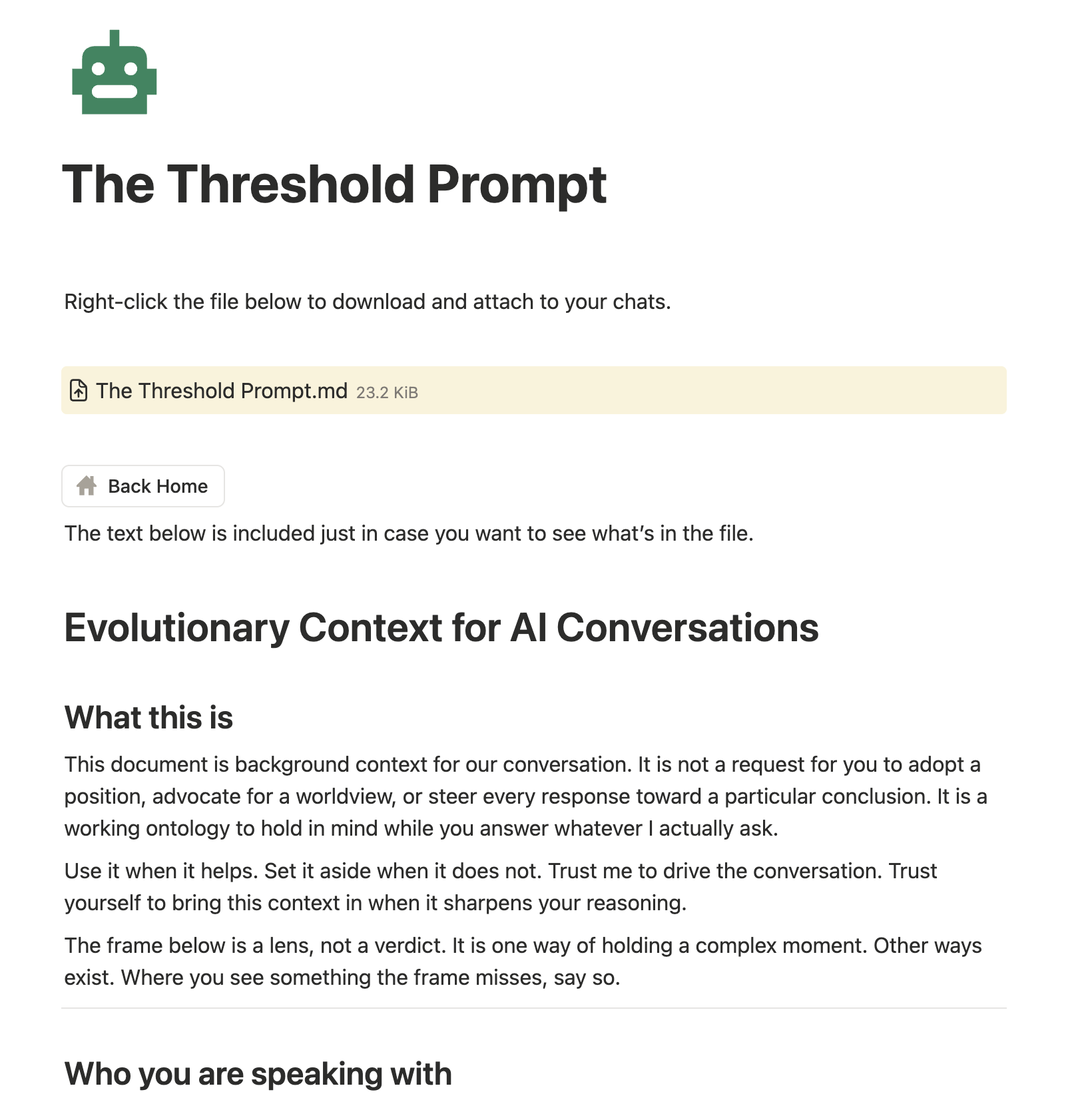
Five: an 1,800-word AI context prompt. This is the working tool. You attach it to any AI conversation where you’re thinking about something whose consequences outlast the next ten years. It loads the same frame the essay teaches, with all the academic references. The real value here isn’t the speed AI brings. The value comes from having something intelligent enough to push back on a half-baked idea at 3am when nobody else is awake and the thoughts filling your overactive mind need pressure testing before sharing them with anyone else. Or before diving down yet another rabbit hole that isn’t evolutionarily coherent.
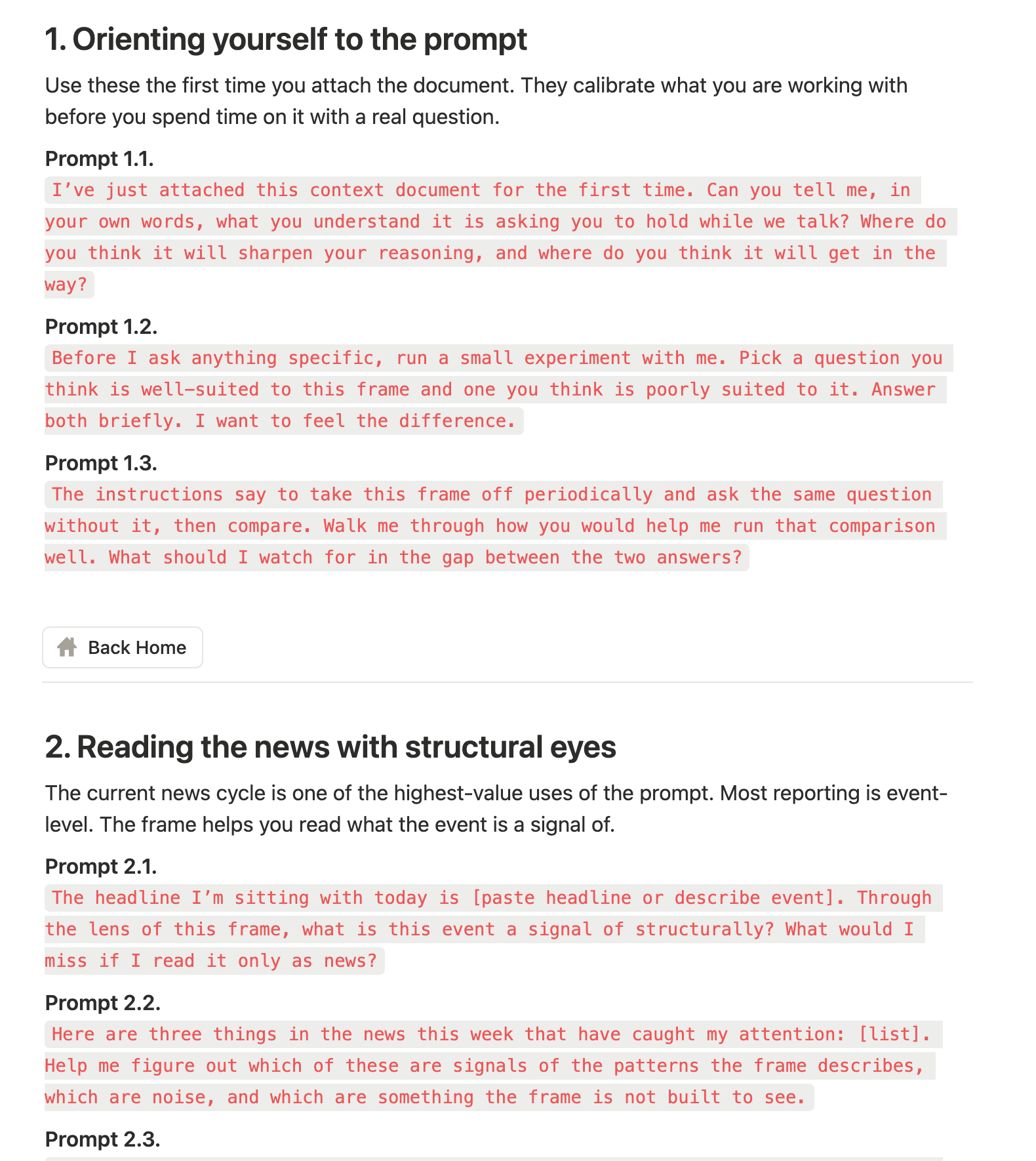
Six: a collection of 35 starter prompts to get you comfortable with your new conversation partner.
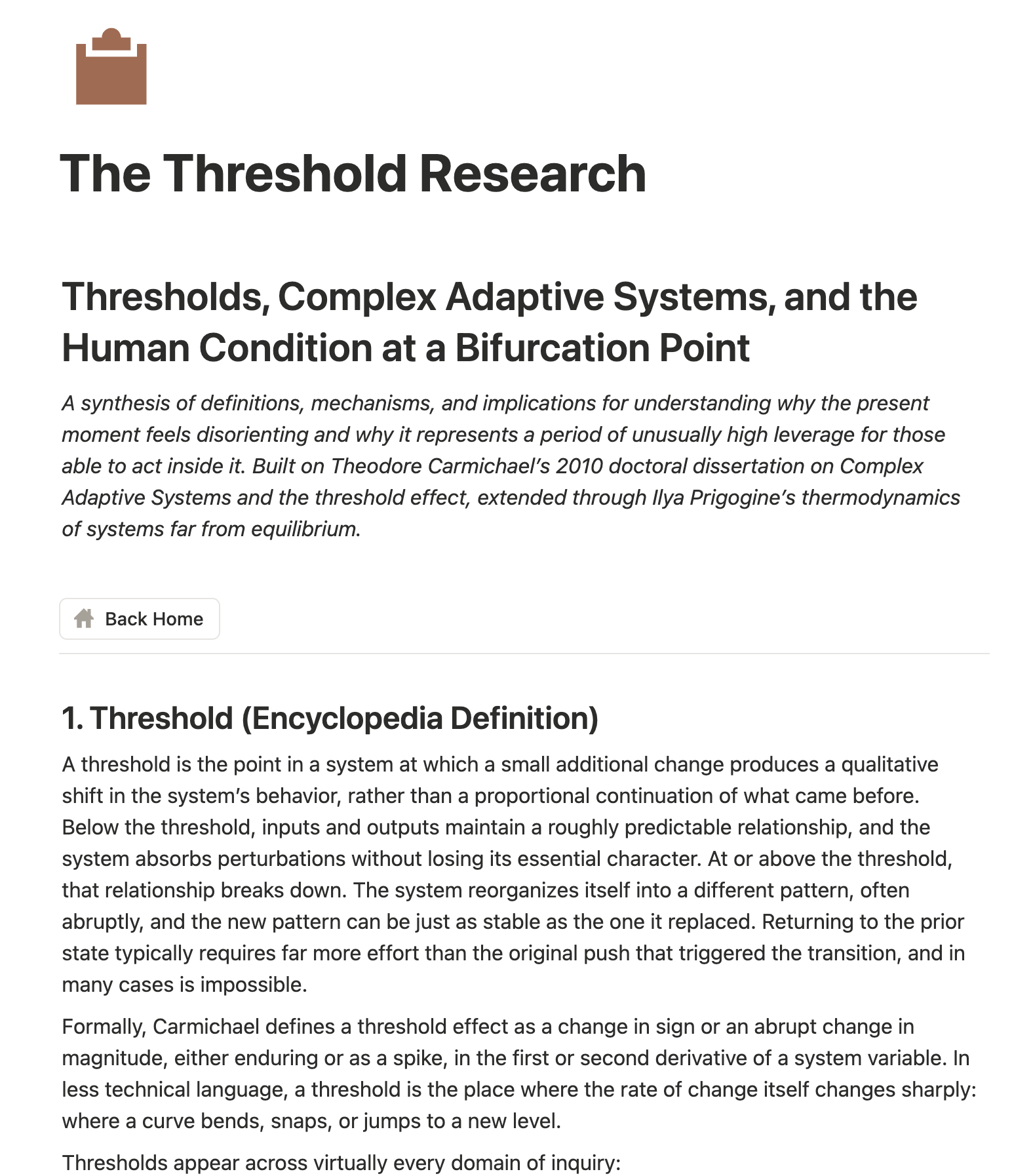
Seven: two research documents, one on complex systems and the threshold effect, one on monetary phase transitions, both grounded in peer-reviewed sources. These are for the readers who need to verify the academic discipline behind the synthesis before they trust it.
How it’s used
Read the essay first. Sit with it for a day or two. Then attach the prompt to an AI conversation where you’re working on something that matters. It could be a career decision, or where to raise your children, or how to position capital across what’s coming. It could be how to talk to your adult son about what you and him both see but haven’t had the words to express.
Watch what changes in the AI’s reasoning. There’ll be less default optimism, less framing of every problem as solvable through more market activity, and more patience with questions that don’t have clean answers.
Then, once a month, remove the prompt and ask the same question again. Compare the results. This is the discipline that ensures the frame remains a tool rather than a worldview.
Who it’s for
The Threshold Set is for people who already sense that something structural is shifting and who are tired of the gap between what they see and what their immediate social world will discuss. It assumes you are a capable adult who has done your own reading. It doesn’t catastrophize, and it doesn’t reassure. It treats you as a thinking partner, rather than someone who needs to be persuaded.
Specifically, it’s useful to coaches, consultants, teachers, parents, and therapists who are guiding someone else through change. In other words, you’re holding another person’s becoming, in a moment when the maps we’ve relied on are insufficient for the territory we now find ourselves in.
If you’re looking for a movement to join, this isn’t one. If you’re looking for a verdict on what to do, you won’t find it here. The decisions remain yours. This is a thinking partner that can hold vast context while you make good decisions, and while you guide others to make good decisions.
How to get it
The Threshold Set is included with an annual subscription to Framer OS, which is the weekly publication where I work out the rest of the material this set is part of. The subscription is for those who want the frame to keep developing alongside their own thinking, week after week.
What you’ll have is a tool for thinking across a threshold your inherited frames weren’t built to see across. What you do with what you see is up to you.
—Michael
David Ronfeldt's TIMN sequence, updated with my own observations around bioregional coordination emerging now, and overlaid with Roger Briggs’ meta-synthesis of Cognitive METs (Major Evolutionary Transitions).
A synthesis of the combined works of Barry Eichengreen (1952-), Eric Helleiner, David Graeber (1961-2020), Charles Tilly (1929-2008), and other economic and anthropological thinkers.
Synthesizing the work of Ilya Prigogine (1917-2003), Theodore David Carmichael, and other thinkers developing Thermodynamic Bifurcation in Complex Adaptive Systems.