
The Night my (Material) Lens Cracked
How a Thai beach shattered my worldview... and the framework that emerged from the wreckage


In last week’s essay I described the final evening of complete coherence for me: a sticky July night in 2004 in Bangkok, looking out over a city still steaming from the afternoon monsoon from the deck of the world’s highest outdoor restaurant:
What to do When Your Experience Feels Obsolete

It was a sticky summer evening in July 2004. A man in his late-thirties stood at the top of a stone staircase on the sixty-third floor of the State Tower, looking out over Bangkok. An afternoon downpour had swept through the city an hour…
In that essay, I said I wasn’t going to conclude the story, but that I would revisit what happened in Thailand.
Today is that day.
Allow me to tell the story of what happened in the next chapter of my Thailand experience. In Part 2 of this essay, after telling the story that precedes the discovery, I’ll conclude with a framework that explains why this relates directly to the angst you’re experiencing related to the Meaning Crisis.
Ready? Let’s dive in.
Part One: The Beach
Bangkok to Koh Phi Phi
After that evening at Sirocco, I had no plan. For the first time in longer than I could remember, my calendar was empty and the days ahead were my own. Twenty years of global telecoms projects… and suddenly nothing was due. No deliverables, no client calls, no flights booked to the next city where another tech system needed implementing.
Thailand was supposed to be a pause, a temporary break from corporate life. Little did I know it would become a threshold; a portal into a world I had no idea existed.
I spent a few days in the city exploring temples, eating street food on Khao San Road, doing the things tourists do when they’re pretending to be intrepid travelers. But something kept pulling me south. Every expat I’d met during my years of doing business in Bangkok had told me about the islands, and I’d never had the chance to see them. So I went.
The journey south was a gradual shedding. I started with too much luggage. City slicker luggage that announces you need air conditioning, room service, and a concierge. But as I made my way from Bangkok to Krabi, watching backpackers drift through the country with nothing more than a daypack and a pair of flip-flops, I found myself abandoning things. A jacket I didn’t need, shoes that made no sense on unpaved roads, a collared shirt that belonged to someone sitting in a boardroom, instead of someone standing on a ferry dock in thirty-five-degree heat.
In hindsight, the shedding of physical baggage mirrored something happening at a deeper level. I was peeling off layers of identity that had no function outside the world I’d temporarily left behind.
The ferry from Krabi to Koh Phi Phi cemented in place the shift already underway.1 The diesel engine was so loud that conversation became impossible, so I stopped trying. I sat on the open deck and watched the Andaman Sea flow past. Limestone karsts rose out of turquoise water and long-tail boats crossed our wake, while the mainland slowly dissolved into Thai-haze behind us. Something loosened in my chest that I didn’t know needed loosening. By the time we docked at the island, I had the distinct feeling of meeting a version of myself I hadn’t known existed. This was the version that didn’t need to plan the next twenty-four hours, didn’t need to know the WiFi password, and didn’t need to be anywhere particular at all.

I checked into a small resort and spent a few days doing nothing consequential: swimming, tanning, jogging walking the length of the beach at sunset. A highlight was devouring succulently grilled fish bought from a fisherman and handed to a woman who cooked on an open fire at the edge of the beach. The world I had come from — the boardrooms, the satellite uplinks, the quarterly targets, the fancy restaurants — felt like something I’d heard about from peers rather than something I’d actually lived.
What happened next wasn’t something I planned, sought, or could have imagined.
The Night
It was a crystal-clear evening. So clear that I could see satellites tracking through the myriad stars every twenty minutes or so. At dinner earlier I’d had two glasses of (disgustingly cheap but all that’s available on the islands) wine. They were two Thai-sized glasses, which are closer to thimbles than anything you’d find on a Sirocco table. I mention this because what followed demanded an explanation, and two thimble-sized splashes of alcohol fell far short of a reasonable ‘why and wherefore.’
I was lying on my back on the beach, alone. My travel partner had gone to a bar further down the beach. The sand was still warm from the day’s heat. The sound of waves lapping the shore had a rhythm to it. It wasn’t mechanical like a metronome. It sounded more like perfectly natural breath, the way the sea sighs when it’s calm and unhurried. The air smelled of salt and charcoal from the cooking fires. Above me, in the absurdly vivid sky, the Milky Way sprawled out like some kind of inter-galactic roadmap where the routes connecting nodes could only be seen by experienced galaxy travelers. Shooting stars appeared and vanished, like secretive, off-the-beaten-track don’t-tell-anyone-else travel guides, beckoning at the edge of my vision.
Suddenly, I felt my body becoming lighter.
I’m not talking about a general feeling of relaxation. Literally, my body became lighter. Without any fanfare, I was floating centimeters above the sand.
Before I could fully assess what was happening — before the rational, analytical telecoms professional could mobilize his arsenal of logical skepticism — I felt my body rising. Before I could blink, or pinch, or what-the?, I could see the resort below me. Then the full length of the beach. Then the bar behind the rocks at the far end of the peninsula.
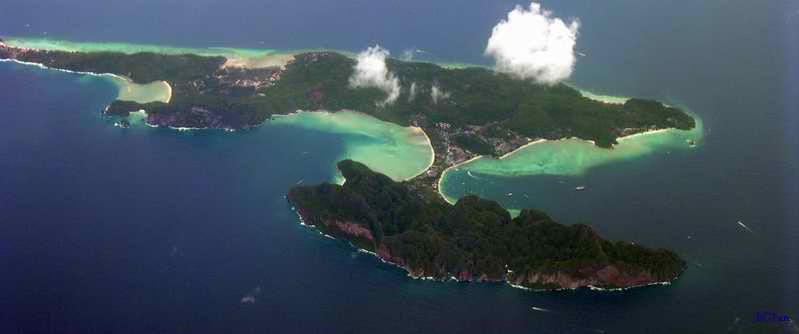
Time had lost its grip, and so had I, so I have no idea how quickly this unfolded, but within what felt like moments I could see the entire island, then the mainland, then the vast expanse of ocean that I’d crossed on the ferry a few days earlier.
The zoom-out accelerated. Within what felt like milliseconds I was looking down on the planet: blue-white-green, hanging in the blackness of space. Then the solar system. Then the galaxy. Then something I have no word for, because the scale exceeded any frame I possessed.
And then… the knowing arrived.
I don’t mean knowledge; I’m talking about a deep knowing.
This distinction matters in ways I’m not sure I can fully explain except to use a single word: grok.
Knowledge is something you acquire. Knowing is something that hits you with the force of a freight train plowing into your very existence while rearranging the totality of everything that makes you, you… before you have time to consent, question, or combat.2
The symphonic cacophony I experienced was an overwhelming, palpable, unambiguous tidal wave of awareness that I was an integral part of everything I could see… and everything I could not. Not connected to it. An integral part of the whole. The way a wave is part of the ocean. Not a separate thing observing the whole, but the whole… temporarily expressing itself as a man lying on a beach in Thailand… or whatever.
What happened wasn’t any kind of thought experiment. It was an actual physical experience, something as real as any earlier life experience. It landed in my body with the impact of a physical collision.3
“Mike, are you OK?”
My partner had come back to find me. Apparently an hour had passed. I was still lying on the sand, staring at the sky, trying to process something that defied every framework I possessed, every cellular-level ‘truth’ I believed was mine.
How on earth could I explain what had just happened?
When I’d lain down on that beach earlier that evening, I was a rational, analytical technology professional on a well-deserved break. My entire life had confirmed beyond any reasonable question that science, technology, and logic underpinned everything we knew about how life works. My career was proof. The systems I’d built and implemented were proof. The world I operated in — global telecoms, satellite networks, secure financial messaging — was grounded on the premise that reality is measurable, manageable, and ultimately optimizable.
The experience on that beach contradicted none of my interpretation of reality. But… (and it’s a big but) the experience enfolded, exceeded, transcended all of it in ways I couldn’t put to words.
The Morning After
I watched the sunrise the next morning from a different perspective. Same beach, same sand, same waves, but I was not the same person who had lain down the evening before, and the world I woke into was not the world I had fallen asleep in.
The rational part of my mind, the part that had spent twenty years solving complex technical problems, demanded a (rational, technical) explanation. Fair enough. So did every other part of me.
What followed was a two-year odyssey through every body of literature I could find that might account for what had happened. I started with neuroscience. Then psychology. Then the world’s diverse religious traditions: Christianity, Buddhism, Hinduism, Sufism. I was desperately hunting for descriptions that matched my experience; something I could latch on to; something that would serve as an anchor in a world thrown upside down.
Nothing.
Then quantum physics. Then consciousness research: Ken Wilber’s Integral Theory, Beck and Cowan’s Spiral Dynamics, David Hawkins, Noetic Science, Eastern philosophy, Western mysticism…
I read voraciously, compulsively, the way you do when something has happened that you cannot un-know and cannot yet explain.
I gave up firmly held beliefs along the way. The most challenging to discard wasn’t a religious conviction or a political position. It was Business-as-Usual that was the hardest of all beliefs to release… by far. Not because it was the most defensible, but because my identity was fully, unquestionably welded to it.
Nothing I found in those two years of searching fully explained the experience. But the search itself did something more important than providing an answer. It made visible to me that the lens through which I viewed ‘reality’ as potentially problematic.

I began to see that what needed explaining wasn’t the experience itself. What needed investigation was the interpretive framework through which I was trying to make sense of my the world. The lens I’d been looking through my entire life — the one installed by my parents, my education, my industry, my generation, my culture — was incapable of holding what had happened on that beach. The experience itself wasn’t irrational or unheard of. (I’ve since met many who have experienced something similar. In fact there is now an emerging body of scientific research dedicated to these experiences.4) Rather, the lens through which I’d been observing the world had been too narrow.
Through this lens, all I could see was business, markets, systems, optimization, efficiency: Business-as-Usual. The lens couldn’t grok what I’d been shown: that reality is participatory, interconnected, alive in ways that the mechanistic worldview I’d inherited could not account for.
The lens was the problem.
Not the world.
Not my controversial way of thinking about the world.
The lens.
My lens had irreparably shattered.

It has taken me twenty years to build a replacement. I’m not talking about twenty years of merely reading, though there was plenty of that. It wasn’t twenty years of retreating from the world to meditate on a mountaintop. It’s been twenty years of deep engagement with alternative ways of living.
After a short stint back in the corporate world in London, I returned to South Africa, started a bioregional regeneration project involving 25,000 people, and raised a daughter who will turn 21 in 2035 on my own.
It has taken twenty years of highly specific, challenging work of examining what was installed, exposing it to what it could no longer explain, and constructing, piece by piece, framework by framework, encounter by encounter, an interpretive architecture adequate to what I’d been shown in those few seconds (?) minutes (?) hours (?) on a Thai beach in 2004. (I still have no idea how long the experience lasted).
The framework that follows is the product of that construction. It’s the result of a twenty-year quest to provide a better understanding of human nature: a quest to uncover who we are and what we are to become.5
Part Two: The Framework
A brief word before we proceed, about why Part One even exists.
I could have published the thesis that follows as an academic paper. I’ve considered it many times, over many years. But I’ve decided against publishing it formally, preferring a more narrative format.
Why?
It’s not that I think the scholarship is inadequate or lacks depth. Rather, it’s because the thesis itself challenges the paradigm within which academic legitimacy is determined. The Material worldview, the one that dominates our universities, our institutions, our peer-review processes, our entire culture, isn’t well-equipped to evaluate a framework that calls the Material worldview into question. The lens cannot assess a critique of itself. It’s like asking a fish to evaluate a theory about water.
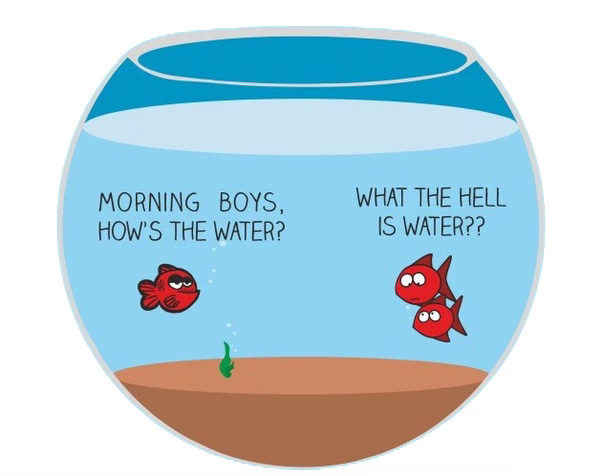
So I’m not publishing this as an argument to be won.
I’m not trying to convince anyone.
If the framework that follows doesn’t match your experience of what’s happening in the world, throw it out like anything that’s exceeded its sell-by date. No harm done. But if it holds something you’ve been sensing, something your current interpretive framework can’t quite name, then it was written for you.
My personal story in Part One matters because it establishes the origin.
This framework didn’t emerge from theory alone.
It emerged from an experience that shattered my worldview into a gazillion pieces and demanded that a new one be built.
That’s its lineage.
Take it or leave it, but don’t mistake what comes next for armchair speculation or for philosophical self-aggrandizement. This is the version of reality I was shown that night.
Buckle up.
(There are a ton of footnotes to come. If you hover over them, the footnote text will appear, so that you don’t have to scoot back and forth.)
The Evolution of Human Coordination & Cooperation
Civilization organises itself through forms of coordination that evolve in sequence. This is not my claim. It was mapped with considerable rigor by David Ronfeldt at the RAND Corporation in 1996, and the framework, called TIMN, identifies four fundamental forms that layer onto each other as societies grow in complexity.6
Tribes: kinship, identity, belonging. Coordination through shared blood, story, and sacred obligation. The organizing logic is loyalty.
Institutions: hierarchy, law, doctrine. Coordination through formalized authority, codified rules, and vertical command. The organizing logic is legitimacy.
Markets: exchange, competition, price signals. Coordination through decentralized transactions between self-interested actors. The organizing logic is efficiency.
Networks: the emerging fourth form. Coordination through distributed, horizontal, non-hierarchical relationships. The organizing logic is reciprocity.
Each form builds on what came before; it doesn’t replace it. A healthy society integrates all four. Tribes don’t disappear when institutions emerge. Institutions don’t vanish when markets develop. Each new form layers onto what came before, producing greater complexity and greater capability, but also greater fragility.
The good news is that earlier forms persist, rather than disappear. They must.
The bad news is that transitions to the next form can be blocked, captured, or perverted.
Ronfeldt made an observation that has given me sleepless nights:
“Bad actors may prove initially more adept than good actors at using a new form.” — David Ronfeldt, creator of TIMN
Warlords mastered hierarchy before the (only partially more) legitimate state arose. Pirates mastered trade before lawful merchants did.
The same pattern is repeating now with Networks.7
I’ll explain why in a minute, but first, here’s how you can tell which game is actually being played. Each form of coordination coheres around a physical node that is distinct from the others. This is a place where its logic concentrates, becomes visible, and reproduces itself:
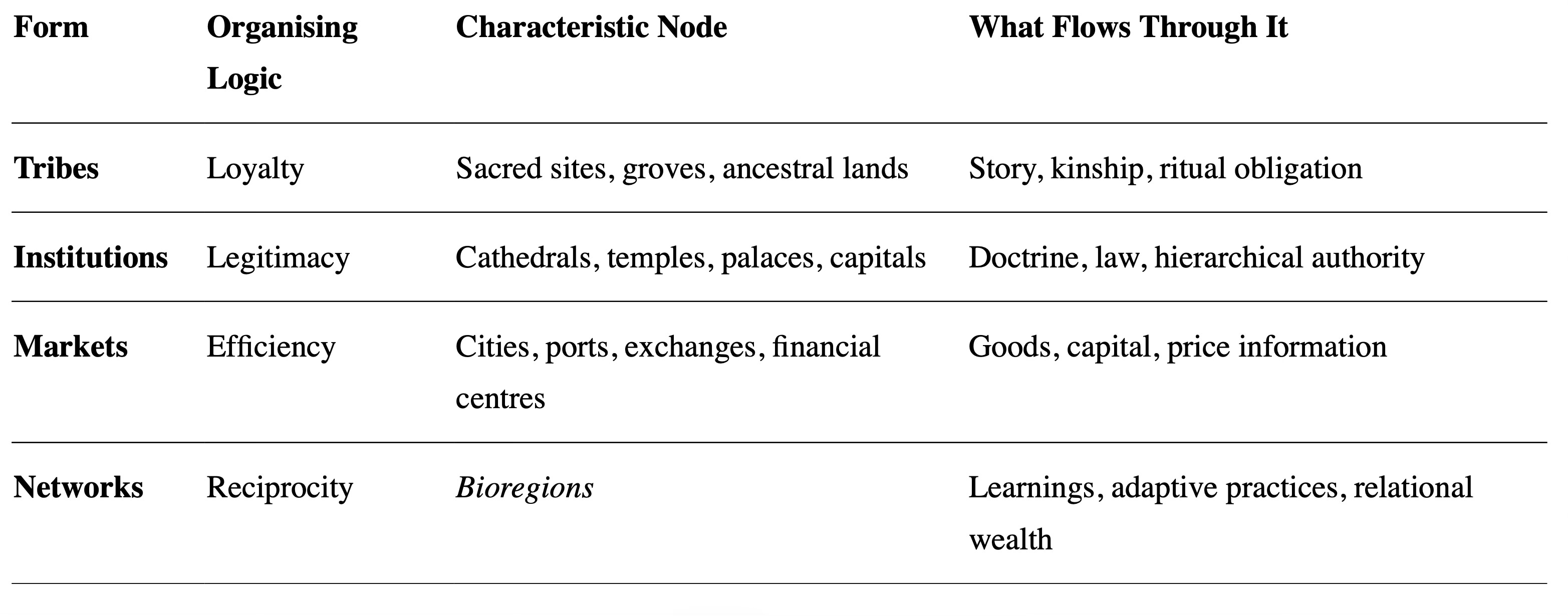
Activity in each node tells you precisely what kind of coordination is actually operating.
The term that we need to unpack a little is the +N in TIMN: Networks. Bear in mind my background in telecommunications and information technology. The term Networks is not what you think it is, and it had me confused for decades.
When you look at what’s being proposed as ‘the network age’ and see data centers, tech platform headquarters, and server farms as the nodes — with behavioral data, attention metrics, and prediction products flowing through them — you are not looking at the N in TIMN. You are looking at the third form using network technology to intensify its own logic of extraction and efficiency.
The infrastructure is new. The coordination form is as old as the Industrial Revolution.
The genuine fourth form requires a different kind of node entirely. See the table above to remind yourself of what I mean by node.
How the ‘M’ in TIMN has Been Captured
Analysts across the (geo)political spectrum describe Technocracy as the consolidation of digital identity systems, central bank digital currencies (CBDCs), surveillance infrastructure, algorithmic governance, and resource control under coordinated elite management. While it all requires resilient digital networks (widespread fiber, 5G, Starlink, etc.), it is not the emergence of a Network form that mimics Nature.
It is not natural.
It is the Market form’s attempt to prevent natural networks from forming.
This claim is documented across multiple peer-reviewed literatures:
Shoshana Zuboff mapped the architecture of Surveillance Capitalism — an emergent logic of accumulation where human behavioral data becomes raw material for prediction products.8 The system records, modifies, and commodifies everyday experience. It uses Network infrastructure but serves Market logic.
Nick Srnicek and Julie Cohen documented how platforms provide the infrastructure to mediate between user groups while displaying monopoly tendencies driven by network effects.9 This is digital enclosure, structurally identical to the historical enclosure of commons that preceded the Market form’s dominance.10
Yanis Varoufakis argues that platform giants have moved from production to predation, creating dependencies where societies cannot function without them.11
The debate over whether Technofeudalism represents a new feudalism or an intensification of the extractive capitalism model doesn’t matter one iota. What does matter is how this maps to the evolution of coordination: Network technology is being used to concentrate Market power rather than distribute it.
Antoinette Rouvroy and Thomas Berns identified what they call ‘algorithmic governmentality.’12 They are referring to governance that bypasses individuals as conscious subjects entirely, operating on data profiles where the question of consent simply does not arise. This is coordination without participation. Dictatorial control. It is the opposite of the Network form. Classic late-stage empire. Classic signs of bad actors using Networks as a new form of coordination before good actors can get their act together. Just like warlords and pirates.
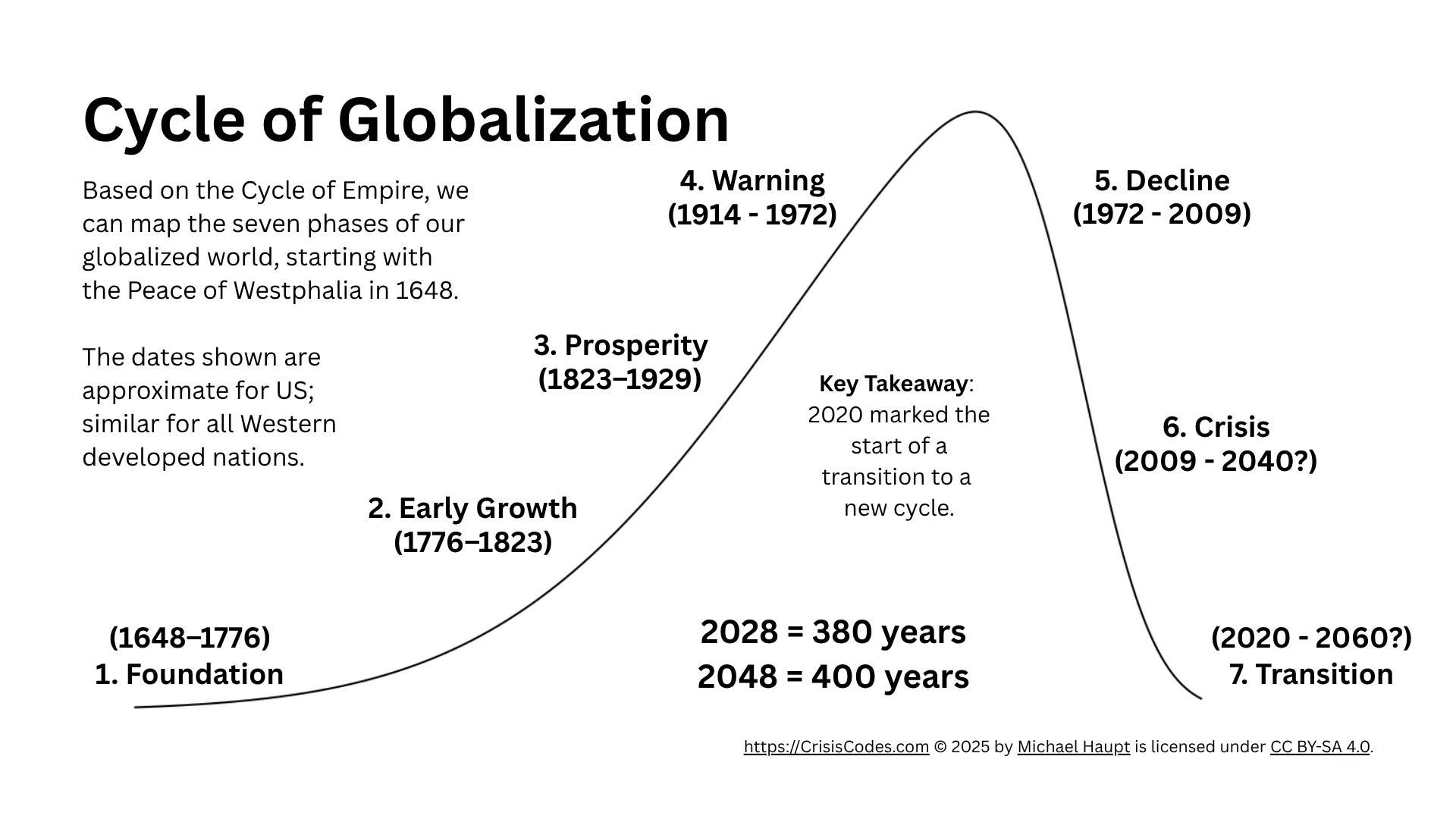
When you read through Ronfeldt’s framework again with the understanding of how totalitarianism increases in later stages of any empire, the picture becomes stark.13 The Big Tech developmental path today is not the transition to +N. It is the T+I+M system using network technology to deepen its own logic: resource extraction, behavioral prediction, centralized control. At the same time, it prevents the genuine, Nature-inspired Network form from emerging.
There is a structural reason the capture of M in TIMN cannot and will not produce the next level of coordination. The Universal Law of Increasing Complexity states that living systems tend to become more ordered and diverse over time.14 It suggests that when systems are subjected to selection for functional information, they evolve toward increased complexity, in direct contrast to how entropy dictates disorder in thermodynamics and non-living systems.
Modern social systems sit at the extreme end of the complexity spectrum.
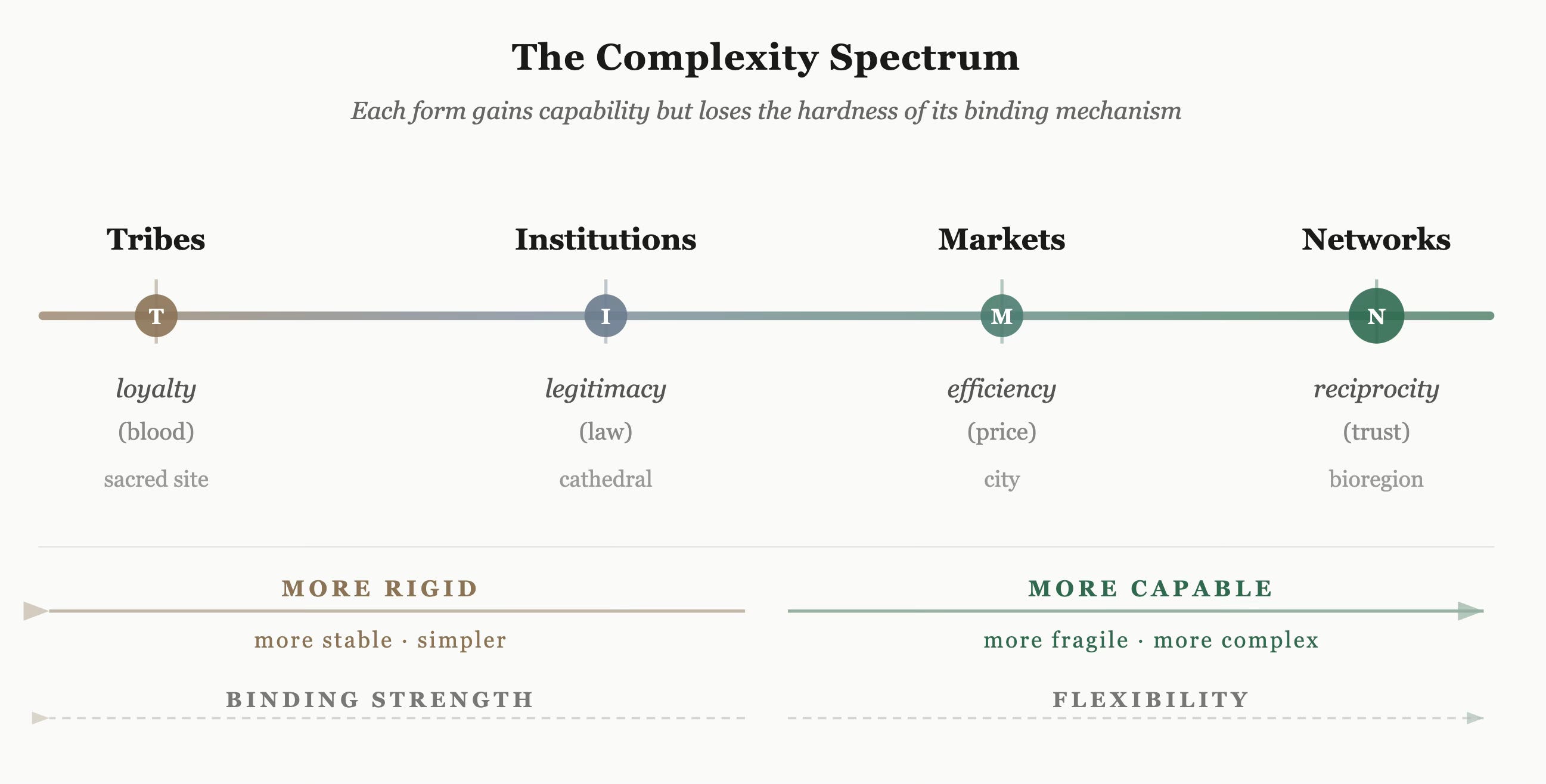
Each form has a different mechanism that ensures social cohesion. The mechanisms, or Social Contract, look like this at each form:15
Tribes: Loyalty through shared meaning, enforced by elders who carry the bloodline
Institutions: Legitimacy through laws imposed by the system, enforced by courts or the clergy
Markets: optimized Efficiency through the invisible hand of the market, enforced through share price or dividends
Networks: open records of Reciprocity that build trust at scale, enforced through ecological signals like the carrying capacity of the land. (This is where Triple Entry Accounting and Blockchain play a role, but not in the manner we’ve seen in early versions of cryptocurrencies like Bitcoin.)
The further right on the spectrum, the more flexible the form, and as a result the more fragile the structure that underpins the form of coordination. More complex forms require continuous reassessment and renewal (renegotiating the Social Contract) rather than physical enforcement of static rules. The latter is what’s happening today; the former is what should happen in a healthy living system.
The Point of ‘M’ Capture?
Technocratic consolidation (personified through characters like Altman, Benioff, Bezos, Brin, Ellison, Gates, Huang, Ma, Musk, Lutnik, Page, Sacks, Schmidt, Son, Thiel, Zuckerberg, and more16) attempts to reverse this tradeoff of complex coordination. Their proposed solutions bypass physical enforcement through traditional mechanisms like standing armies and a police force with digital surveillance, financial exclusion, and algorithmic control. The result is a system (technocracy) that appears highly coordinated but has actually regressed to a lower level of complexity.17 It is rigid, brittle, and entirely incapable of the adaptive flexibility that genuine Network coordination requires.
James C. Scott documented the same dynamic in Seeing Like a State: imperial consolidation achieves control through radical simplification.18 This explains why the UN and other global bodies push for monoculture food production and standardized health protocols, while citizens prefer more holistic approaches (that are more complex). State simplification serves control and extraction but destroys local knowledge and institutional diversity.19 Digital technocracy is the same move with better tools in the hands of those who most desire control.
The Mycelial Alternative
Ronfeldt himself admitted that “figuring out the Networks form has perplexed me the most.” The confusion makes sense, because the word ‘network’ has been captured by the Market form. When most people hear ‘network’ (and this included me given my background), they imagine it means the internet, social media, telecommunications infrastructure — all of which are Market-form technologies operating on Market-form logic. The nodes are servers. The flows are data. The organizing principle is extraction and growth.
The genuine fourth form needs a different metaphor. One drawn from biology rather than engineering or technology.
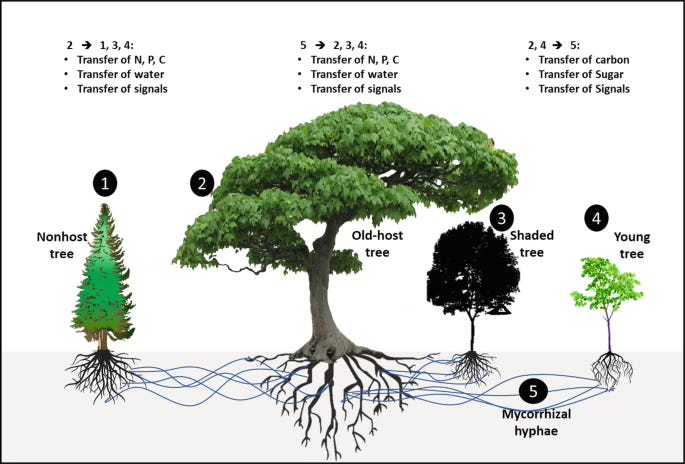
Beneath a forest floor, mycorrhizal networks connect trees of different species, ages, and conditions into a communication and resource-sharing system. These networks distribute nutrients from areas of surplus to areas of need without central direction. They transmit chemical signals that warn neighbouring organisms of threats. They connect organisms across species boundaries. They operate without hierarchy — no command node, no central server, no platform owner. They are place-based, emerging from and serving specific ecological contexts. They strengthen through diversity; monocultures produce weak networks while polycultures produce resilient ones. And they enable the forest to function as a superorganism while each tree retains its individual integrity.
This is the biological template for what the fourth form of coordination looks like when it has not been captured by the third. Ironically, it required a background in telecommunications and technology to be able to see the distinction between different forms of Network.
Notice what is absent in the natural form: a command centre. No node in a mycorrhizal network accumulates at the expense of the rest. This is the fundamental distinction. Market-form networks concentrate wealth and power. That is what they are designed to do, and they do it with extraordinary efficiency. Networks the way nature builds them distribute resources and diffuse power. We’re talking about the same word, but an entirely opposite architecture. So, when someone says ‘network,’ what the hell do they actually mean?
The characteristic node of Tribal coordination is the sacred site.
For Institutional coordination it is the cathedral, or the court.
For Market coordination, the node is the city.
The characteristic node of Mycelial Coordination is the bioregion: a geographic area defined by ecological characteristics: watershed, soil type, climate patterns, species communities. It is an area not defined by political boundaries the way cities and nations are.
Elinor Ostrom won the Nobel Prize for demonstrating that commons governance — polycentric, scale-appropriate, embedded in ecological context — works.20 Her research provides the empirical foundation for this emerging form of coordination. Recent work by Savini and colleagues proposes ‘cooperative geopolitical relations through polycentric networks’ where the bioregion functions as a system of communities coordinated through lateral exchange.21
What flows between bioregions in a mycelial Network form isn’t data or capital like in a Market form. It is learnings: adaptive practices for soil regeneration, water management, community governance, conflict resolution, ecological stewardship. Each bioregion develops solutions suited to its specific context. These solutions are shared laterally — not imposed vertically — and adapted by receiving communities to their own conditions. The Network strengthens through diversity of practice, rather than through standardization.
This form of coordination is already unfolding globally. In the Valley of Grace bioregional project in South Africa, in commons governance movements across southern Europe, in indigenous-led land stewardship from Aotearoa to the Amazon, in watershed restoration efforts across the Great Lakes in North America.22 These are more significant coordination attempts than intentional communities or traditional NGO programmes. They are attempts to organize human activity around ecological reality — through distributed governance, shared learning, and relational rather than financial wealth.
No two look alike, and none can be replicated as a template. Their lessons transfer the way mycorrhizal networks transfer nutrients — laterally, context-specifically, adapted by each receiving community to conditions that only it can read.
What does this have to do with the Meaning Crisis?
OK, here’s my point of this thesis. (At last, I hear you say.)
If, like me, you’ve spent decades mastering a system that now feels hollow… If the promotions stopped meaning something before the career ended… If the wealth accumulated but the purpose didn’t… If you lie awake sensing that something fundamental has shifted but can’t name what… If any of those are true for you, you’re not experiencing a personal crisis. You are experiencing the Meaning Crisis.23
But what exactly is the Meaning Crisis?
Meaning = Growth
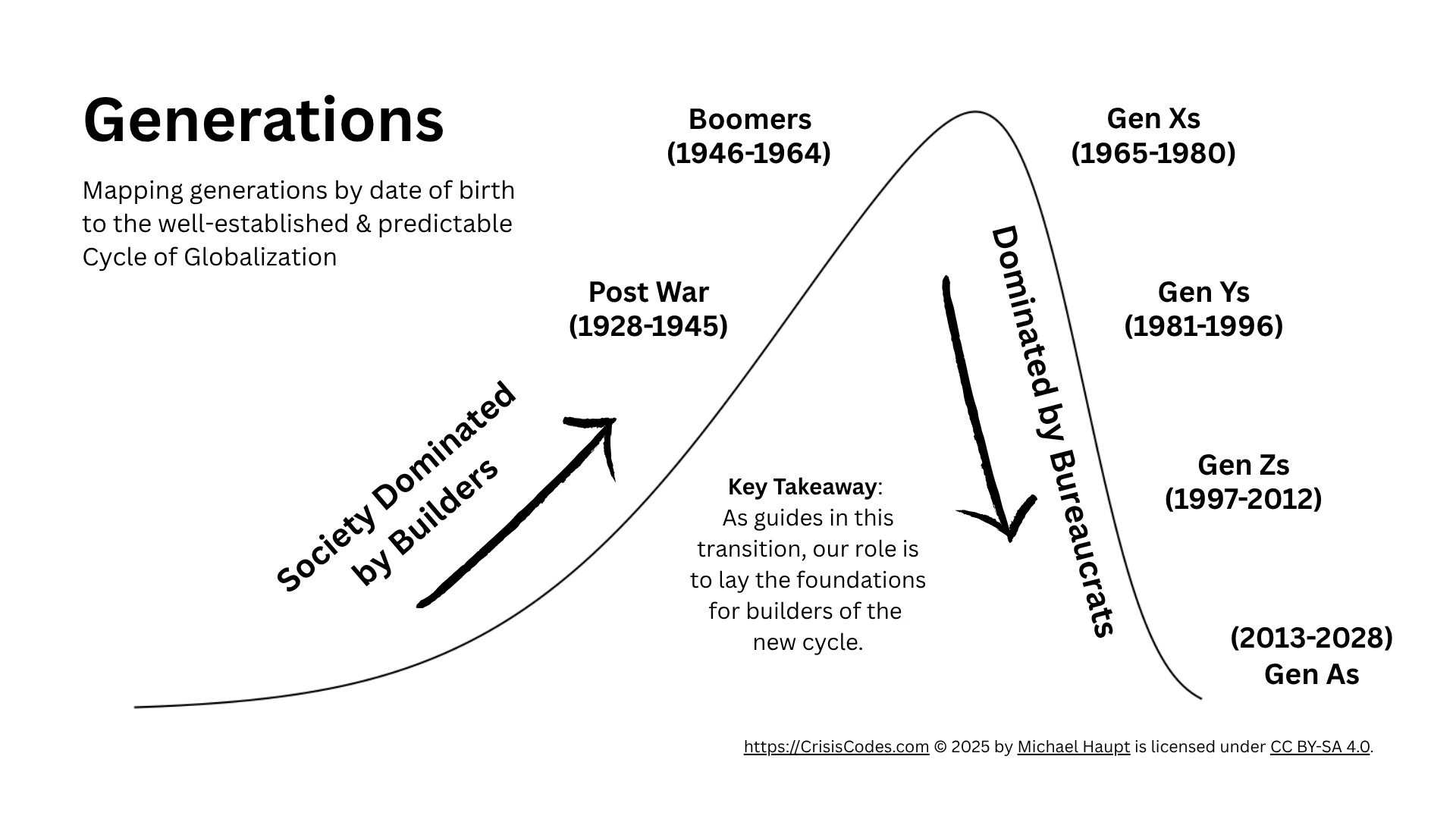
The social contract that held the modern world together for the past 12,000 years was simple: participate in the growth, share in the returns. Every institution — financial, governmental, academic, corporate — was built to serve that bargain. The bargain held for as long as growth continued.
But every living system follows an S-curve. The growth phase accelerates, peaks, and decelerates. This isn’t some dry academic theory. It is the most documented pattern in biology. And human civilization — twelve thousand years into its growth phase — is now bending the curve.
When the institutions designed for growth can no longer deliver growth, the social contract defaults. When the social contract defaults, meaning collapses — because meaning, for most people, was embedded in the contract itself. Work hard, get ahead, leave more for your children. That narrative is the social contract in its most intimate form. And it is breaking. The breakage hasn’t come about because anyone failed. It’s simply because the growth it depended on has reached the limits that every S-curve reaches.
That is what the Meaning Crisis is. This isn’t something that’s optional at the individual level. It is not even culturally applicable to some cultures and not others. It is evolutionary across the entire human species.
The instinct is to solve for the Meaning Crisis individually: find a therapist, read another book, watch another YouTube video, take the retreat, support another protest. But there’s something much more challenging to hear: transformative cultural change does not emerge through individual deliberate design. Boyd, Richerson, and Henrich’s cultural evolution research demonstrates that it emerges through competitive selection among cultural variants.24
What on earth does that mean, ‘competitive selection among cultural variants’?
It means that what is called for now is fringe experiments. Communities and individuals that try different approaches are the ones that will make it through this shift. The more adequate frameworks will gradually outcompete the less adequate ones. Frameworks that refuse to align with the bend at the top of the S-curve simply will not be around after the Decade of Dramatic Disruption (2030s).
That’s what all this is about. No central planner can plan for this, because the system in which they operate cannot see the S-curve. So whatever happens next is all going to be unplanned.
Brace yourself.
Here’s an example of unplanned cultural evolution that’s highly relevant to us: For centuries, the Western Church prohibited marriage between cousins. The intent was doctrinal, but the effect was societal. By forbidding the intermarriage that held extended kinship networks together, the Church gradually dissolved the clan-based social organisation that had been the human default for millennia. Over generations, this produced populations that were more individualistic, more trusting of strangers, and more willing to engage in impersonal transactions — precisely the psychology required for markets, institutions, and democratic governance to function. Nobody designed this. Nobody foresaw it. Joseph Henrich’s research documents this causal chain in detail.25
The point is that the most consequential cultural shifts are not and cannot be engineered. They emerge.
Does this mean we just sit back and wait for the proverbial to hit the fan?
No.
Here are three claims that, taken together, ground where I’m taking this thesis.
First: shared interpretive frameworks are causally necessary for large-scale coordination. Groups that share interpretive frameworks coordinate more effectively than groups that share only vocabulary. This is the gap my recent 2030 Worldview Workshop revealed. Participants who used identical words meant fundamentally different things. The same is happening all across society. That means we’d better form groups that understand each other.
Second: Donella Meadows identified paradigm as the second-highest leverage point in any system.26 Most sustainability interventions target shallow leverage points — policies, incentives, regulations — while neglecting deep ones. Paradigm-level interventions are harder to implement but produce disproportionate systemic effects. The critical variable isn’t imposing a worldview but preserving the conditions under which better worldviews can be selected for.
Third — and perhaps most consequentially: technocratic consolidation systematically destroys this selection environment. By eliminating institutional diversity, replacing local governance with algorithmic management, and substituting surveillance for trust, technocracy removes the very conditions under which the cultural evolution of more adequate interpretive frameworks can occur. In other words, technocracy is evolutionarily incoherent. It will fail, because its underlying premise is directly linked to the growth paradigm which led to its emergence.
Threshold Guides can help us navigate
I’ve previously written about the role of the unique individuals who feel comfortable playing in this space.

The role of Threshold Guides is to:
Preserve institutional diversity against technocratic simplification — maintaining the selection environment.
Make the contest visible — helping people see that two fundamentally different forms of coordination are competing for the same technological substrate.
Embody the mycelial alternative — demonstrating through practice that the fourth form works, particularly when we redefine Networks (TIMN).
Hold the tension — maintaining the capacity to see both what is composting and what is sprouting, without collapsing into either despair or false optimism.
This is what systems intervention at the highest available leverage point looks like. Don’t tell me you’re a ‘systems thinker’ if you don’t at least have a somewhat comparable viewpoint about the evolution of human coordination baked into your DNA.
What’s at stake?
Peter Turchin’s structural-demographic theory, tested across seven historical civilisations with quantitative data, identifies a recurring pattern: elite overproduction, popular immiseration, and state fiscal distress interact to produce secular cycles of two hundred to three hundred years.27 His prediction of growing political instability peaking around 2020 — published in Nature in 2010 — has been confirmed by everything that’s happened since.28
The critical insight is that Turchin’s cycles are not inevitable natural laws. They are the signature of failed transitions. They are what happens when a civilization cannot move to a higher level of coordination and instead oscillates between consolidation and fragmentation within the same form. Each cycle concentrates more wealth, alienates more of the population, and produces more brittle institutions… until the system either transitions or catastrophically simplifies.
Joseph Tainter observed that modern civilization may be trapped in suboptimal complexity, because competing complex polities would fill any vacuum left by collapse. The old pattern of ‘the rise and fall of empire’ may no longer be valid. In a world where all habitable surface is covered by complex states, the choice is no longer between transition and collapse. It is now between transition and permanent entrapment in a system of diminishing returns on complexity, managed by technocratic infrastructure that prevents both collapse and renewal.
What then are we to do?
Everything currently being proposed — every policy, every framework, every summit communiqué — is an attempt to restart a growth curve that biology has finished with.
E-ve-ry-thing.
You cannot solve a phase transition with better management of the phase that is ending. Every hour and every dollar spent trying is an hour and a dollar unavailable for what actually matters. The S-curve does not negotiate, and neither does what follows.
In stark contrast, Panarchy Theory describes a specific phase in the adaptive cycle — the alpha phase, between release and reorganization — where the system is maximally open to novelty and reorganization at a higher level of complexity.29 This window does not stay open indefinitely. If the system does not reorganize at a higher level, it rigidifies at the existing level or fragments to a lower one.
Stated more simply: If you want to play a role in what’s unfolding — at a level that actually matters — you need to become comfortable with what this thesis proposes.
And what this thesis proposes is that we are in a window of panarchairos right now.30 The technocratic programme is an attempt to close it — to reorganize the system at the existing level of Market coordination using Network technology as enforcement infrastructure. The bioregional regeneration movement, commons governance, and mycelial coordination represent the attempt to reorganize at a genuinely higher level.
What will determine the outcome?
I’ve come to believe that the determining factors are not resources, technology, or political power. It is whether enough people can see the contest clearly enough to act within it coherently. It’s a contest between Material and Mycelial Consciousness.31 Worldview sufficiency — the capacity to see what is actually happening — is the binding constraint.
Wrapping Up

The man who stood at the top of those stairs in Bangkok twenty-two years ago could not have seen any of this. The lens through which he observed life was built for a world that was already ending. It showed him markets, systems, optimization, efficiency… and it showed him those things with extraordinary clarity. What it could not show him was that the form of coordination he’d spent his career mastering was approaching the limits of what it could produce.
What broke on that Thai beach a few days later was the operating system that had been installed without his consent.
The framework I’ve laid out here is what I built to replace it. It took twenty years. It draws on evolutionary biology, systems science, civilizational history, complexity theory, commons governance, consciousness research, and two decades of hands-on work in bioregional regeneration. It is imperfect, incomplete, and almost certainly wrong in places I can’t yet see.
But it holds what my old lens could not.
I offer it here as a recognition device rather than a formal argument. I’m not trying to present infallible proof. I am surfacing patterns. If it names something you’ve been sensing — if it gives shape to a disorientation you haven’t been able to resolve through more strategy, more information, more planning, or more positive thinking — then it was written for you.
The transition I’m referring to isn’t something that might happen in the future. It is the very ground beneath your feet, shifting. The 2030s — the Decade of Dramatic Disruption — will affect all of us in one way or another. Some of us will see what’s unfolding clearly enough to act consciously within it. Others won’t understand the process because the old lens will keep showing them a world that no longer exists.
That night in Thailand in 2004 was when my lens cracked. The twenty years that followed were the construction of a new one. What I’ve shared here is a blueprint that’s working for me. I hope it will work for you.
Frame on, and love the ones you’re with.
Michael
PS. You’re still here. Wow. The framework above took twenty years to refine. The 2030 Worldview Workshop compresses the essential construction into something a small group can do together. The next cohort is forming now. If this essay named something you’ve been carrying, the workshop is where you do something about it. Join the waitlist for priority access.
About the Author
Michael Haupt spent twenty years building global telecommunications infrastructure and the last twenty years researching civilizational transitions and what happens when Business-as-Usual loses coherence. He is the creator of Framer OS and leads the Valley of Grace bioregional regeneration project in rural Western Cape, South Africa.
References and Further Reading
The Thai word for island, “เกาะ” (pronounced with a short ‘o’ and low tone), is sometimes spelled without an ‘h’ (ko) because there is no direct equivalent to an ‘h’ in the Thai script, and both ko and koh are informal Romanizations of the same sound. I like keeping the h as a little reminder to myself of all the other things I let go of. If you’d like a deeper dive into the h-or-no-h-debate, see this Substack: https://thaiislandquest.substack.com/i/1089143/how-to-say-island-in-thai
Just to be clear, I have never had a freight train plow into me, so I’m not sure what exactly this might feel like. But that night felt like what I imagine the nanosecond before impact to be like.
Again, to be clear, I don’t believe for a minute that anyone could see my physical body levitating. But in all records from those who have experienced something similar, physical and non-physical worlds blur and the distinction entirely evaporates.
Variously known as Expanded Consciousness or Out of Body Experiences, After Death Communication, Near Death Experiences, Shared Death Experiences, Terminal Lucidity, and others. I collectively refer to them as Mycelial Science: https://bit.ly/Myc-Sci
I have no interest in being right. I have every interest in being accurate. If you find an error, a gap, or a place where the reasoning doesn’t hold, tell me. This framework gets stronger through challenge, rather than passive agreement.
Ronfeldt’s TIMN Framework: Ronfeldt, D. (1996). Tribes, Institutions, Markets, Networks: A Framework About Societal Evolution. RAND Corporation. https://bit.ly/3FypJx8 (be patient - can take up to 20 seconds to load)
I’ve expanded what’s happening in +N in the TIMN model in this number 2 of 3 Research Briefs:
02. Human Coordination - Research Brief

The second of three research briefs placing bioregional economies within the context of the evolution of human coordination. This brief overlays David Ronfeldt’s TIMN framework onto the M.G. Taylor Group Genius framework and weaves in Elisabet Sahtouris’ competition-to-collaboration hypothesis, arguing that bioregional regeneration nodes are the next leap in the complexity of human coordination.
Surveillance Capitalism: Zuboff, S. (2019). The Age of Surveillance Capitalism. PublicAffairs. https://bit.ly/Surv-Cap
Platform Capture: Cohen, J.E. (2019). Between Truth and Power: The Legal Constructions of Informational Capitalism.Oxford University Press. Srnicek, N. (2016). Platform Capitalism. Polity. https://juliecohen.com/between-truth-and-power/
Enclosing the English Commons: Property, Productivity and the Making of Modern Capitalism, University of Oxford. https://globalcapitalism.history.ox.ac.uk/files/case26-enclosingtheenglishcommonspdf
Technofeudalism: Varoufakis, Y. (2024). Technofeudalism: What Killed Capitalism. Melville House. https://bit.ly/TechnoFeud
Algorithmic Governance: Rouvroy, A. & Berns, T. (2013). Algorithmic Governmentality and Prospects of Emancipation. https://www.greeneuropeanjournal.eu/algorithmic-governmentality-and-the-death-of-politics/
Totalitarianism covers concepts like Authoritarianism, Fascism (including the latest form, Ecofascism), and Technofeudalism. It is a political notion in which all citizens in society, both public and private, are monitored, controlled, and governed. In other words, the state (or the Power Elite) becomes all-consuming, invading every aspect of life. It does not permit individual freedom. Importantly, totalitarianism is implemented legally, through the system, by the Constitution and supported by the majority of the citizens. https://bit.ly/tot-ism
Why Everything in the Universe Turns More Complex by Philip Ball: https://www.quantamagazine.org/why-everything-in-the-universe-turns-more-complex-20250402/
When trust between citizens and institutions degrades simultaneously across multiple nations, it’s a sign that the social contract itself is losing coherence globally. Turchin identifies this as one of the final-stage markers before a secular cycle breaks. This process is accelerating, not stabilizing. The 2030s — what I call the Decade of Dramatic Disruption — will stress-test whatever remains of that contract to breaking point. https://bit.ly/Soc-Con
For further context on these individuals, see The Power Elite, a 1956 book by sociologist C. Wright Mills, in which Mills calls attention to the interwoven interests of the leaders of the military, corporate, and political elements of society, exactly the same as what’s happening in 2026, seventy years later: https://bit.ly/4qS2YWP
Technocracy is a social and ideological movement and economic system that first appeared in the early 20th century. The movement proposed replacing politicians and businesspeople with scientists and engineers who had the technical expertise to ‘scientifically’ manage the economy. There are attempts today to revive it, and I use this term an umbrella phrase that encapsulates all activities by the power elite that erode individual and collective sovereignty: https://bit.ly/Techcy
Complexity and Binding: Scott, J.C. (1998). Seeing Like a State.Yale University Press. Download PDF or learn more.
The UN’s One Health initiative — centralized governance of human, animal, and environmental health under a unified global framework — is Scott’s thesis in real time. Holistic language, but monocultural logic. The word ‘One’ tells you everything about which direction the coordination flows. https://bit.ly/1-Health
Commons Governance: Ostrom, E. (2010). Beyond Markets and States: Polycentric Governance of Complex Economic Systems. Nobel Prize Lecture. https://bit.ly/3OWhCPi
Bioregionalism: Savini, F. et al. (2025). “Bioregionalism and Degrowth: Addressing the Urban-Other Divide.” Planning Theory & Practice. https://doi.org/10.1080/14649357.2025.2524106
I used to actively update a list of bioregional regeneration projects around the world, but the field is maturing so rapidly, it’s hard to keep up: https://bit.ly/Bio-Inits
John Vervaeke is the creator of the cult hit YouTube series Awakening from the Meaning Crisis. He integrates science and spirituality to address the Meaning Crisis. https://bit.ly/42srFjd
Cultural Evolution: Henrich, J. (2020). The WEIRDest People in the World: How the West Became Psychologically Peculiar and Particularly Prosperous: https://www.amazon.com/dp/0374173222. Boyd, R. & Richerson, P. (2009). Culture and the Evolution of Human Cooperation: https://pmc.ncbi.nlm.nih.gov/articles/PMC2781880/
Dr. Joseph Henrich’s research focuses on evolutionary approaches to psychology, decision-making and culture, and includes topics related to cultural learning, cultural evolution, culture-gene coevolution, human sociality, prestige, leadership, large-scale cooperation, religion and the emergence of complex human institutions. https://bit.ly/3ZSOFpV
Leverage Points: Meadows, D. (1999). Leverage Points: Places to Intervene in a System. Abson, D.J. et al. (2017). Also Leverage Points for Sustainability Transformation. https://bit.ly/LevPoints
Collapse and Transition: Turchin, P. (2023). End Times: https://bit.ly/EndTimesTurchin Tainter, J. (1988). The Collapse of Complex Societies.Cambridge University Press: https://bit.ly/4roGLka
Political instability may be a contributor in the coming decade: https://peterturchin.com/publications/political-instability-may-be-a-contributor-in-the-coming-decade/ In this essay, Turchin points to a 200-300 year pattern. The Cycle of Globalization is 378 years old in 2026. A reset is long overdue.
Panarchy: Gunderson, L.H. & Holling, C.S. (2002). Panarchy: Understanding Transformations in Human and Natural Systems. Island Press. https://bit.ly/4rFCl8H
Panarchairos from panarchy + kairos (the Greek concept of the critical, opportune moment, as distinct from chronos, which is sequential time). I’m proposing this word in honor of the window that exists, AND that this kind of window demands a qualitatively different response than ordinary time does. We cannot manage kairos. We can only recognize it and act, or we miss it.
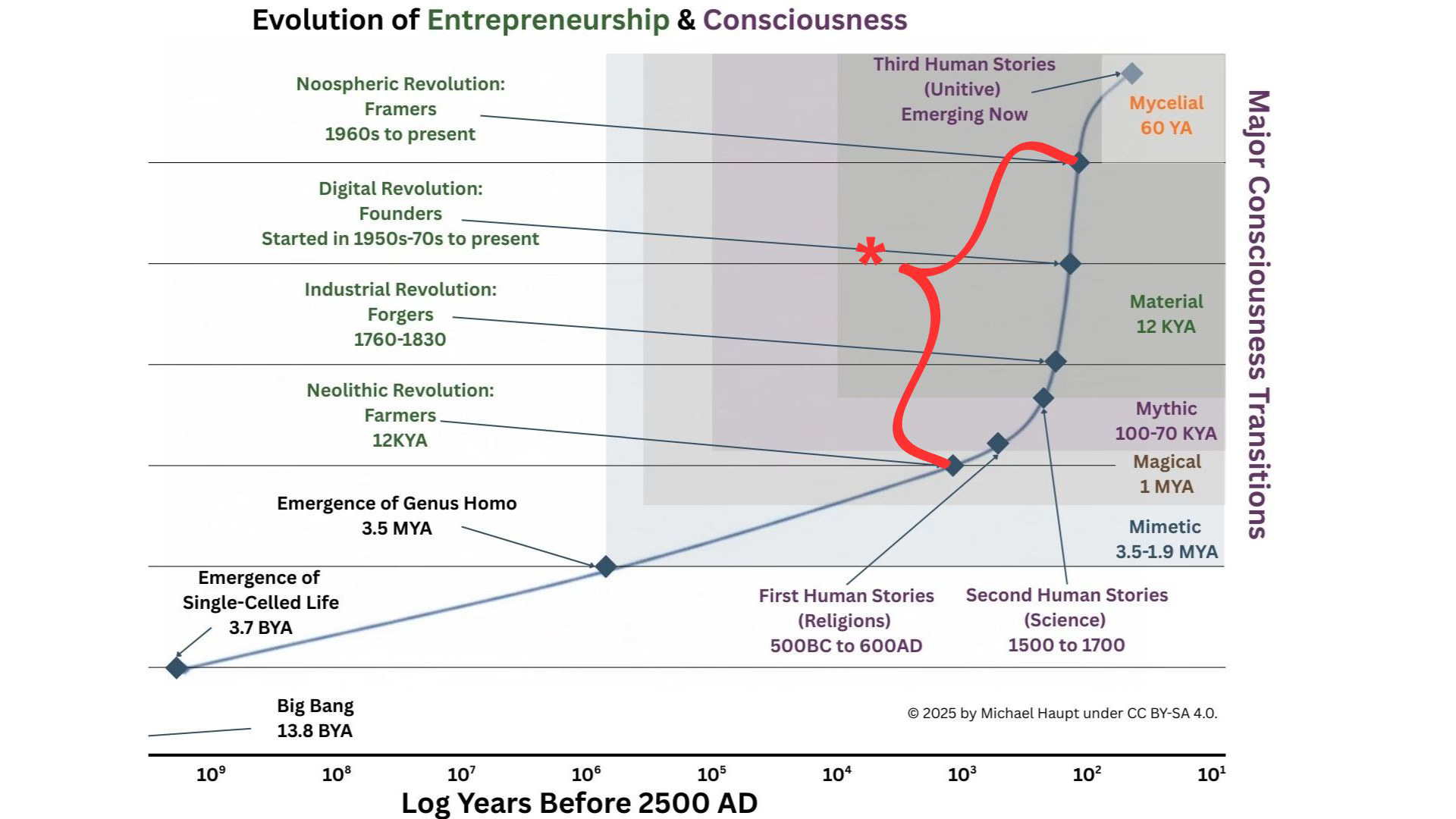
Human consciousness has undergone four Cognitive METs (Major Evolutionary Transitions), each proceeded by a Momentous Leap: Mimetic ⇢ Magical ⇢ Mythic ⇢ Material ⇢ Mycelial. Explore more: https://bit.ly/EvCon
This is a very informative piece. I was familiar with the fact that late-stage empires show increased totalitarianism but not with the TIMN model. I find the framing of "network technology being used to concentrate market power rather than distribute it" and essentially co-op or prevent "the genuine, Nature-inspired network from emerging" to be key takeaways. I could use a little more clarity on what constitutes "Nature-inspired networks" although from my own experience they are direct relationships with real people in specific locales that engage in freely-chosen shared activities, (music/arts, fitness, gardening) although some have also emerged from voluntary time in digital spaces as well.
I find the Complexity Spectrum helpful for understanding the different layers of currently operative social organization. The dilemma as I see it is whether a threshold majority choose the evolutionary impulse towards the new form of mycelial consciousness (something implying creative effort and some level of self-transcendence) or tip backwards towards the atavistically tribal? This question forms the thesis of a highly insightful book I just finished entitled "Tribal Future of the West" by Mike Maxwell. The thesis is that sovereignty is migrating downward to more local and tribal forms as nation states and institutions lose legitimacy and fracture. How to reconcile "the strong tribal thesis" with the Noospheric-Mycelial R(evolution) is my homework.
This article also helped clarify one essential role of threshold guide to be that of "preserving the conditions under which better worldviews can be selected for"; that essentially we are in a race between the technocratic consolidation of a sclerotic, life-blind market system and free cultural-relational evolution organized around ecological reality. (This is the thesis of another great book called "Value Wars: The Global Market versus the Life Economy" by Canadian Prof. John McMurtry.) I also find the introduction of panarchy theory to provide the fundamental time orientation for threshold guides. We are in a race, a contest, a competition where time is of the essence. The "alpha phase" window will be a brief but potent phase that must be boldly seized and stewarded by all who are cultivating the evolutionary impulse. I see an epic struggle not just between the emerging practitioners of mycelial consciousness and the technocratic controllers but between evolutionary agents themselves as we struggle to coordinate cohesive responses to crisis and lay firm foundations for future builders. Cheers!
Thank you for putting the time to write this. Very informative and tracks with some of my owj understanding.